MXM Thanks EG manual
Source code on GitHub · Questions on Discord
This manual goes through MXM Thanks EG card by card. What every MXM editor shares, such as presets, pages, zoom, themes and the keys, is in Using the MXM editors.

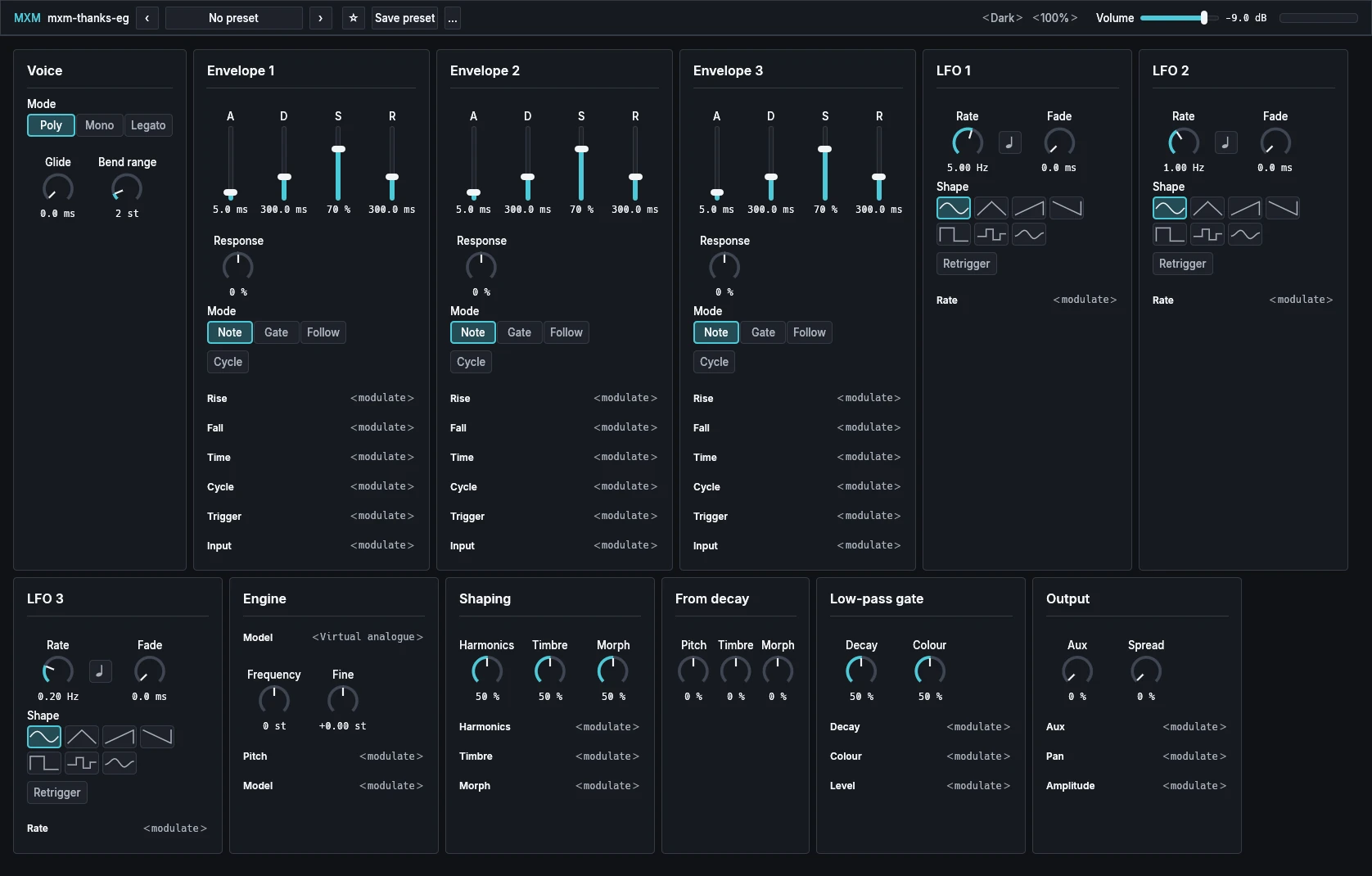
App bar
From the left: the plugin’s name, the preset row, Theme and Scale, Volume, and a level meter.
| Control | Range | Init |
|---|---|---|
| Volume | −60.0 dB to 0.0 dB | −9.0 dB |
Volume is the instrument’s output level. The factory presets never move it: each sound is levelled in its own settings.
Voice
| Control | Range | Init |
|---|---|---|
| Mode | Poly, Mono, Legato | Poly |
| Glide | 0.0 ms to 5.00 s | 0.0 ms |
| Bend range | 0 st to 24 st | 2 st |
Poly plays up to eight notes at once. A new note takes an idle voice, or else the released voice that has sounded longest, or else the held one that has. Mono and Legato play one voice with last-note priority: in Mono each new note starts the sound again, and in Legato a note played over a held one carries on. Changing Mode releases every voice.
Glide is the slide time between notes, and zero turns it off. The slide is exponential, timed to within 1 % of the new note. In Poly a note glides from the last note played, in Mono from wherever the voice is, and in Legato only on a tied note. Bend range is in semitones.
Envelope 1, 2 and 3
The three cards are the same, and each envelope runs once per voice.
| Control | Range | Init |
|---|---|---|
| A | 0.5 ms to 30.00 s | 5.0 ms |
| D | 0.5 ms to 30.00 s | 300.0 ms |
| S | 0 % to 100 % | 70 % |
| R | 0.5 ms to 30.00 s | 300.0 ms |
| Response | −100 % to 100 % | 0 % |
| Mode | Note, Gate, Follow | Note |
| Cycle | Off, On | Off |
A, D, S and R are attack, decay, sustain and release. Response bends every stage at once: logarithmic below the centre, straight at it, exponential above. It changes the curve, not the times. An envelope changes nothing until a route takes it somewhere.
Mode decides what starts the envelope. On Note each note starts it and letting go releases it. On Gate its Trigger starts it, it holds while the trigger is high, and it releases when the trigger falls. On Follow it moves towards whatever is routed into its Input, rising at the attack time and falling at the release time, which makes it a lag or a portamento for any signal.
Cycle makes the envelope repeat its attack and decay as a wave of its own, skipping the sustain and turning at 0.8 of full level. In Gate mode it cycles while Cycle is on or its Cycle target is high, and in Follow mode Cycle does nothing. A rising trigger during the decay, sustain or release restarts the attack from wherever the envelope is. During the attack it is ignored.
Each card has six route lines. Rise moves the attack time, Fall the decay and release times, and Time all of them together. Cycle and Trigger are the gates that make it cycle or start it, and Input is what it follows.
LFO 1, 2 and 3
| Control | Range | Init |
|---|---|---|
| Rate | 0.01 Hz to 50.00 Hz | 5.00 Hz, 1.00 Hz, 0.20 Hz |
| Sync | Off, On | Off |
| Fade | 0.0 ms to 10.00 s | 0.0 ms |
| Shape | Sine, Triangle, Saw up, Saw down, Square, Sample and hold, Smooth random | Sine |
| Retrigger | Off, On | Off |
The three cards differ only in their Init rates: a vibrato, a slow sweep and a drift. Sync is the note symbol beside Rate. With Sync on and a host tempo, the knob reads a note length, 4 bars at the bottom of its travel and 1/32 at the top. Without a host tempo the free rate stands. Fade brings the LFO in after each note, its depth rising in a straight line from zero. The shapes are drawn as pictures; Sample and hold takes a new random value every cycle, and Smooth random glides from one random value to the next.
With Retrigger off, one LFO serves every voice, and its Rate can only be moved by shared sources: Wheel, Pressure, Bend and the other shared LFOs. With it on, each voice has its own, started again with each note. Each card has one route line, Rate.
Engine
| Control | Range | Init |
|---|---|---|
| Model | 24 engines in three banks | Virtual analogue |
| Frequency | −48 st to +48 st | 0 st |
| Fine | −1.00 st to +1.00 st | +0.00 st |
Model chooses the engine. Click it for a list grouped as Bank 1, Bank 2 and Bank 3. Frequency tunes the engine in semitones, up to four octaves either way, and Fine by up to a semitone either way.
| Model | What it is |
|---|---|
| Analogue with filter | Classic oscillator waves through a resonant filter |
| Phase distortion | Bright, vocal tones made by bending the shape of a wave |
| Six-op FM 1, 2 and 3 | FM tones from banks of stored six-operator voices |
| Wave terrain | A wave traced across a shifting landscape, smooth or gritty |
| String machine | A chord of ensemble strings and organ, softly chorused |
| Chiptune | Square-wave chords and arpeggios with the buzz of early home computers |
| Virtual analogue | Two classic oscillator waves, detuned or locked together |
| Waveshaping | A triangle folded and shaped into bright, hollow tones |
| Two-op FM | One wave bending the pitch of another, with feedback |
| Grain and formant | Vocal and formant tones made from short grains of sound |
| Harmonic | Organ-like tones built from a row of harmonics |
| Wavetable | Waves swept through a table of shapes |
| Chords | Four-note chords from a choice of chord shapes |
| Speech | Vowels, formants and spoken words |
| Granular cloud | A cloud of tiny grains, a shimmer or a swarm |
| Filtered noise | Noise through a resonant filter |
| Particle noise | Scattered clicks and drops of sound through resonant filters |
| Inharmonic string | A plucked or bowed string with a metallic, bell-like edge |
| Modal resonator | Struck bars, bells and plates |
| Bass drum | A deep, punchy kick drum |
| Snare drum | A snare drum, tight or rattling |
| Hi-hat | A hi-hat, closed or open |
Bank 1 runs from Analogue with filter to Chiptune, Bank 2 from Virtual analogue to Speech, and Bank 3 from Granular cloud to Hi-hat.
Some engines make their own envelope: the six-op engines, the chiptune, the inharmonic string, the modal resonator, the three drums and the speech engine’s words. On these the gate’s Level is only an accent, and letting go of the key does nothing, except on the chiptune, whose release closes it as the gate would. The inharmonic string and the modal resonator ring on. Morph alone sets how long, and from about 70 % only the instrument’s guard ends them, fading a released note that still sounds after 30 seconds. The factory plucks damp them with an envelope routed to Morph. The chiptune’s arpeggio moves on only in Mono: in Poly each note takes a fresh voice and plays its first step.
Pitch and Model take routes. A route on Model reaches up to 24 engines either way, and the engine is picked again at each note.
Shaping
| Control | Range | Init |
|---|---|---|
| Harmonics | 0 % to 100 % | 50 % |
| Timbre | 0 % to 100 % | 50 % |
| Morph | 0 % to 100 % | 50 % |
The engine’s three sound controls, and each engine decides what they do. Harmonics is the first; Timbre is most often its brightness or texture, and Morph most often a blend or a change of shape. All three take routes.
From decay
| Control | Range | Init |
|---|---|---|
| Pitch | −100 % to 100 % | 0 % |
| Timbre | −100 % to 100 % | 0 % |
| Morph | −100 % to 100 % | 0 % |
Each note has a built-in decay envelope. These three set how far it sweeps the pitch, Timbre and Morph: up above the centre, down below it. The same envelope is the Decay route source. This card has no route lines.
Low-pass gate
| Control | Range | Init |
|---|---|---|
| Decay | 0 % to 100 % | 50 % |
| Colour | 0 % to 100 % | 50 % |
Every note passes through the gate. At Init a note pings it, and Decay is how long it rings. Colour sets how the gate closes: at 100 % it is a plain fade in volume, and below that a filter that darkens the note as it fades.
The route lines are Decay, Colour and Level, which has no knob. Once a route aims at Level, the gate follows the Level routes instead of the ping. Level follows the gate’s compressed curve, where −6 dB needs about 19 %, and it darkens the sound too unless Colour is at 100 %.
Output
| Control | Range | Init |
|---|---|---|
| Aux | 0 % to 100 % | 0 % |
| Spread | 0 % to 100 % | 0 % |
Each engine makes a second sound, a variation of its main one. Aux blends the main sound into the second, and Spread moves the main sound to the left and the second to the right. At 100 % Spread, Aux does nothing.
The route lines are Aux, Pan and Amplitude, and the last two have no knobs. Pan is a balance, at full level in both channels at the centre. Amplitude scales the output from silence to double.
Routes
Sixteen route slots connect 19 sources to 32 targets. There is no routing page: each target has a line on the card of the control it moves, and that line offers ‹ modulate ›. At Init no slot is in use.

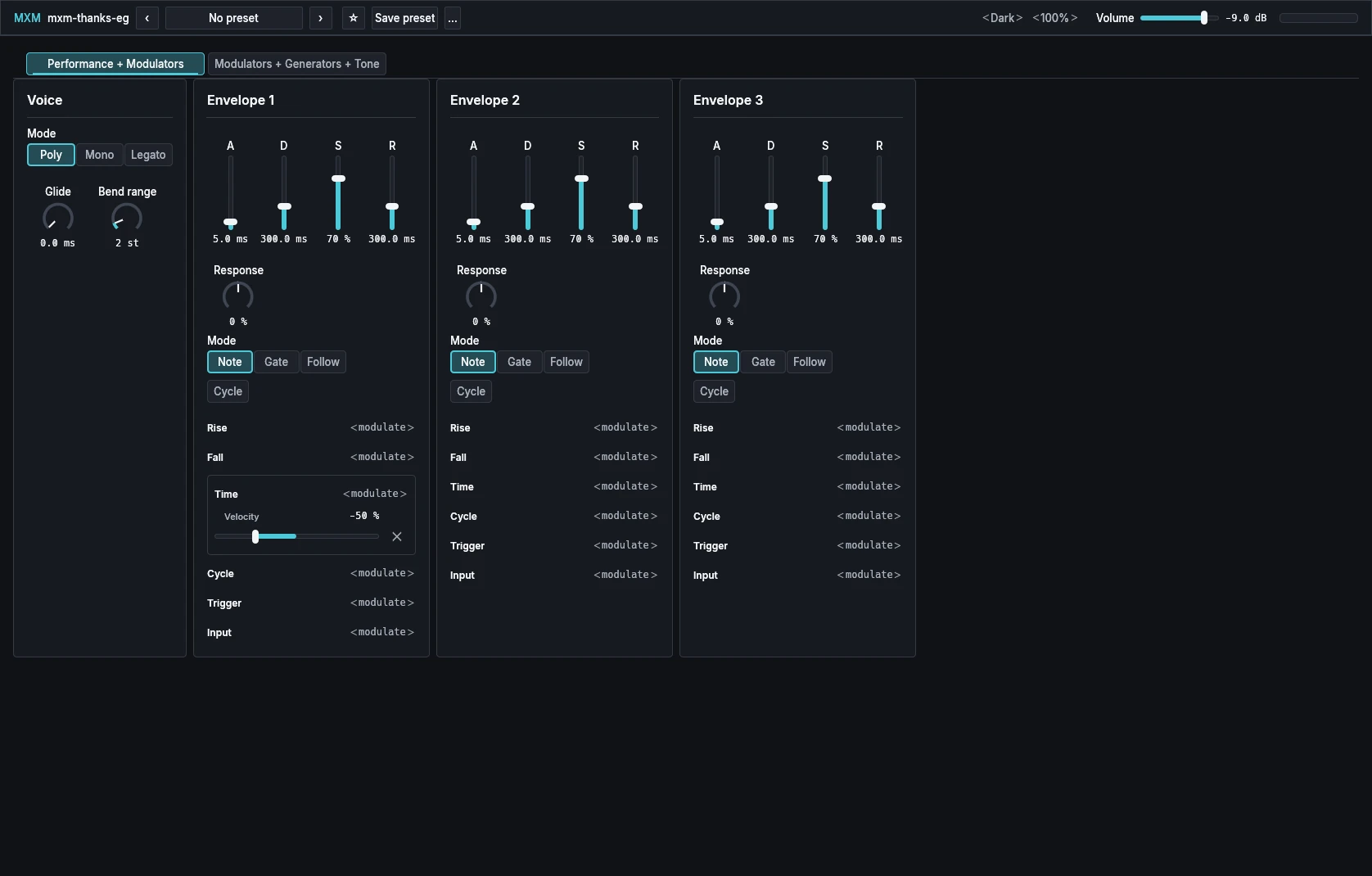
Choose a source and it takes a free slot, the one this target had before if there is one, so a removed source comes back at its old depth. The route appears as a row named after its source, with an amount slider and a ×. The × switches the source off and keeps the depth. ‹ modulate › only offers sources not yet on that target. When all sixteen slots are in use, every line reads all 16 in use until you remove a route.

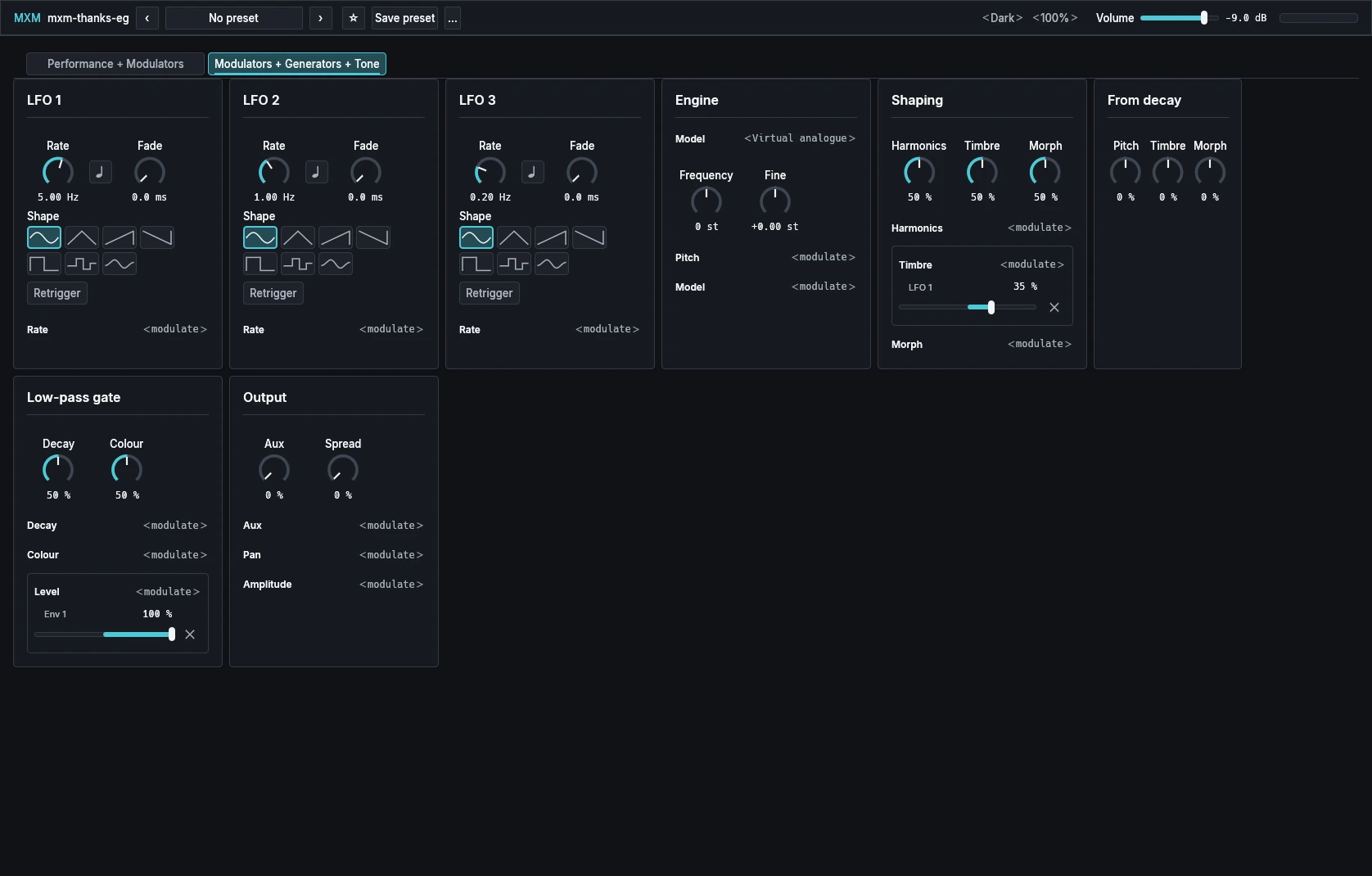
The sources are:
- Env 1, Env 2 and Env 3, from 0 to 1
- a rise end and a cycle end for each envelope: gates, the first high from the end of the attack until the envelope rests or attacks again, the second its opposite
- LFO 1, LFO 2 and LFO 3, from −1 to 1
- Decay, each note’s built-in decay envelope
- Key, the note after glide, measured from middle C
- Velocity, measured down from the hardest note
- Wheel (CC 1) and Pressure (channel pressure), from 0 to 1, and Bend, from −1 to 1
- Random, a new value for each note
| Card | Targets |
|---|---|
| Engine | Pitch, Model |
| Shaping | Harmonics, Timbre, Morph |
| Low-pass gate | Decay, Colour, Level |
| Output | Aux, Pan, Amplitude |
| LFO 1, 2 and 3 | Rate |
| Envelope 1, 2 and 3 | Rise, Fall, Time, Cycle, Trigger, Input |
Amounts run from −100 % to 100 % of the target’s reach:
| Target | Full reach |
|---|---|
| Pitch | ±12 st |
| Model | ±24 engines |
| Harmonics, Timbre, Morph, Decay, Colour, Aux, Pan, Level | the whole range |
| Amplitude | from silence to double |
| Rate | ±4 octaves |
| Time | 16 times shorter or longer; positive shortens |
| Rise, Fall | the whole range, in seconds; positive slows |
| Cycle, Trigger, Input | the source’s own value |
Key routes reach per octave. An amount of 100 % on Rise or Fall adds 30 seconds, so for small changes use Time. Cycle and Trigger are high while the routes on them add up to more than half. Two slots with the same source and target add up. A loop, such as an envelope triggering itself, runs one 0.25 ms step late and behaves the same way every time.
A few pairs take a slot and move nothing: a playing source such as the wheel or velocity into Cycle or Trigger, and Key or Random into Level. Velocity into Level only works upwards.
Playing notes
The engines run at 48 kHz, and one converter takes the mix to the host’s rate. At 48 kHz there is no latency. At other rates the converter adds a fixed latency, reported to the host: 78 samples at 44.1 kHz, 88 at 96 kHz and 176 at 192 kHz.
MXM Thanks EG answers notes with velocity, pitch bend, the mod wheel (CC 1), channel pressure and, in a CLAP host, per-note tuning. MIDI CC 120 cuts every note at once, and CC 123 releases every held key.
A cycling envelope in Gate mode, or an LFO on Level, can sound with no key held, so the instrument keeps running while anything sounds. A Follow envelope whose input stays above zero after the note, such as Key above middle C, never rests, and its voice never goes idle.