MXM Shimmer manual
Source code on GitHub · Questions on Discord
This manual goes through MXM Shimmer card by card. What every MXM editor shares, such as presets, pages, zoom, themes and the keys, is in Using the MXM editors.

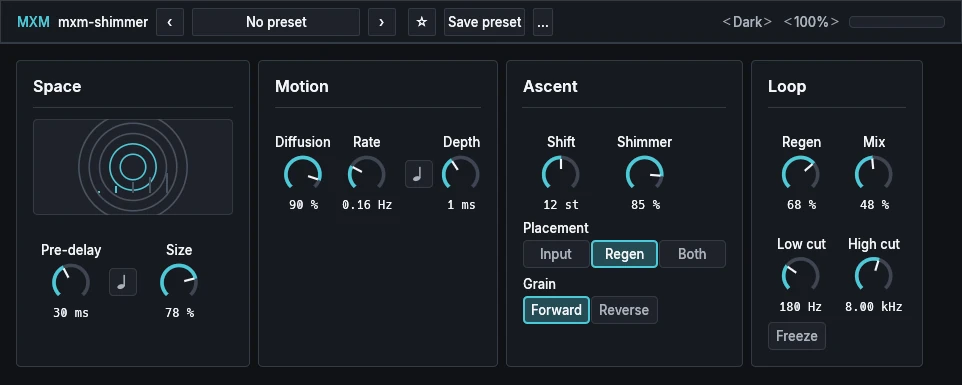
MXM Shimmer is a stereo reverb inside an outer feedback loop. The sound is delayed by Pre-delay, goes into the reverb, and the reverb’s output comes back round through a low cut and a high cut to be fed in again. A pitch shifter can read the input, the return of that loop, or both. Mix then blends the result with the dry sound.
App bar
Nothing beyond the shared preset row, Theme, Scale and a level meter whose clip light stays on until you click it. Mix is on the Loop card.
Space
| Control | Range | Init |
|---|---|---|
| Pre-delay | 0 ms to 250 ms | 30 ms |
| Pre-delay sync | Off, On | Off |
| Size | 0 % to 100 % | 78 % |
The display at the top draws arcs for the reverb spreading and rising marks for the shimmer climbing. The arcs space out as Size grows, the marks climb further the larger the Shift, and the arcs get heavier while the effect is sounding. Text in its corners says Held while Freeze is on and Off when Mix is at zero.
Pre-delay delays the start of the reverb; the dry sound stays on time. Even at 0 ms the reverb takes about 19 ms to answer, through its own early reflections. Pre-delay sync is the note symbol beside the knob. With it on and a tempo from the host, the knob picks a note length from 1/64 to 1/8, the top the longest. A synced pre-delay glides to its new length rather than jumping.
Size scales the reverb, from distinct early echoes to a broad, slow bloom. It also moves the point at which Regen starts to ring on by itself: the larger the space, the lower on Regen’s travel that point sits.
Motion
| Control | Range | Init |
|---|---|---|
| Diffusion | 0 % to 100 % | 90 % |
| Rate | 0.01 Hz to 8.00 Hz | 0.16 Hz |
| Rate sync | Off, On | Off |
| Depth | 0 ms to 8 ms | 1 ms |
Diffusion runs from audible repeats to a dense wash. It changes how the sound is scattered on its way into the reverb, and leaves the length of the tail alone. Low settings give an echo-like orbit.
Rate and Depth make the reverb’s delay lines drift slowly. More depth thickens the tail, and also shortens it. A host lists them as Mod rate and Mod depth. Init’s depth is 1.3 ms, shown as 1 ms. Rate sync is the note symbol beside Rate. With it on and a host tempo, the knob picks a note length from 1/32 to 4 bars, the top the fastest.
Ascent
| Control | Range | Init |
|---|---|---|
| Shift | 0 st to 24 st | 12 st |
| Shimmer | 0 % to 100 % | 85 % |
| Placement | Input, Regen, Both | Regen |
| Grain | Forward, Reverse | Forward |
Shift is how far up the shimmer is pitched, in whole semitones and only upward: 7 is a fifth, 12 an octave, 19 an octave and a fifth, 24 two octaves. Both stereo channels rise by the same interval through their own voices. Shimmer is how loud the shifted layer is. It doesn’t change how long the tail lasts, so a long tail can carry a faint shimmer, and a short one a strong one. At 0 % there is no shifted sound at all and MXM Shimmer is a plain reverb.
Placement is where the shifter reads:
- Input adds a steady harmony on top of the reverb. The shifted sound crosses the room once and stays at the interval you set.
- Regen shifts what comes back round the loop, so the shift repeats on every pass and the tail climbs ever higher. How far it climbs depends on Regen.
- Both gives the steady harmony and the climbing shimmer together.
Changing Placement while a tail is sounding fades from one to the other, so it doesn’t click.
The shifter is a delay whose read point sweeps, and each sweep is one grain, faded in and out so its restart is silent. Grain sets which way the sweeps run. On Forward each grain plays forwards; on Reverse it plays backwards before it is shifted, which gives a smoother bloom. With Shift at 0 st and Grain on Forward, the shifter is only a delay. On Reverse the grains still play backwards. Changing Grain while a tail sounds fades the shifted part out and back in.
Loop
| Control | Range | Init |
|---|---|---|
| Regen | 0 % to 100 % | 68 % |
| Mix | 0 % to 100 % | 48 % |
| Low cut | 20 Hz to 4.00 kHz | 180 Hz |
| High cut | 1.00 kHz to 20.00 kHz | 8.00 kHz |
| Freeze | Off, On | Off |
Regen is how long the reverb lasts. It is the gain of the outer loop and the only control that adds gain to the effect. The top few percent of its travel are past the point where the loop rings on by itself, and how high that point sits depends on Size. A soft limit in the loop keeps the sound from running away, so it settles at a steady level instead of growing without end.
Mix is the balance of dry sound and reverb. At zero the effect is off: the output is the dry sound to the bit, in mono and in stereo, and the reverb is emptied once. Turning Mix up again starts from silence rather than letting an old tail out. Mix at zero wins over Freeze.
Low cut and High cut sit inside the outer loop, so they act on every pass. Low cut keeps the tail from getting muddy. High cut darkens the tail as it goes on, more with each lap.
Freeze holds the reverb’s current sound and keeps it circulating inside the reverb. While it is on, the held sound no longer goes through the shifter or the two cuts, so it doesn’t climb, doesn’t darken and doesn’t fade, and the slow drift pauses. New sound still gets in. Whatever you play is shifted once, at the current Shift and whatever the Placement, and adds to what is held. Switched on in silence, Freeze makes no sound and waits for input. Switching it on or off while sound plays fades between the two states.
Tempo, tail and hosts
Only Pre-delay and Rate follow the host’s tempo, each through its own note symbol, and neither has any effect without a tempo from the host. While a tail is dying away, MXM Shimmer tells the host how long it has left. With Freeze holding sound, it tells the host to keep it running. There is no MIDI input. Every control can be automated.