mxm-poly-06 manual
Six DCO voices, each with its own low-pass filter and amplifier, followed by a global high-pass filter and stereo chorus.
Each voice has one ADSR shared by its filter and amplifier. The ranges and Init values below come straight from the plugin.
Modulator
LFO rate — 0.10 … 30.00 Hz, Init 5.00 Hz
Sets the shared LFO speed.
LFO delay — 0 ms … 3.00 s, Init 0 ms
Sets how long the LFO takes to fade in after a note starts.
LFO to pitch — 0 … 100% (0 … 7 semitones), Init 0%
Sets vibrato depth. Small values give normal vibrato; the full range reaches a fifth.
Wheel to LFO — 0 … 100%, Init 50%
Sets how much the modulation wheel adds to LFO depth.
Oscillator
Saw, pulse, and sub come from one stable ramp, so they never drift against each other.
Range — 16’, 8’, or 4’, Init 8'
Sets the octave. 8’ is concert pitch.
Saw — Off or On, Init On
Switches the sawtooth on or off.
Pulse — Off or On, Init Off
Switches the pulse wave on or off.
Pulse width — 5 … 95%, Init 50%
Sets the pulse duty cycle. 50% is square; moving either way makes it thinner.
PWM depth — 0 … 100%, Init 0%
Sets how far the LFO moves the pulse width.
PWM mode — Manual or LFO, Init Manual
Chooses a fixed or LFO-modulated pulse width.
Sub — 0 … 100%, Init 0%
Sets the sub-oscillator level, one octave below the main oscillator.
Noise — 0 … 100%, Init 0%
Sets the white-noise level.
Filter
Each voice has a low-pass filter. The high-pass filter comes after all six voices are mixed.
HPF — Boost, Flat, Cut 1, or Cut 2, Init Flat
Chooses the global high-pass setting:
- Boost: +10 dB below 250 Hz.
- Flat: no change.
- Cut 1: 226 Hz corner.
- Cut 2: 721 Hz corner.
Cutoff — 20.0 Hz … 20.0 kHz, Init 16.0 kHz
Sets the low-pass frequency for each voice.
Resonance — 0 … 100%, Init 0%
Sets filter feedback. The filters can self-oscillate from about 90%.
Envelope amount — 0 … 100% (0 … 7 octaves), Init 0%
Sets how far the envelope moves the cutoff.
Envelope polarity — Normal or Inverted, Init Normal
Makes the envelope open or close the filter.
LFO to filter — 0 … 100% (0 … 3 octaves), Init 0%
Sets how far the LFO moves the cutoff.
Key tracking — 0 … 100% (0 … 1:1), Init 0%
Makes higher notes raise the cutoff. At 100%, one keyboard octave moves the filter by one octave. The pivot is middle C.
Envelope
One ADSR per voice controls both its filter and amplifier.
Attack — 2 ms … 3.00 s, Init 2 ms
Time to reach full level.
Decay — 2 ms … 12.00 s, Init 400 ms
Time to fall from full level to Sustain.
Sustain — 0 … 100%, Init 80%
Level held while a key is down.
Release — 2 ms … 12.00 s, Init 300 ms
Time to fade after the note is released.
Amplifier
VCA mode — Envelope or Gate, Init Envelope
Envelope shapes the volume with the ADSR. Gate stays fully open while a key is down, leaving the envelope free to shape only the filter.
Level — −60.0 … 0.0 dB, Init −2.0 dB
Sets patch level before the chorus. This can change how hard the chorus is driven and is saved with the preset.
Volume — −60.0 … 0.0 dB, Init −6.0 dB
Sets master level after the chorus.
Chorus
Chorus mode — Off, I, II, or I + II, Init Off
Chooses the built-in stereo bucket-brigade chorus speed: 0.5 Hz, 0.8 Hz, or 1.3 Hz. Depth and wet level are fixed here.
mxm-chorus-06 is the same DSP with Rate, Depth, Mix, and Noise controls.
The plugin fades its chorus noise to silence when no voice or tail remains, allowing the host to put it to sleep.
Voice
Key assign — Poly 1, Poly 2, or Unison, Init Poly 1
- Poly 1: takes the first free voice.
- Poly 2: rotates through all six voices and their small differences.
- Unison: stacks all six in phase on one note. It gets louder, not wider.
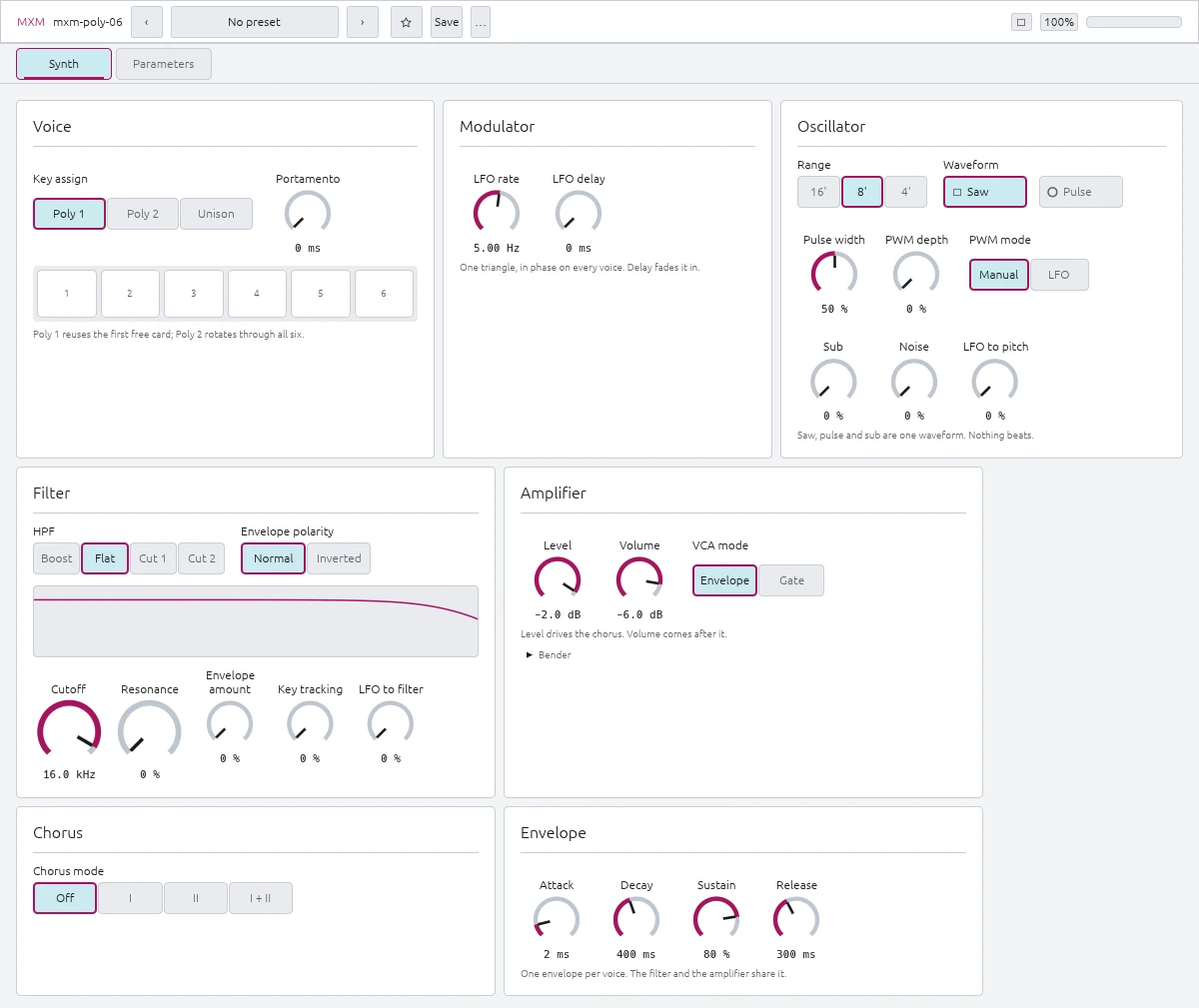
The voice display shows each assignment and makes stolen notes easy to spot.
Portamento — 0 ms … 2.00 s, Init 0 ms
Sets glide time.
Bend range — 0 … 24 st, Init 2 st
Sets pitch-bend range in semitones.
Bend to filter — 0.0 … 4.0 oct, Init 0.0 oct
Sets how far pitch bend also opens the filter.
Parameters view
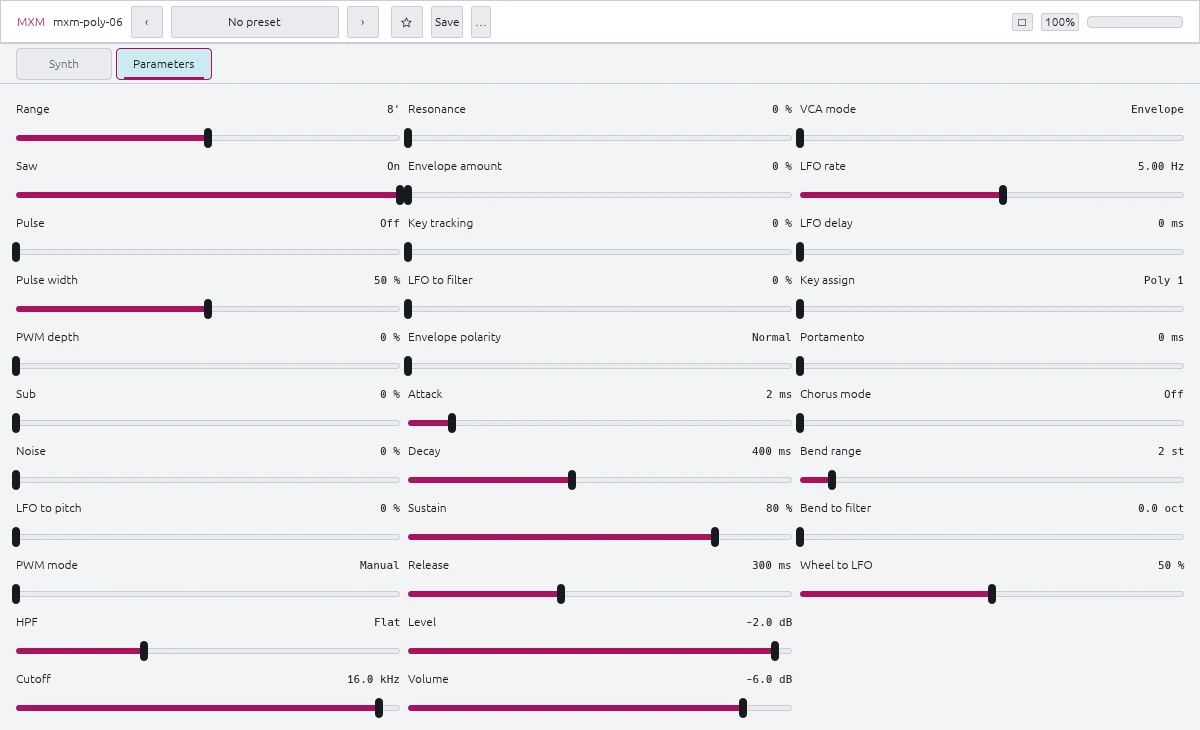
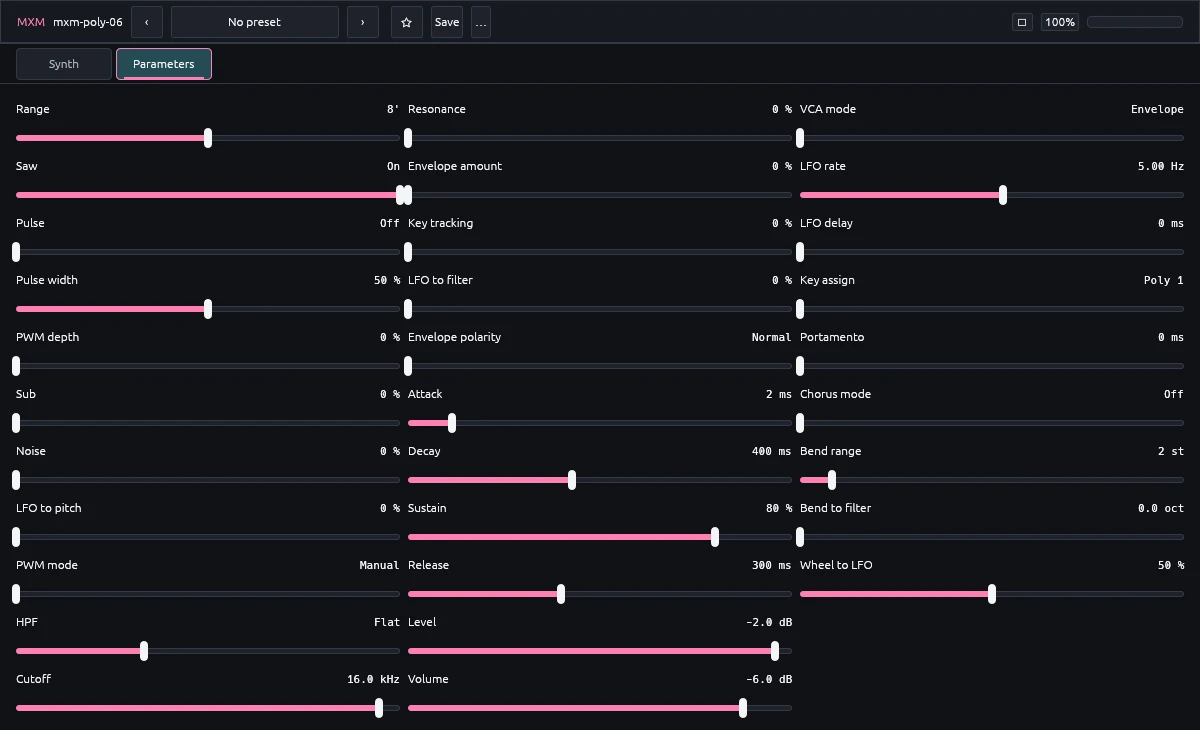
The Parameters view puts all 31 controls on one page with sliders and exact text entry.