MXM Para 07 manual
Source code on GitHub · Questions on Discord
This manual goes through MXM Para 07 card by card, then explains the routes. What every MXM editor shares, such as presets, pages, zoom, themes and the keys, is in Using the MXM editors.

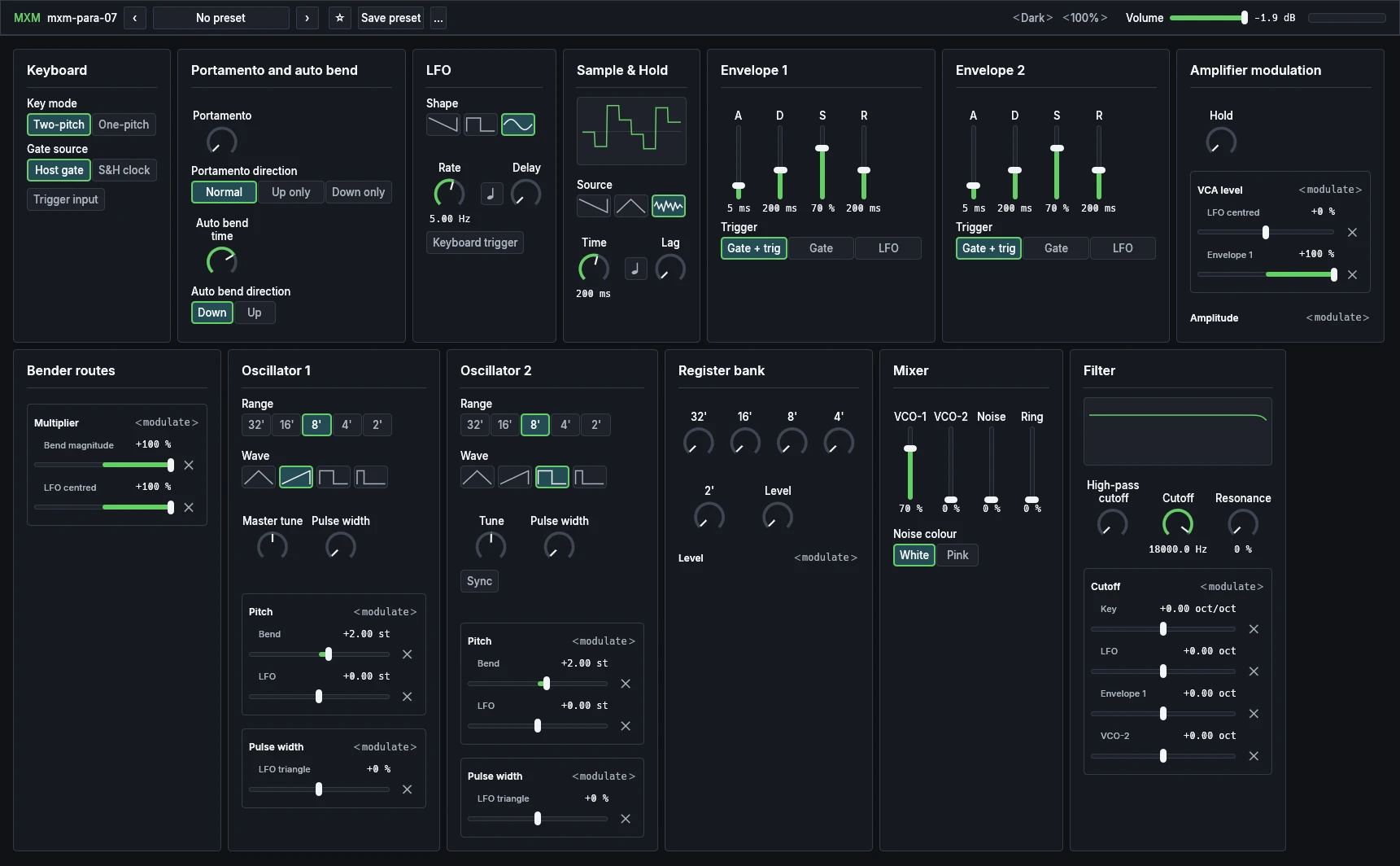
All 13 cards fit on one page at the opening size. In a smaller window the envelopes, and the oscillators, stay side by side whenever a row can hold them.
App bar
From the left: the plugin’s name, the preset row, Theme and Scale, Volume and a level meter whose clip light stays on until you click it.
| Control | Range | Init |
|---|---|---|
| Volume | −60.0 dB to 0.0 dB | −1.9 dB |
Keyboard
| Control | Range | Init |
|---|---|---|
| Key mode | Two-pitch, One-pitch | Two-pitch |
| Gate source | Host gate, S&H clock | Host gate |
| Trigger input | Off, On | Off |
Key mode decides where your keys go. On Two-pitch, VCO-1 plays your highest held key and VCO-2 your lowest. On One-pitch, both play the highest.
Gate source decides what starts the envelopes: your keys, or the sample and hold’s clock, so the sound plays by itself in either key mode.
Trigger input starts the envelopes once each time it goes from Off to On, and is meant for automation.
Portamento and auto bend
| Control | Range | Init |
|---|---|---|
| Portamento | 0 ms to 3.00 s | 0 ms |
| Portamento direction | Normal, Up only, Down only | Normal |
| Auto bend time | 20 ms to 700 ms | 200 ms |
| Auto bend direction | Down, Up | Down |
Portamento is the glide time between notes, and zero turns it off. Portamento direction lets it glide both ways, only up, or only down.
Auto bend is a swoop at the start of each note, up into the pitch or down into it. Time sets how long it lasts. Its depth is a route: nothing happens until you add Auto bend to an oscillator’s Pitch.
LFO
| Control | Range | Init |
|---|---|---|
| Shape | Sawtooth, Square, Sine | Sine |
| Rate | 0.20 Hz to 25.00 Hz | 5.00 Hz |
| Sync | Off, On | Off |
| Delay | 0 ms to 3.00 s | 0 ms |
| Keyboard trigger | Off, On | Off |
The Shape sawtooth is a falling one. Sync is the note symbol beside Rate. With it on and a host tempo, Rate picks a note length from 1/32 to four bars, limited to the lengths that fit between 0.2 Hz and 25 Hz at that tempo. Without a host tempo the free rate stands.
Delay fades the LFO in when you start playing. Only the sine fades: the sawtooth and the square arrive at full. Keyboard trigger restarts the LFO on every key.
Sample & Hold
| Control | Range | Init |
|---|---|---|
| Source | LFO saw, LFO triangle, Random | Random |
| Time | 13 ms to 2.00 s | 200 ms |
| Sync | Off, On | Off |
| Lag | 0 ms to 2.00 s | 0 ms |
Source is what gets sampled: the LFO’s saw or triangle, or noise for random steps. Time is the time between steps. With Sync on and a host tempo it picks a note length from 1/64 to a whole note. Lag smooths the steps into glides.
The scope draws the last eight steps, newest on the right, with the sampled LFO faint behind them. For stepped pitch, add Sample and hold to a Pitch stack.
Envelope 1
| Control | Range | Init |
|---|---|---|
| A | 0 ms to 4.00 s | 5 ms |
| D | 0 ms to 8.00 s | 200 ms |
| S | 0 % to 100 % | 70 % |
| R | 0 ms to 8.00 s | 200 ms |
| Trigger | Gate + trig, Gate, LFO | Gate + trig |
Trigger decides what restarts the envelope. On Gate + trig every new key restarts it. On Gate only the first key starts it, and it starts again only after every key is up. On LFO, the LFO restarts it on every cycle for as long as a key is held.
At Init, Envelope 1 opens the amplifier at full and is patched to the cutoff at zero. With every fader at zero it still gives a very short pulse, and the click that makes is left in, on purpose.
Envelope 2
| Control | Range | Init |
|---|---|---|
| A | 0 ms to 4.00 s | 5 ms |
| D | 0 ms to 8.00 s | 200 ms |
| S | 0 % to 100 % | 70 % |
| R | 0 ms to 8.00 s | 200 ms |
| Trigger | Gate + trig, Gate, LFO | Gate + trig |
The same as Envelope 1, and routed to nothing at Init. Route it somewhere to hear it.
Amplifier modulation
| Control | Range | Init |
|---|---|---|
| Hold | 0 % to 100 % | 0 % |
Hold keeps the amplifier open with no key down, for drones.
VCA level is what opens the shared amplifier. At Init it holds Envelope 1 at +100 % and LFO centred at zero, for tremolo. Velocity here runs from 0 % to +100 % only and can only close the amplifier for softer notes. Key isn’t offered, because a key held away from middle C would leave the amplifier stuck open.
Amplitude comes after the amplifier and scales the output from silence to double. Nothing is patched at Init.
Bender routes
This card holds the Multiplier. Each row is a factor, and the Multiplier is all of them multiplied together. It is also a source in every route menu.
At Init it holds Bend magnitude and LFO centred, both at +100 %. Bend magnitude is how far the lever is from centre, either way, so the product is an LFO whose depth you play with the lever. Nothing uses the Multiplier at Init: add it to a Pitch or Cutoff stack to hear it. The Multiplier can take itself as a factor, one sample late.
Oscillator 1
| Control | Range | Init |
|---|---|---|
| Range | 32’, 16’, 8’, 4’, 2' | 8' |
| Wave | Triangle, Sawtooth, Square, Pulse | Sawtooth |
| Master tune | −3.50 st to 3.50 st | 0.00 st |
| Pulse width | 0 % to 100 % | 0 % |
Range sets the octave: 8’ is the note you play. Master tune tunes the whole instrument, and VCO-2 follows, keeping its own offset.
Pulse width affects the Pulse wave only. At 0 % it is square, and turned up it narrows to a tenth of the cycle. It never goes wider than square. While a note plays, a caption on the card shows the frequency the oscillator is sounding.
Pitch takes routes, in semitones. At Init it holds Bend at +2.00 st, so pitch bend works straight away, and LFO at zero for vibrato. For a wider bend, raise Bend in both Pitch stacks, up to ±15.00 st. Pulse width takes routes too, moving the width from where the knob puts it. LFO triangle is patched in at zero.
Oscillator 2
| Control | Range | Init |
|---|---|---|
| Range | 32’, 16’, 8’, 4’, 2' | 8' |
| Wave | Triangle, Sawtooth, Square, Pulse | Square |
| Tune | −7.50 st to 7.50 st | 0.07 st |
| Pulse width | 0 % to 100 % | 0 % |
| Sync | Off, On | Off |
Tune sets VCO-2 against VCO-1. A little detunes it so the two beat, and more makes an interval. It starts 0.07 st sharp, so the moment you raise VCO-2 in the mixer you hear the beating.
Sync locks VCO-2 to VCO-1 for the hard-sync sound; retune VCO-2 to sweep it. Only VCO-2’s core is reset, not the divider after it.
Pitch and Pulse width work as on Oscillator 1, with the same routes at Init.
Register bank
| Control | Range | Init |
|---|---|---|
| 32' | 0 % to 100 % | 0 % |
| 16' | 0 % to 100 % | 0 % |
| 8' | 0 % to 100 % | 0 % |
| 4' | 0 % to 100 % | 0 % |
| 2' | 0 % to 100 % | 0 % |
| Level | 0 % to 100 % | 0 % |
An organ-like stack of five square waves, taken from VCO-1 and locked to its phase, so they follow VCO-1’s pitch. The five knobs set each octave’s level, and Level sets the whole bank’s level in the mix.
Level takes routes, which the original didn’t have. Nothing is patched at Init.
Mixer
| Control | Range | Init |
|---|---|---|
| VCO-1 | 0 % to 100 % | 70 % |
| VCO-2 | 0 % to 100 % | 0 % |
| Noise | 0 % to 100 % | 0 % |
| Ring | 0 % to 100 % | 0 % |
| Noise colour | White, Pink | White |
Ring is the ring modulator, VCO-1 times VCO-2, a metallic, bell-like tone. Noise colour chooses bright white noise or darker pink.
If the sum gets too hot for the filter, a Mixer overload, clear button appears; click it to clear the warning. The mixer warns but does not limit, as on the original.
Filter
| Control | Range | Init |
|---|---|---|
| High-pass cutoff | 10.0 Hz to 10000.0 Hz | 10.0 Hz |
| Cutoff | 5.0 Hz to 20000.0 Hz | 18000.0 Hz |
| Resonance | 0 % to 100 % | 0 % |
High-pass cutoff takes low end away before the main filter. It loses some level as its corner rises, as the original did. Cutoff sets the resonant low-pass, lower being darker. Resonance adds emphasis at the cutoff, and turned up far the filter whistles on its own.
The display draws a solid curve where Cutoff is set, and a dashed one where the filter actually is while a note plays. It prints no numbers.
Cutoff takes routes, in octaves. At Init it holds Envelope 1, LFO, Key and VCO-2, all at zero. Key is keyboard tracking: +1.00 oct/oct follows the keys fully. VCO-1, VCO-2 and Noise move the cutoff at audio rate.
Routes
The original’s fixed and paired connections are routes in MXM Para 07. The 9 destinations are the ones described above: Pitch and Pulse width on each oscillator, Cutoff, VCA level, Amplitude, Multiplier and the register bank’s Level. There are 18 sources:
- Key (the high key’s pitch after portamento, measured from middle C), Velocity, Wheel (CC 1), Pressure, Bend, Bend magnitude (how far the lever is from centre) and Pedal (CC 11)
- Noise, in the colour chosen on the Mixer
- LFO (the output the original sent to pitch and filter), LFO centred (the zero-centred one it sent to the amplifier and multiplier) and LFO triangle (with no delay, for pulse width)
- Sample and hold, after its lag
- Envelope 1 and Envelope 2
- Auto bend, already pointing the way Auto bend direction says
- Multiplier
- VCO-1 and VCO-2, at audio rate
Every source can reach every destination, except Key into VCA level.
Click ‹ modulate › under a destination and choose a source. It becomes a row with a fader and a × that removes it, and a removed route keeps its amount for when you add it again. Faders read what the route delivers with its source at its peak, in semitones, octaves or percent, and a Key route reads per octave of keyboard.
Routes the original had keep the reach they had there. Routes it never had take the reach every MXM instrument uses, such as ±12.00 st on pitch.
| Destination | Full reach |
|---|---|
| Pitch | ±12.00 st from LFO; ±24.00 st from Sample and hold or Auto bend; ±15.00 st from Bend; ±10.00 st from Multiplier; ±12.00 st from sources the original didn’t send to pitch |
| Pulse width | +40 % from LFO triangle; ±45 % from sources the original didn’t have, such as Wheel |
| Cutoff | ±10.21 oct from Envelope 1; ±4.00 oct from LFO, Sample and hold, Envelope 2 or VCO-2; ±2.50 oct from Noise; ±2.00 oct from Bend or Multiplier; ±1.00 oct from Pedal; ±1.00 oct per octave from Key |
| VCA level | +100 % from Envelope 1 |
| Amplitude | from silence to double (±100 %) |
The routes patched in at Init are listed card by card above. Each Pitch stack opens with only LFO and Bend; factory sounds that use the sample and hold or auto bend on pitch add those routes themselves.
When VCO-1 or VCO-2 modulates a pitch, the FM arrives one sample late. Amounts move smoothly over 10 ms. In a host, each route is two parameters you can automate, such as “Cutoff from LFO” for the amount and “Cutoff from LFO on” for whether it is there.
Playing notes
A second key adds or moves an oscillator pitch, not a voice. When you let go of one of two held keys, both oscillators go to the key still held. Velocity counts from the key that last started an envelope, and reads zero at the hardest note, so a route from it leaves the hardest notes alone and moves softer ones.
Per-note tuning from the host is followed. All Sound Off (CC 120) silences everything at once, and All Notes Off (CC 123) releases the notes as usual.