MXM Mono PR1 manual
Source code on GitHub · Questions on Discord
This manual goes through MXM Mono PR1 card by card, then explains the routes. What every MXM editor shares, such as presets, pages, zoom, themes and the keys, is in Using the MXM editors.

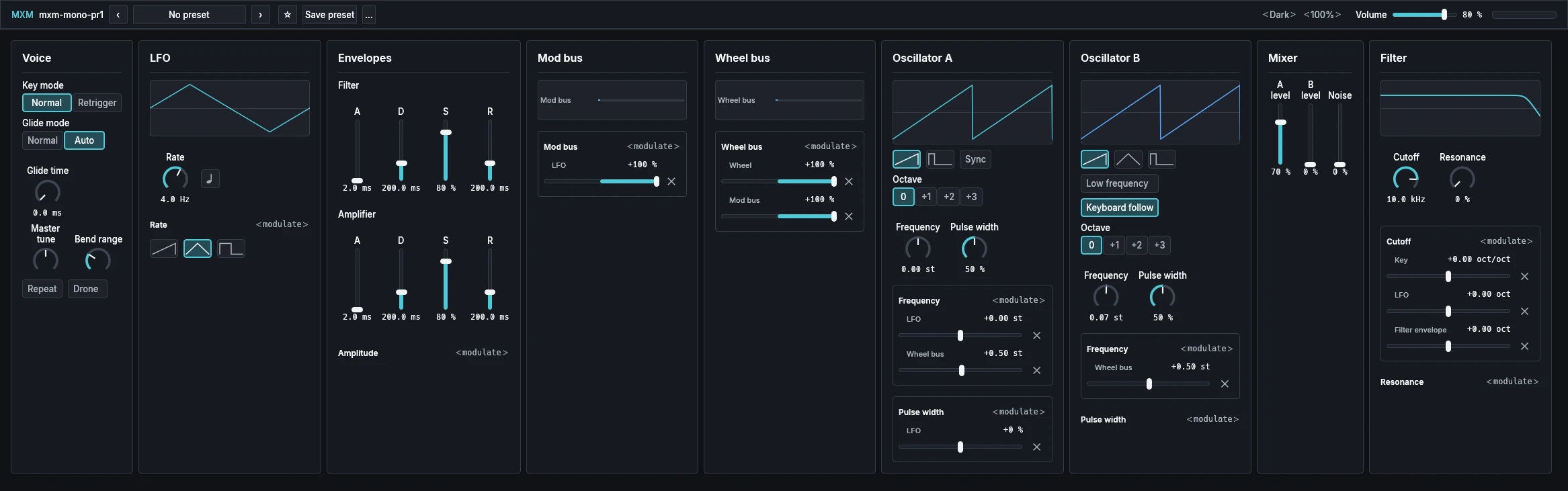
At the opening size the nine cards sit on two pages: Performance + Modulators + Generators, with everything up to Oscillator B, and Tone, with Mixer and Filter.
App bar
From the left: the plugin’s name, the preset row, Theme and Scale, Volume and a level meter whose clip light stays on until you click it.
| Control | Range | Init |
|---|---|---|
| Volume | 0 % to 100 % | 80 % |
Volume is the instrument’s level, but it works on the amplifier’s drive rather than on the finished signal. Turned up, it also saturates. No factory preset moves it.
Voice
| Control | Range | Init |
|---|---|---|
| Key mode | Normal, Retrigger | Normal |
| Glide mode | Normal, Auto | Auto |
| Glide time | 0.0 ms to 30.00 s | 0.0 ms |
| Master tune | −2.00 st to 2.00 st | 0.00 st |
| Bend range | 0 st to 24 st | 7 st |
| Repeat | Off, On | Off |
| Drone | Off, On | Off |
Key mode sets both note priority and triggering. On Normal the lowest held key sounds, and a new key pressed over held ones does not restart the envelopes. On Retrigger the key pressed last sounds, and every new key restarts them.
Glide time is the slide between notes, and zero turns it off. On Normal glide mode every change of pitch glides. On Auto only overlapping notes do. Master tune shifts the whole instrument by up to two semitones either way.
Repeat restarts both envelopes on every cycle of the LFO, so the sound repeats by itself while a key is held. It follows the LFO’s clock even with all three LFO waves switched off, and with LFO sync on it repeats on the beat. Drone holds the note on with no key down. It holds the envelopes’ gate open, as a held key would, rather than opening the amplifier directly. When more than one is on, Drone wins over Repeat, and Repeat over the keyboard.
LFO
| Control | Range | Init |
|---|---|---|
| Rate | 0.1 Hz to 30.0 Hz | 4.0 Hz |
| Sync | Off, On | Off |
| Saw | Off, On | Off |
| Triangle | Off, On | On |
| Square | Off, On | Off |
Sync is the note symbol beside Rate. With sync on and a host tempo, Rate picks a note length from 1/32 to four bars, fastest at the top, and shows the division instead of hertz. Only lengths that fit between 0.1 Hz and 30 Hz at the current tempo can be reached. Without a host tempo the free rate applies.
The three wave buttons add together, so saw and square on at once gives a shape of its own. With all three off the LFO puts out nothing. The display draws the sum.
Rate takes routes, in octaves. Nothing is patched to it at Init.
Envelopes
| Control | Range | Init |
|---|---|---|
| Filter A | 2.0 ms to 30.00 s | 2.0 ms |
| Filter D | 2.0 ms to 30.00 s | 200.0 ms |
| Filter S | 0 % to 100 % | 80 % |
| Filter R | 2.0 ms to 30.00 s | 200.0 ms |
| Amplifier A | 2.0 ms to 30.00 s | 2.0 ms |
| Amplifier D | 2.0 ms to 30.00 s | 200.0 ms |
| Amplifier S | 0 % to 100 % | 80 % |
| Amplifier R | 2.0 ms to 30.00 s | 200.0 ms |
Two ADSR envelopes on one card, each a row of four faders under its heading, Filter and Amplifier. The amplifier envelope shapes the volume of every note. The filter envelope reaches the cutoff, or anything else, through routes; at Init it is patched to the cutoff at zero.
Amplitude takes routes. It scales the output after the amplifier, from silence to double. Nothing is patched to it at Init.
Mod bus
Mod bus has no knobs: it is a place to add modulation up before sending it on. Everything routed into it adds together, and the result is the source called Mod bus in every menu. The display shows its level as it moves.
At Init it holds the LFO at +100 %. Every source except the mod wheel can go in; the wheel belongs to Wheel bus.
Wheel bus
Wheel bus multiplies instead of adding. Each row is a factor, and Wheel bus is all of them multiplied together. A row at zero leaves Wheel bus alone. A row at +100 % multiplies Wheel bus by that source in full. The result is the source called Wheel bus, and the display shows its level.
At Init it holds Mod bus and Wheel, both at +100 %, so Wheel bus is Mod bus times the mod wheel. With the LFO in Mod bus, and Wheel bus routed to both oscillators’ frequency, the wheel fades vibrato in and out.
Because it multiplies, an empty Mod bus is zero, and Wheel bus is then zero too, whatever else you add. Putting the LFO straight into Wheel bus is the obvious thing to try, and with Mod bus empty it gives silence at every wheel position. The way that works is the one Init uses: LFO into Mod bus, Mod bus into Wheel bus, Wheel bus into the target.
Oscillator A
| Control | Range | Init |
|---|---|---|
| Saw | Off, On | On |
| Pulse | Off, On | Off |
| Sync | Off, On | Off |
| Octave | 0, +1, +2, +3 | 0 |
| Frequency | −6.00 st to 6.00 st | 0.00 st |
| Pulse width | 0 % to 100 % | 50 % |
The wave buttons are drawn as pictures, and they add: saw and pulse together is a shape of its own. With both off, Oscillator A is silent. The display draws two cycles of what is switched on.
Sync locks Oscillator A to Oscillator B for the hard-sync sound, even when B is silent in the mixer. Octave raises A in exact octave steps, and Frequency tunes it around the played pitch. Pulse width sets how narrow the pulse is. At either end it goes silent, deep pulse-width modulation can silence it too, and a wide pulse can drop out under sync. These are kept on purpose.
Frequency takes routes, in semitones. At Init it holds the LFO at zero and Wheel bus at +0.50 st, which is the mod wheel’s vibrato. Pulse width takes routes too, with the LFO at zero at Init.
Oscillator B
| Control | Range | Init |
|---|---|---|
| Saw | Off, On | On |
| Triangle | Off, On | Off |
| Pulse | Off, On | Off |
| Low frequency | Off, On | Off |
| Keyboard follow | Off, On | On |
| Octave | 0, +1, +2, +3 | 0 |
| Frequency | −6.00 st to 6.00 st | 0.07 st |
| Pulse width | 0 % to 100 % | 50 % |
Oscillator B works like A, with a triangle as well. Its Frequency starts slightly sharp, so the moment you raise B level in the mixer the two beat. Frequency is also how you set an interval, a sync ratio, or a modulation rate.
Low frequency drops B seven octaves into a range for modulation rather than for listening. Keyboard follow off makes B ignore the keys and hold its own pitch. Together they make B a second LFO. What you hear from B and what B modulates are the same summed waveform, so the wave buttons change both, and B can modulate its own frequency. Its waveform is drawn in the colour the editor uses for modulation.
Frequency holds Wheel bus at +0.50 st at Init. Pulse width has nothing patched.
Mixer
| Control | Range | Init |
|---|---|---|
| A level | 0 % to 100 % | 70 % |
| B level | 0 % to 100 % | 0 % |
| Noise | 0 % to 100 % | 0 % |
Three faders into the filter. B at zero still syncs A and still modulates, so B can be heard only through what it does to the rest.
Filter
| Control | Range | Init |
|---|---|---|
| Cutoff | 10.0 Hz to 20.0 kHz | 10.0 kHz |
| Resonance | 0 % to 100 % | 0 % |
A four-pole resonant low-pass. Cutoff sets where it starts darkening the sound, and Resonance adds emphasis at the cutoff. The display draws the response at the knob’s cutoff and at the cutoff after modulation, including the resonant peak. It is drawn from the model’s equations, not measured.
Cutoff takes routes, in octaves. At Init it holds Key, LFO and Filter envelope, all at zero. Key is keyboard tracking: +1.00 oct/oct follows the keys fully. Resonance takes routes too, with nothing patched.
Routes
Every modulation in MXM Mono PR1 is a route from a source to a target. There are 10 targets, each drawn under its own control: Rate on LFO, Amplitude on Envelopes, Mod bus and Wheel bus on their own cards, Frequency and Pulse width on each oscillator, and Cutoff and Resonance on Filter. There are 14 sources:
- Key, Velocity, Wheel (CC 1), Pressure and Bend
- Noise, LFO and Gate
- Filter envelope and Amplifier envelope
- Mod bus and Wheel bus
- Oscillator B and Oscillator A, at audio rate
Every source can reach every target except one pair: the mod wheel can’t go into Mod bus.
Click ‹ modulate › on a target and choose a source. It becomes a row named after the source, with a fader and a × that removes it. Removing a route keeps its amount, so adding it again brings the depth back. Faders run from −100 % to +100 % of the route’s reach and read what they deliver in the target’s unit. Key routes read per octave of keyboard.
| Target | Full reach |
|---|---|
| Frequency (A and B) | ±24.00 st from LFO, Filter envelope, Oscillator B, Mod bus or Wheel bus; ±12.00 st from the others; ±12.00 st per octave from Key |
| Pulse width (A and B) | ±50 % from LFO, Filter envelope, Oscillator B, Mod bus or Wheel bus; ±45 % from the others; ±9 % per octave from Key |
| Cutoff | ±16.00 oct from Filter envelope; ±8.00 oct from LFO, Oscillator B, Mod bus or Wheel bus; ±4.00 oct from the others; ±1.00 oct per octave from Key |
| Resonance | ±100 %; ±20 % per octave from Key |
| Rate | ±4.00 oct; ±1.00 oct per octave from Key |
| Amplitude | from silence to double (±100 %); ±20 % per octave from Key |
| Mod bus, Wheel bus | ±100 % |
A pulse-width route at full reads +50 % because that is how far it moves the width.
Ten routes are there at Init. At zero: Cutoff from Filter envelope, Key and LFO; Oscillator A’s frequency and pulse width from LFO. At full: Mod bus from LFO, and Wheel bus from Mod bus and from Wheel. And both oscillators’ Frequency from Wheel bus at +0.50 st. With the mod wheel at rest, Init sounds as if none of them were there. Velocity and pressure reach nothing at Init.
Which rows show is set entirely by the parameters, so a preset sets the whole panel. In a host each route is two parameters, such as “Cutoff from LFO” for the amount and “Cutoff from LFO on” for whether it is there.
Playing notes
MXM Mono PR1 has one voice. Key mode sets whether the lowest or the last key sounds, and whether new keys restart the envelopes. Auto glide only slides between overlapping notes.
When nothing can be heard, the oscillators and the LFO stop and wait, and pick up from there when you play again. After All Sound Off the synth stays silent until you play a note, and nothing on screen shows this. All Notes Off releases held notes. The host is told the sound may ring on for three times the longest release time plus 100 ms after the last note.