mxm-mono-02 manual

Thirty-five parameters. Two free-running oscillators, a sub locked an octave below VCO-1, and one envelope that can drive the filter, the amplifier and the pulse width at once. It follows the Roland SH-2.

Ranges and Init values below are read from the plugin itself. Where the panel shows a percentage, the figure underneath it is given too.

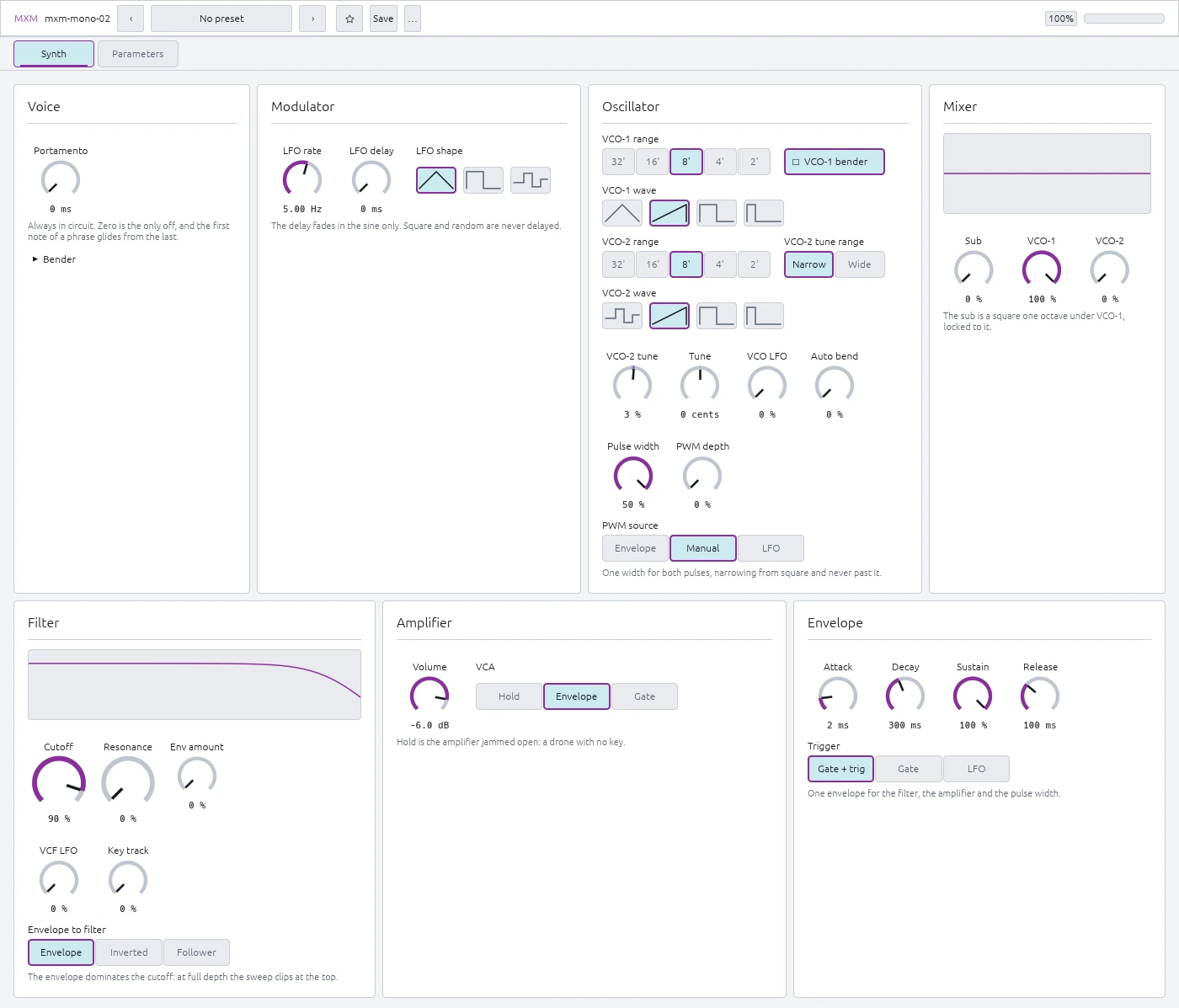
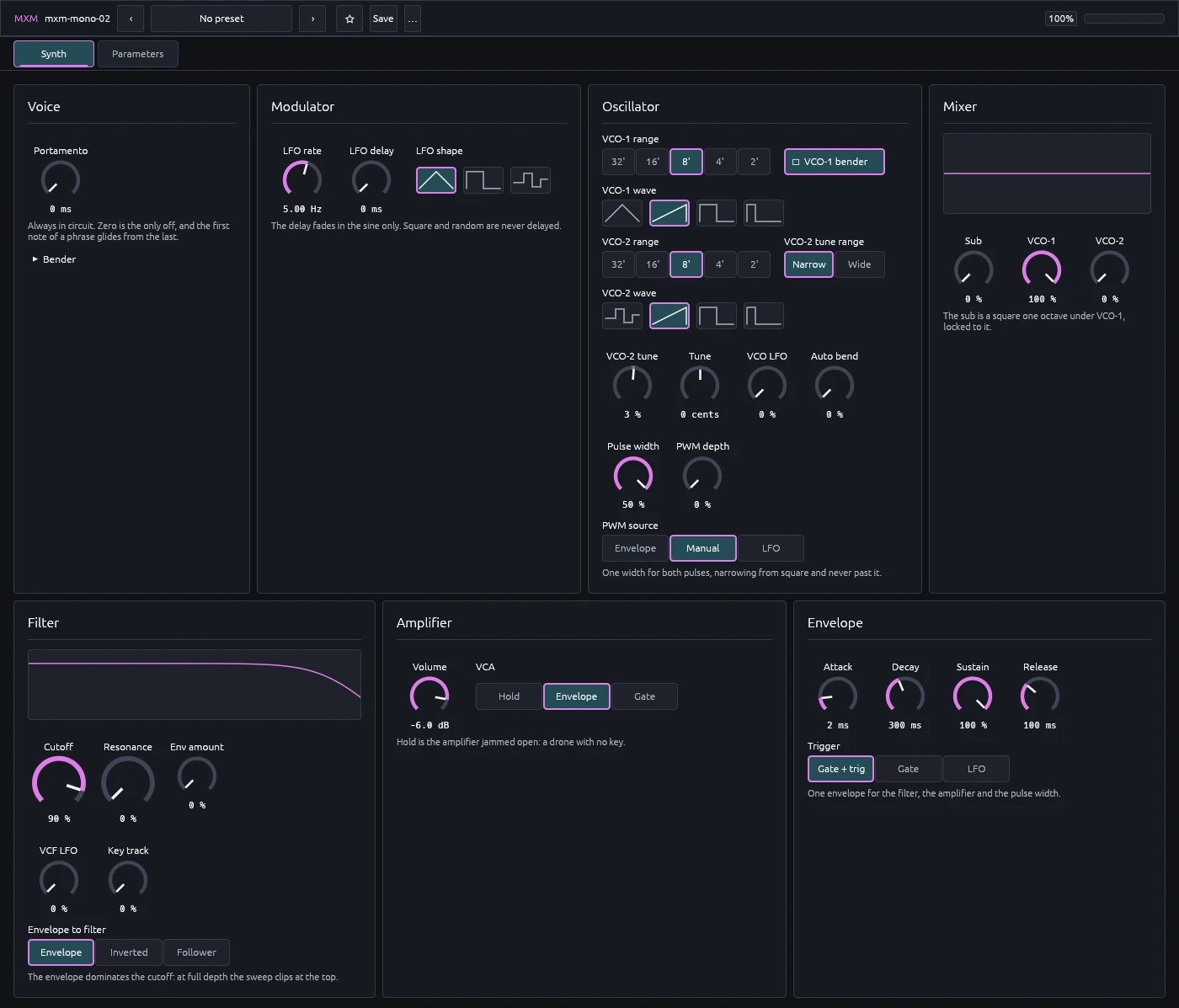
The Synth view: seven modules following the signal The Synth view: seven modules following the signal
The Synth view: seven modules following the signal · click for full size

Modulator

LFO rate — 0.20 … 25.00 Hz, Init 5.00 Hz

The LFO’s speed, in hertz.

LFO delay — 0 ms … 1.50 s, Init 0 ms

How long the LFO takes to fade in after a note starts.

It fades the sine only. Square and random arrive at full depth immediately, because a delayed square is a square that appears part-way through its own cycle, which reads as a glitch rather than as a fade.

LFO shape — Sine, Square or Random, Init Sine

The LFO’s waveform. Random is stepped rather than smooth, moving in jumps at the LFO rate.

VCO LFO — 0 … 100 % (0 … 7 semitones), Init 0 %

Vibrato depth. Full scale is seven semitones — a fifth — so ordinary vibrato lives in the first few percent.

Auto bend — 0 … 100 % (0 … 12 semitones), Init 0 %

How far the pitch dips or rises into each note. Full scale is one octave, which is well past the subtle version and into a deliberate swoop.

Pulse width

Pulse width — 5 … 50 %, Init 50 %

The pulse wave’s duty cycle. 50 % is a square, and the control travels only downward from there to 5 %, because on this architecture the two halves are symmetrical — a 70 % pulse sounds like a 30 % one, so offering both would be two names for one timbre.

One width section serves both oscillators. There is only one width relationship across the pair, which is a real constraint of the instrument rather than a simplification.

PWM depth — 0 … 100 %, Init 0 %

How far the chosen source swings the width away from the manual setting. At zero the source is selected but does nothing, so the width does not jump when PWM source changes.

PWM source — Envelope, Manual or LFO, Init Manual

What moves the pulse width. Manual leaves it under the knob; LFO gives the slow beating; Envelope narrows the pulse over the course of each note.

Oscillators

Tune — −200 … +200 cents, Init 0 cents

Fine tuning for the whole instrument, up to two semitones either way.

VCO-1 range — 32’, 16’, 8’, 4’ or 2’, Init 8'

Octave register for the first oscillator, in organ footages. 8’ is concert pitch.

VCO-1 wave — Sine, Sawtooth, Square or Pulse, Init Sawtooth

One waveform at a time. The saw keeps the small discharge corner of an analogue reset, and the sine is a triangle rounded through a diode model rather than a mathematically pure sine.

VCO-1 bender — Off or On, Init On

Whether pitch bend reaches VCO-1. Turning it off for one oscillator and leaving it on for the other makes the bender open and close an interval instead of moving the whole voice.

VCO-2 range — 32’, 16’, 8’, 4’ or 2’, Init 8'

Octave register for the second oscillator.

VCO-2 wave — Noise, Sawtooth, Square or Pulse, Init Sawtooth

VCO-2 swaps VCO-1’s sine for noise. That makes the second oscillator a noise source when you want one, at the cost of not being able to stack two sines.

VCO-2 tune — −100 … +100 %, Init 3 %

VCO-2’s tuning against VCO-1. What the percentage is worth depends on VCO-2 tune range: ±200 cents on Narrow, ±1750 cents on Wide.

Init is 3 %, which puts VCO-2 a few cents sharp — the two oscillators beat as soon as VCO-2’s mixer level comes up, rather than sitting in a dead unison.

VCO-2 tune range — Narrow or Wide, Init Narrow

Whether VCO-2 tune spans ±200 cents or ±1750 cents — roughly two semitones or a minor fourteenth.

It stays a switch rather than becoming one continuous control because a 7-bit MIDI controller across the wide range cannot resolve the cent-level detuning that the narrow range is for.

Mixer

Sub — 0 … 100 %, Init 0 %

Sub-oscillator level. Locked one octave below VCO-1, so it never drifts against it — the sub is the only part of this instrument that cannot go out of tune.

VCO-1 — 0 … 100 %, Init 100 %

VCO-1’s level into the filter.

VCO-2 — 0 … 100 %, Init 0 %

VCO-2’s level into the filter. Raise it from Init and the detune set by VCO-2 tune starts beating immediately.

Filter

A four-stage OTA cascade with the diode clamp the source circuit shows. Bass falls away as resonance rises, and no compensation has been added to tidy the response.

Cutoff — 0 … 100 % (10 Hz … 20 kHz), Init 90 %

The filter’s corner. The control spans eleven octaves from a 10 Hz floor, so it reaches from below the audible band to above it. Init sits near the top, leaving the filter nearly open.

Resonance — 0 … 100 %, Init 0 %

Feedback around the cascade. It self-oscillates in the top fifth of the control, and from about 75 % the filter is seeded with an inaudible excitation so it can sing from silence.

Envelope to filter — Envelope, Inverted or Follower, Init Envelope

What moves the cutoff. Envelope is the ADSR as usual. Inverted flips it, so the filter closes as the envelope rises. Follower tracks the signal’s own level instead of the envelope, with corner frequencies at 16, 16 and 48 Hz for its three stages — that makes the filter respond to how hard the oscillators are driving it rather than to the keyboard.

Env amount — 0 … 100 % (0 … 10 octaves), Init 0 %

How far the chosen source moves the cutoff. Full scale is ten octaves, applied multiplicatively — a very wide sweep, which is why small amounts do most of the musical work. In Follower mode the depth is five octaves instead.

VCF LFO — 0 … 100 % (0 … 4 octaves), Init 0 %

How far the LFO moves the cutoff. Full scale is four octaves.

Key track — 0 … 100 % (0 … 1.2:1 with the keyboard), Init 0 %

How much the played note moves the cutoff, pivoting on middle C. At 100 % the cutoff rises slightly faster than the keyboard — 1.2 octaves of cutoff per octave played — so a patch gets brighter as you go up rather than merely keeping pace.

Envelope

One ADSR, shared by the filter, the amplifier and the pulse width.

Attack — 1 ms … 2.50 s, Init 2 ms

Time to full level.

Decay — 2 ms … 10.00 s, Init 300 ms

Time from full level down to the sustain level.

Sustain — 0 … 100 %, Init 100 %

The level held while a key is down, as a proportion of full. A level, not a time. Init is 100 %, which makes the Init patch an organ-like hold rather than a decaying one.

Release — 2 ms … 10.00 s, Init 100 ms

Time from the sustain level to silence after the key is let go.

Trigger — Gate + trig, Gate or LFO, Init Gate + trig

When the envelope restarts. Gate + trig restarts on every new note. Gate starts it only when no note was already held, so overlapping notes phrase into one another. LFO refires the envelope from the LFO while a key remains down, which turns a held note into a repeating shape.

Amplifier

VCA — Hold, Envelope or Gate, Init Envelope

What opens the amplifier. Envelope gives the ADSR its usual job. Gate opens fully for as long as a key is down, turning the shared envelope into a filter-only envelope. Hold leaves the amplifier open with no key down at all — a drone, which All Sound Off will cut and keep silent until a deliberate restart.

Volume — −60.0 … 0.0 dB, Init −6.0 dB

Output level.

Voice

Portamento — 0 ms … 5.00 s, Init 0 ms

Glide time between notes. Starts at zero.

The keyboard is low-note priority: a higher note pressed over a held lower one does nothing until the low note is released, and the envelope only fires when the new note comes from below.

Bend range — 0 … 24 st, Init 2 st

How far pitch bend travels, in semitones.

Bend to filter — 0 … 100 % (up to 1:1 with the bend), Init 0 %

How much pitch bend also opens the filter, so a bend brightens as it rises instead of only changing pitch. At full depth a bend of one octave moves the cutoff by one octave.

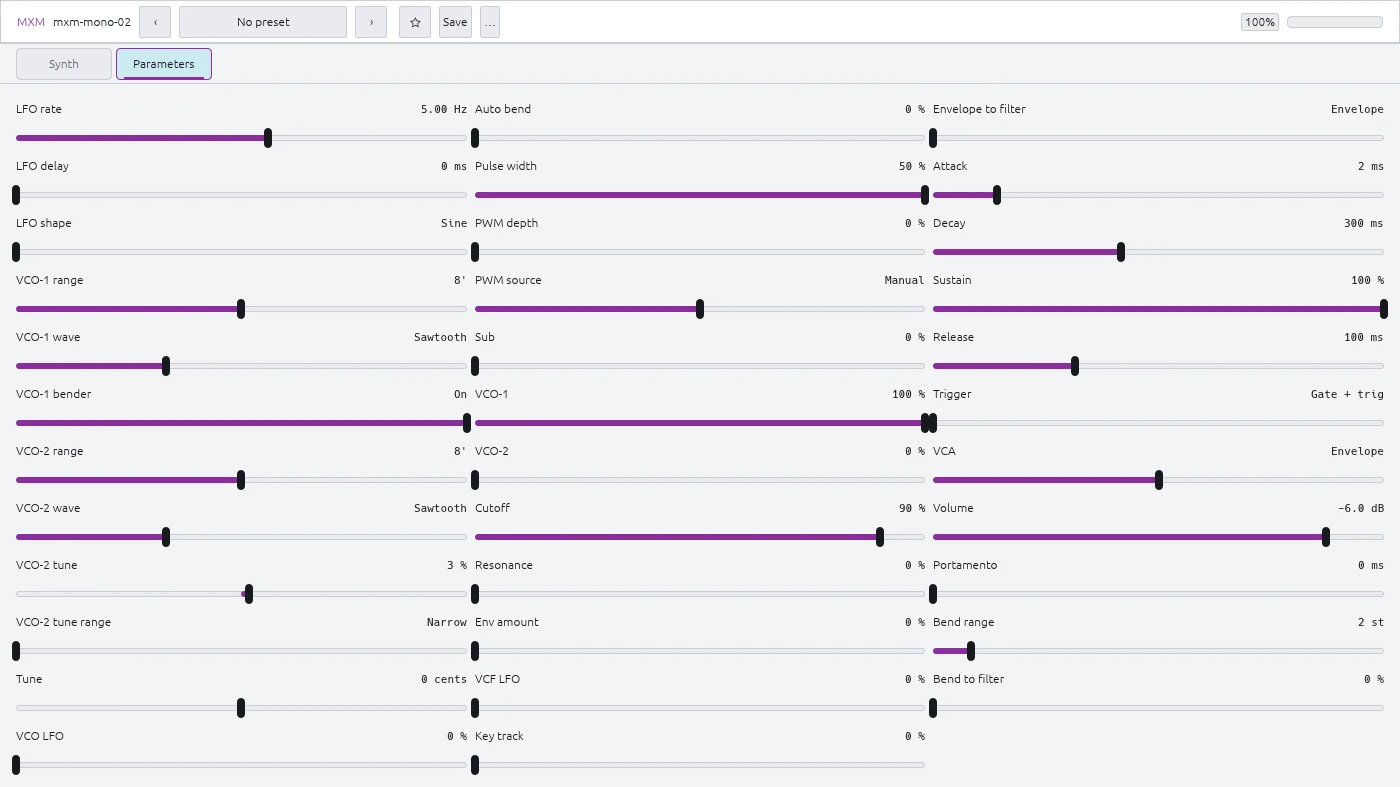
The Parameters view

Every control on one page as an editable slider, with direct text entry. It is the same parameters as the panel, laid out for reading and for typing an exact value rather than for playing.

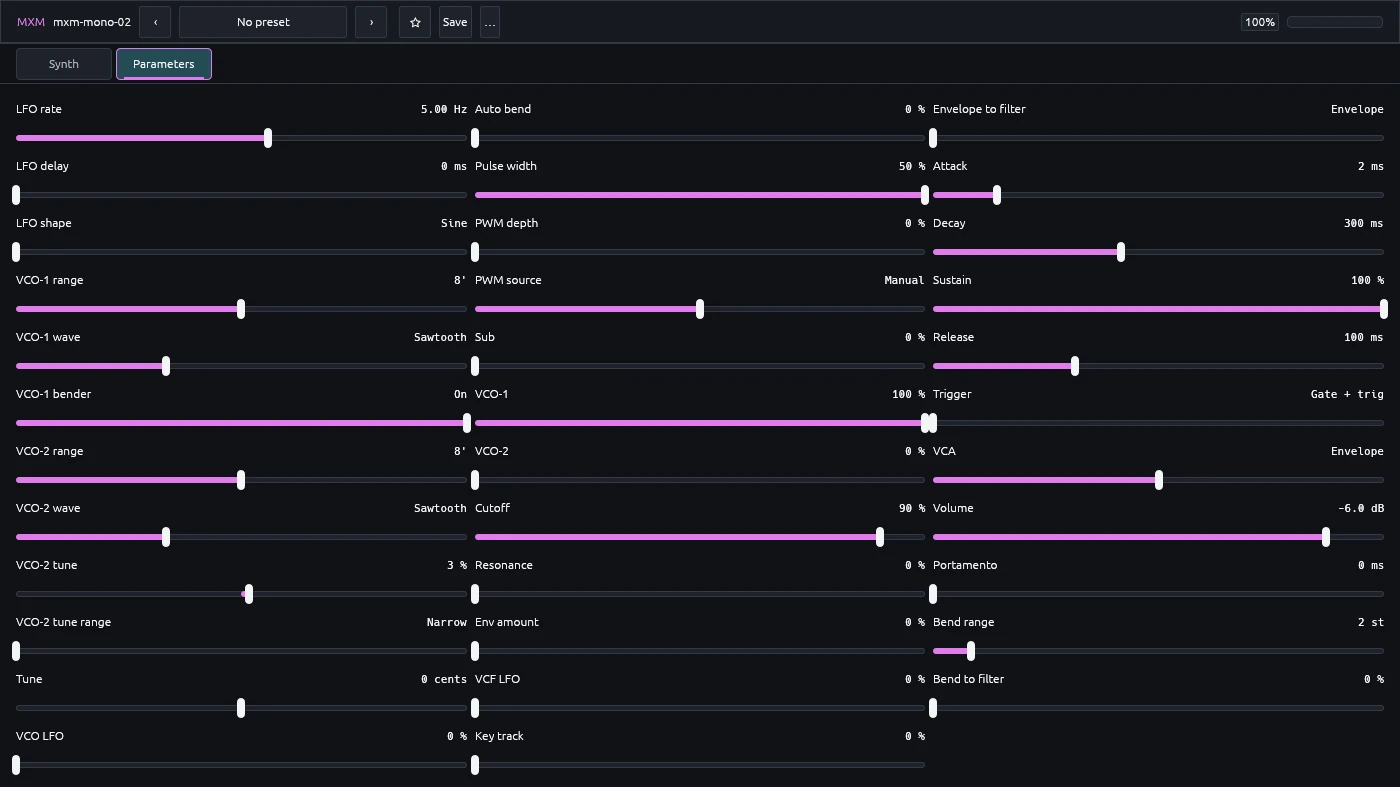
The Parameters view: all 35 controls The Parameters view: all 35 controls
The Parameters view: all 35 controls · click for full size