mxm-mono-01 manual

Twenty-seven parameters, and one envelope that reaches both the filter and the amplifier. That coupling is the instrument: decay and release change tone and articulation together, which is a limitation and also why the panel is quick to read. It follows the Roland SH-101.

Ranges and Init values below are read from the plugin itself. Where the panel shows a percentage, the figure underneath it is given too.

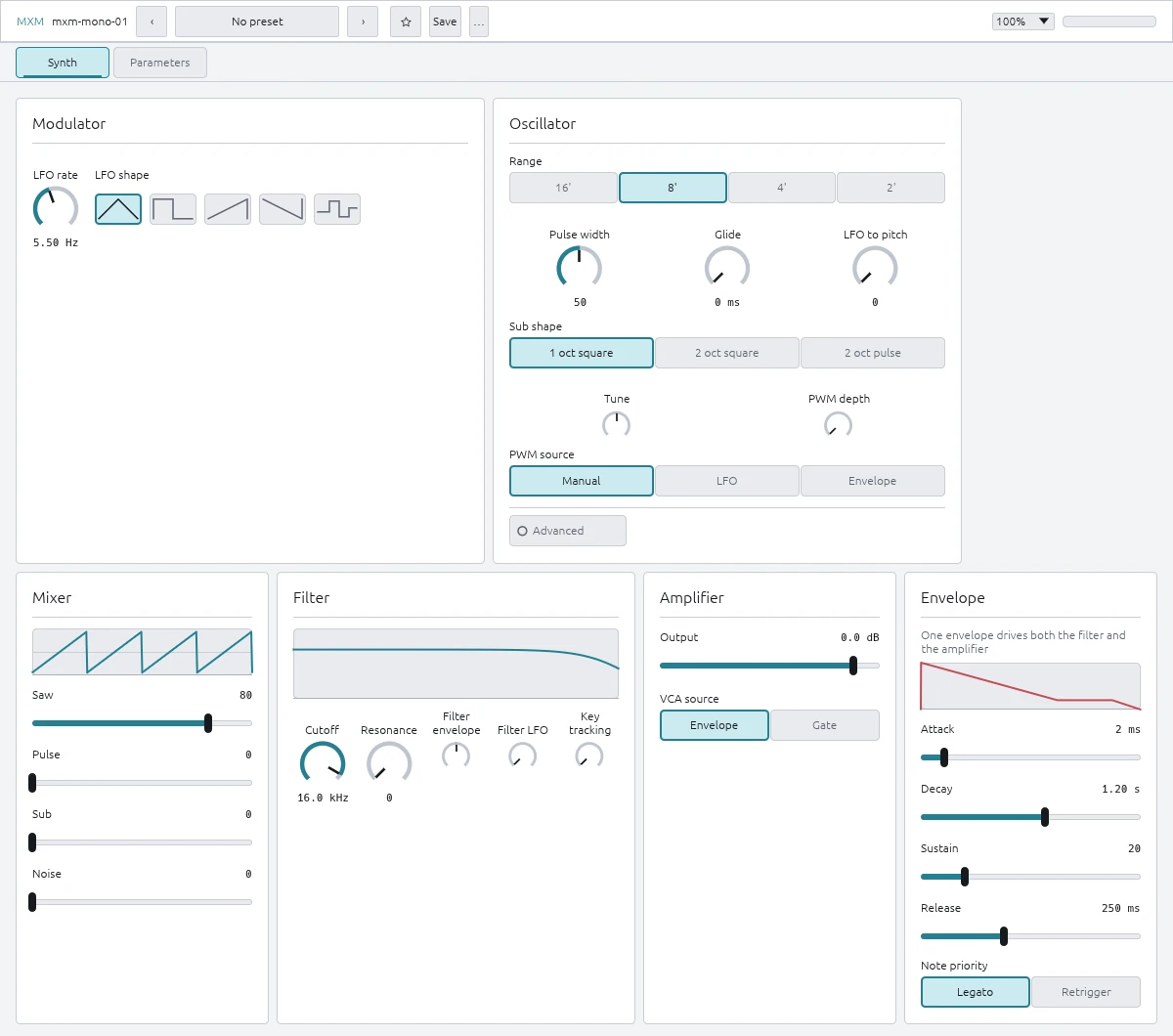
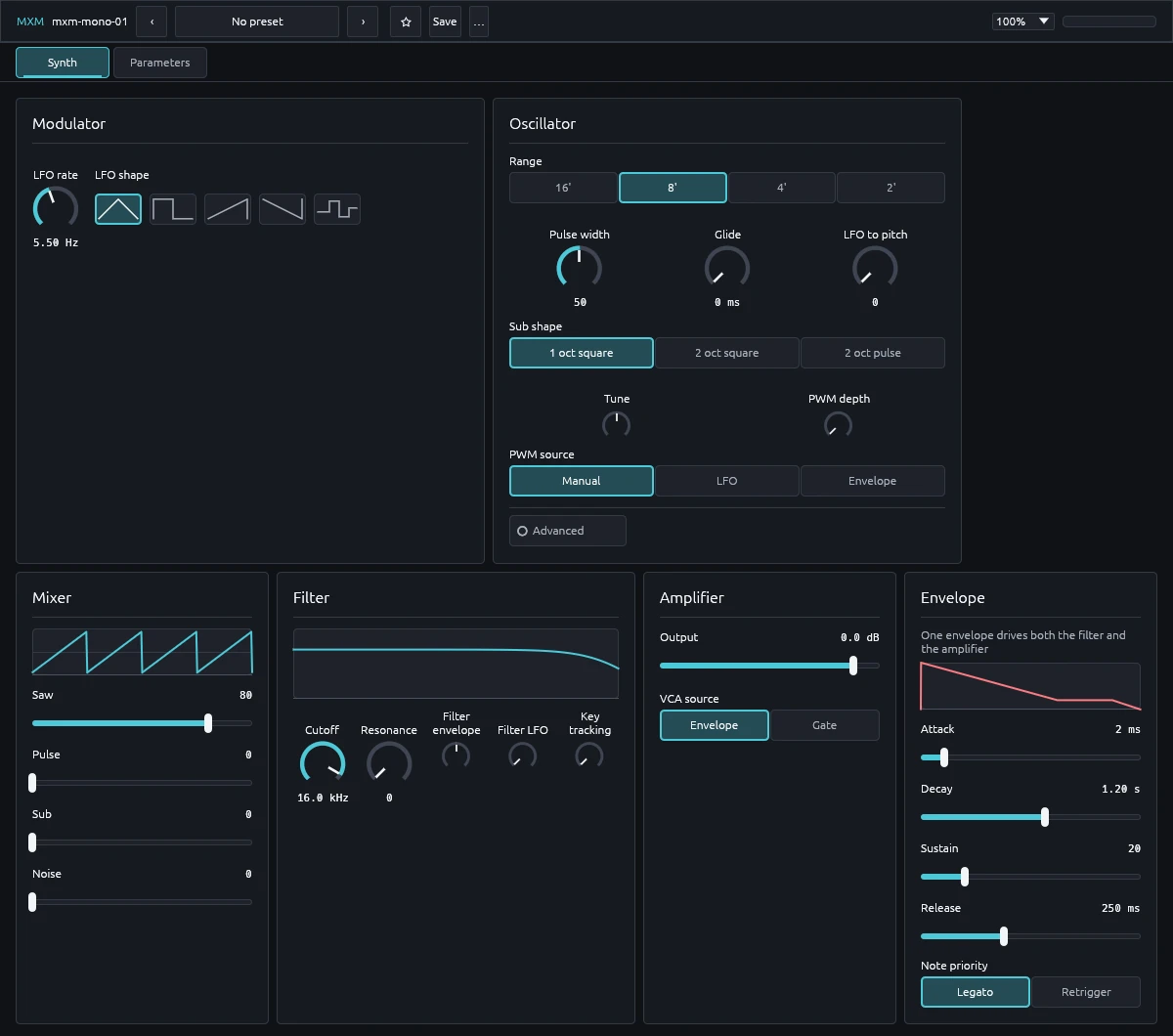
The Synth view: six modules following the signal The Synth view: six modules following the signal
The Synth view: six modules following the signal · click for full size

Oscillator

Range — 16’, 8’, 4’ or 2’, Init 8'

Octave register, in organ footages. 8’ is concert pitch; 16’ is an octave down, 4’ and 2’ one and two octaves up. The register moves the whole voice, so filter settings that suited a bass line will read differently two octaves up unless Key tracking is following.

Tune — −100 … +100 cents, Init 0.0 cents

Fine tuning for the whole instrument, up to a semitone either way. An offset rather than a pitch control: the keyboard still decides the note.

Glide — 0 ms … 2.00 s, Init 0 ms

Portamento time between held notes. Starts at zero, so the instrument does not glide until you ask it to, and then moves smoothly between notes.

How it behaves when notes overlap is decided by Note priority below.

Bend range — 0 … 12 st, Init 2 st

How far pitch bend travels, in semitones. Set once for your setup.

Mixer

Four sources into one filter. The levels are not exclusive — this is a mixer, not a selector — and the panel draws the waveform the four of them make together, which answers questions the level readings alone cannot.

Saw — 0 … 100, Init 80

Sawtooth level. The default patch is one saw through an open filter, so this is the source most patches start from.

Pulse — 0 … 100, Init 0

Pulse level, at whatever width Pulse width and its modulation are producing.

Sub — 0 … 100, Init 0

Sub-oscillator level, at the shape set by Sub shape. Locked to the main oscillator, so it never drifts against it.

Noise — 0 … 100, Init 0

White noise level. A separate source rather than a waveform, so it can be mixed under a pitched sound rather than replacing it.

Pulse width — 5 … 95 %, Init 50 %

The pulse wave’s duty cycle, as a real percentage: 50 % is a square, and the sound thins as it travels either way from there. The range stops short of 0 and 100 because a pulse of zero width is silence.

This is the manual width. It stays where you leave it when you switch PWM source away from Manual, so the modulated width is heard against a width you chose rather than against a reset.

PWM source — Manual, LFO or Envelope, Init Manual

What moves the pulse width. Manual leaves it under the knob; LFO gives the familiar slow beating; Envelope narrows or widens over the course of each note.

Two controls rather than one — source here, amount in PWM depth — which is what keeps the manual width intact while you audition a modulation.

PWM depth — 0 … 100, Init 0

How far the chosen source swings the width either side of the manual setting. At zero the source is selected but does nothing, which is why the width does not jump when you change PWM source.

Sub shape — 1 oct square, 2 oct square or 2 oct pulse, Init 1 oct square

What the sub-oscillator plays. One octave down as a square is the ordinary bass reinforcement; two octaves down is deeper and thinner; the two-octave pulse is the narrow one, which adds weight without filling in as much of the midrange.

Filter

A resonant four-pole low-pass. It loses body as resonance climbs rather than correcting the drop — the loss is the topology.

Cutoff — 20.0 Hz … 20.0 kHz, Init 16.0 kHz

The filter’s corner frequency, in real hertz. Init is almost fully open, so the Init patch is one saw with the filter out of the way.

Resonance — 0 … 100, Init 0

Feedback around the ladder. Bass thins as it rises. From about 90 % the filter is seeded with an inaudible excitation so it can self-oscillate from silence rather than needing a note to start it.

Filter envelope — −100 … +100 (−6 … +6 octaves), Init 0

How far the shared envelope moves the cutoff, and in which direction.

Full scale is six octaves either way, applied multiplicatively, so a given amount means the same musical distance wherever Cutoff sits. Negative amounts close the filter as the envelope rises, which is how you get a sound that opens on release rather than on attack.

Filter LFO — 0 … 100 (0 … 4 octaves), Init 0

How far the LFO moves the cutoff. Full scale is four octaves.

Key tracking — 0 … 100 (0 … 1:1 with the keyboard), Init 0

How much the played note moves the cutoff, pivoting on middle C. At 100 % the cutoff follows the keyboard one octave for one octave, so a patch keeps its brightness as you play up; at 0 % the filter stays where it is set and high notes get progressively duller.

Envelope

One ADSR, reaching both the filter and the amplifier. There is no second envelope, and that is the instrument rather than an omission — decay and release shape tone and articulation together.

Attack — 1 ms … 8.00 s, Init 2 ms

Time to full level. Init is short enough to be percussive without clicking.

Decay — 1 ms … 12.00 s, Init 1.20 s

Time from full level down to the sustain level.

Sustain — 0 … 100, Init 20

The level held while a key is down, as a proportion of full. A level, not a time — it is the only one of the four that is not a duration. At 0 the envelope behaves as attack-decay and the note dies whether or not the key is held.

Release — 1 ms … 12.00 s, Init 250 ms

Time from the sustain level to silence after the key is let go. Because the envelope is shared, this is also how long the filter takes to close, which is why a long release changes the tone of the tail and not only its length.

Modulator

LFO rate — 0.05 … 30.00 Hz, Init 5.50 Hz

The LFO’s speed, in hertz. The bottom of the range is slow enough for a sweep that takes twenty seconds; the top crosses into audio-rate territory.

LFO shape — Triangle, Square, Ramp up, Ramp down or Random, Init Triangle

The LFO’s waveform. Random is a stepped sample-and-hold rather than smooth noise, so it moves in jumps at the LFO rate.

LFO to pitch — 0 … 100 (0 … 7 semitones), Init 0

Vibrato depth. Full scale is seven semitones — a fifth — which is far past vibrato and into sirens; ordinary vibrato lives in the first few percent of the control.

Amplifier

VCA source — Envelope or Gate, Init Envelope

What opens the amplifier. Envelope gives the ADSR its usual job. Gate bypasses the envelope’s amplitude duty entirely and opens the amplifier fully for as long as a key is down, which turns the shared envelope into a filter-only envelope — the nearest this instrument comes to having two.

A change here crossfades over 2 ms rather than switching instantly, so it does not click.

Output — −60.0 … 6.0 dB, Init 0.0 dB

Output level. The range runs 6 dB above unity, so a quiet patch can be brought up without an external gain stage.

Voice

Note priority — Legato or Retrigger, Init Legato

What happens when a new note arrives while another is held. Legato takes the new pitch without restarting the envelope, so overlapping notes glide and phrase into one another. Retrigger starts the envelope again on every note, whether or not the previous one was released.

This is the control that decides whether Glide is heard as a slide or as a series of separate attacks.

The Parameters view

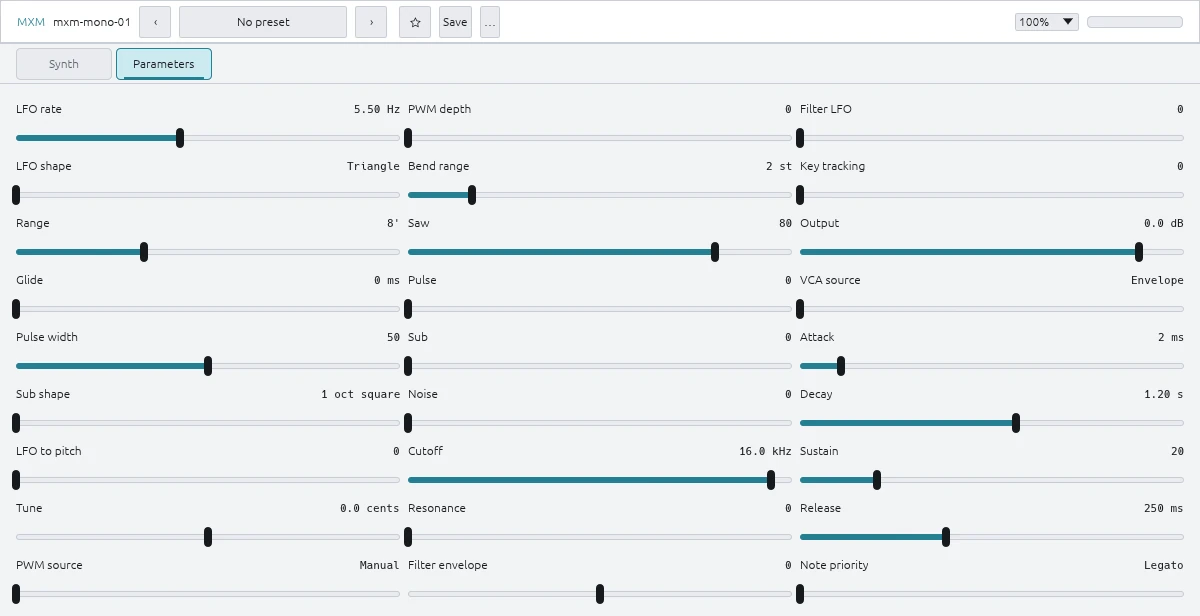
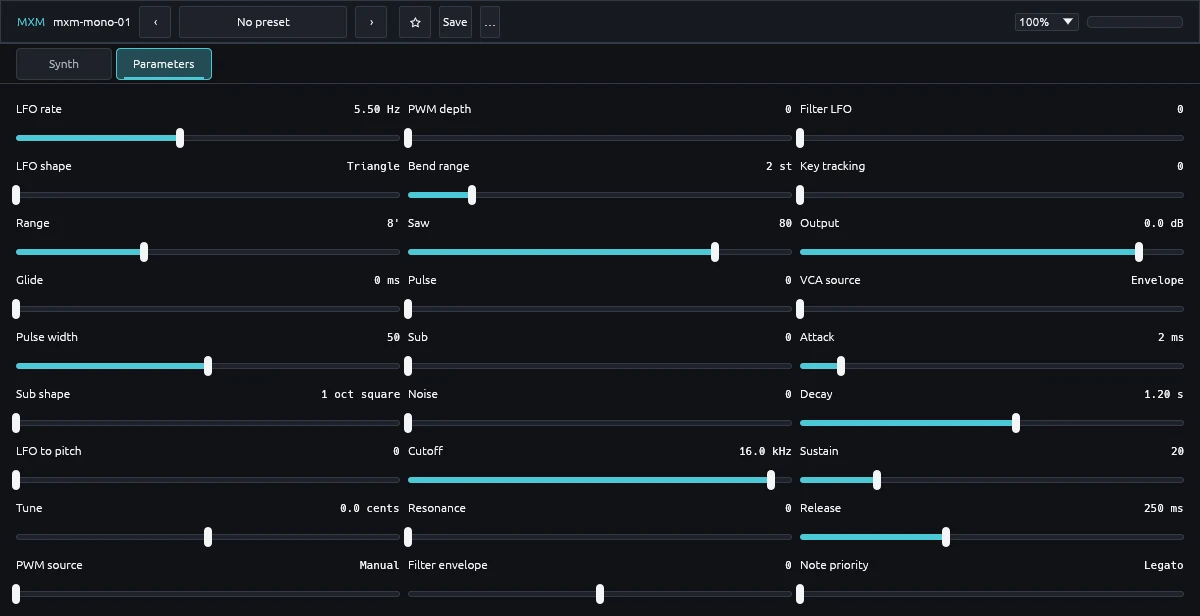
Every control on one page as an editable slider, with direct text entry. It is the same parameters as the panel, laid out for reading and for typing an exact value rather than for playing.

The Parameters view: all 27 controls The Parameters view: all 27 controls
The Parameters view: all 27 controls · click for full size