MXM Modal Synth manual
Source code on GitHub · Questions on Discord
This manual goes through MXM Modal Synth card by card. What every MXM editor shares, such as presets, pages, zoom, themes and the keys, is in Using the MXM editors.

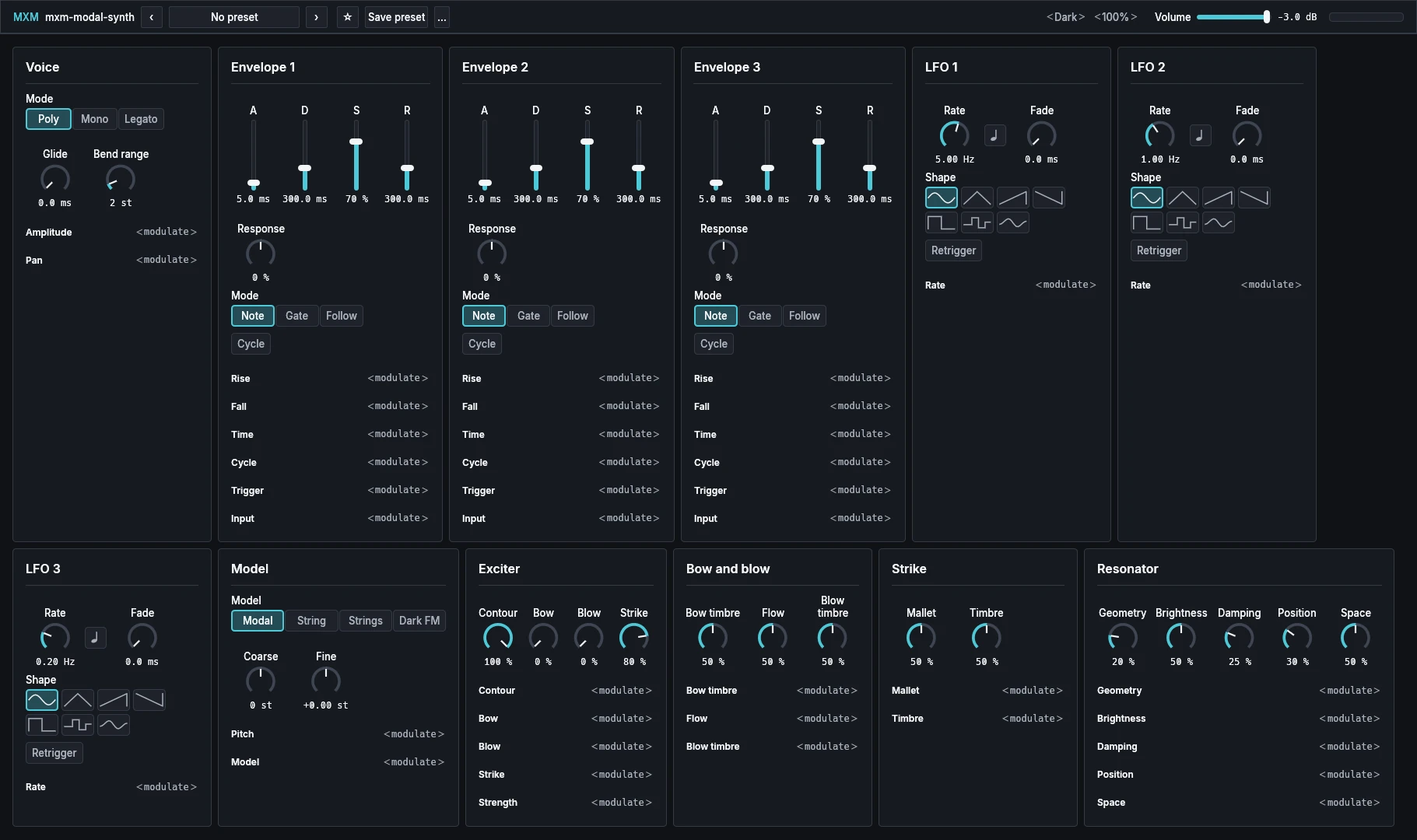
App bar
From the left: the plugin’s name, the preset row, Theme and Scale, Volume, and a level meter.
| Control | Range | Init |
|---|---|---|
| Volume | −60.0 dB to 0.0 dB | −3.0 dB |
Volume is the instrument’s output level and the only control outside the cards. Every factory preset leaves it at −3.0 dB.
Voice
| Control | Range | Init |
|---|---|---|
| Mode | Poly, Mono, Legato | Poly |
| Glide | 0.0 ms to 5.00 s | 0.0 ms |
| Bend range | 0 st to 24 st | 2 st |
Poly plays up to eight notes at once. A new note takes an idle voice, or else the released voice that has sounded longest, or else the held one that has. Mono and Legato play one voice with last-note priority: in Mono each new note starts the sound again, and in Legato a note played over a held one carries on. Changing Mode releases every voice.
Glide is the slide time between notes, and zero turns it off. The slide is exponential, timed to within 1 % of the new note. In Poly a note glides from the last note played, in Mono from wherever the voice is, and in Legato only on a tied note. Bend range is in whole semitones.
The card also has two route lines with no knobs: Amplitude, which scales the voice from silence to double, and Pan.
Envelope 1, 2 and 3
The three cards are the same, and each envelope runs once per voice.
| Control | Range | Init |
|---|---|---|
| A | 0.5 ms to 30.00 s | 5.0 ms |
| D | 0.5 ms to 30.00 s | 300.0 ms |
| S | 0 % to 100 % | 70 % |
| R | 0.5 ms to 30.00 s | 300.0 ms |
| Response | −100 % to 100 % | 0 % |
| Mode | Note, Gate, Follow | Note |
| Cycle | Off, On | Off |
A, D, S and R are attack, decay, sustain and release. Response bends every stage at once: logarithmic below the centre, straight at it, exponential above. No envelope reaches the sound until a route aims it there, and at Init none does. The exciters’ own shape is Contour, on the Exciter card.
Mode decides what starts the envelope. On Note each note starts it and letting go releases it. On Gate its Trigger starts it, it holds while the trigger is high, and it releases when the trigger falls. On Follow it moves towards whatever is routed into its Input, rising at the attack time and falling at the release time, which makes it a lag or a portamento for any signal.
Cycle makes the envelope repeat its attack and decay as a wave of its own, skipping the sustain and turning at 0.8 of full level. In Gate mode it cycles while Cycle is on or its Cycle target is high, and in Follow mode Cycle does nothing. A rising trigger during the decay, sustain or release restarts the attack from wherever the envelope is. During the attack it is ignored.
Each card has six route lines. Rise moves the attack time, Fall the decay and release times, and Time all of them together. Cycle and Trigger are the gates that make it cycle or start it, and Input is what it follows.
LFO 1, 2 and 3
| Control | Range | Init |
|---|---|---|
| Rate | 0.01 Hz to 50.00 Hz | 5.00 Hz, 1.00 Hz, 0.20 Hz |
| Sync | Off, On | Off |
| Fade | 0.0 ms to 10.00 s | 0.0 ms |
| Shape | Sine, Triangle, Saw up, Saw down, Square, Sample and hold, Smooth random | Sine |
| Retrigger | Off, On | Off |
The three cards differ only in their Init rates: a vibrato, a slow sweep and a drift. Sync is the note symbol beside Rate. With Sync on and a host tempo, Rate reads a note length from 4 bars to 1/32, the fastest at the top. Without a host tempo the free rate stands. Fade brings the LFO in after each note, its depth rising in a straight line from zero. The shapes are drawn as pictures; Sample and hold takes a new random value every cycle, and Smooth random glides from one random value to the next.
With Retrigger on, each voice has its own LFO, started again with each new note. With it off, one free-running LFO serves every voice, and its Rate can only be moved by shared sources: Wheel, Pressure, Bend and the other shared LFOs. Each card has one route line, Rate.
Model
| Control | Range | Init |
|---|---|---|
| Model | Modal, String, Strings, Dark FM | Modal |
| Coarse | −36 st to +36 st | 0 st |
| Fine | −2.00 st to +2.00 st | +0.00 st |
Model chooses what the exciters play into. Modal rings with the modes of a bar, a plate or a bell. String is one string, plucked, bowed or blown. Strings is five strings tuned to a chord, which Geometry chooses. Dark FM is a dark pair of FM voices that the exciters’ controls shape. A note keeps the model that was set when it started.
Coarse transposes the voice by up to three octaves either way, and Fine by up to two semitones.
Pitch and Model take routes. One route on Model reaches every model from any other, and the model is picked again for each note.
Exciter
| Control | Range | Init |
|---|---|---|
| Contour | 0 % to 100 % | 100 % |
| Bow | 0 % to 100 % | 0 % |
| Blow | 0 % to 100 % | 0 % |
| Strike | 0 % to 100 % | 80 % |
Bow, Blow and Strike are the levels of the three exciters, and they can play together. Bow is how hard the bow presses on the resonator. On the modal resonator it has a threshold: silent at 30 %, full near 50 %. Blow is how much breath goes in, and above about two thirds a reed tube joins in. Strike is how hard the resonator is struck, and turned high you hear the strike itself as well. Contour shapes the bow and the breath, from a short pluck through a swell to a held note.
The route lines are Contour, Bow, Blow, Strike and Strength. Strength has no knob. It is the accent of all three exciters, resting at its middle, 0 dB, and moved only by routes. The Dark FM voice ignores it once its envelope reaches the sustain.
Bow and blow
| Control | Range | Init |
|---|---|---|
| Bow timbre | 0 % to 100 % | 50 % |
| Flow | 0 % to 100 % | 50 % |
| Blow timbre | 0 % to 100 % | 50 % |
Bow timbre is the bow’s grain, smooth at the bottom and scratchy at the top. Flow is how the breath moves, a steady stream low down, gusts and sputters higher up. Blow timbre is the breath’s colour, dark at the bottom and hissing at the top. All three take routes.
Strike
| Control | Range | Init |
|---|---|---|
| Mallet | 0 % to 100 % | 50 % |
| Timbre | 0 % to 100 % | 50 % |
Mallet chooses what strikes the resonator. Below 40 % it sweeps through nine recorded hits. From 40 % to 60 % it is a mallet, from 60 % to 80 % a plectrum, which strikes twice, and above 80 % a shower of particles, which can keep a held string sounding. Timbre is the strike’s brightness, a soft thud at the bottom and a hard click at the top. Both take routes.
Resonator
| Control | Range | Init |
|---|---|---|
| Geometry | 0 % to 100 % | 20 % |
| Brightness | 0 % to 100 % | 50 % |
| Damping | 0 % to 100 % | 25 % |
| Position | 0 % to 100 % | 30 % |
| Space | 0 % to 100 % | 50 % |
Geometry is the resonator’s shape. On Modal it moves from a stretched string through bars and plates to bells. On String, Geometry at 0 makes the bridge buzz. On Dark FM it is the filter’s mode, low-pass below the half. On Strings it picks one of eleven chords, changing every 10 %:
| Geometry | Chord |
|---|---|
| 0 % | Octaves |
| 10 % | Minor seventh |
| 20 % | Minor |
| 30 % | Minor ninth |
| 40 % | Minor eleventh |
| 50 % | Fifths |
| 60 % | Major eleventh |
| 70 % | Major ninth |
| 80 % | Major |
| 90 % | Major seventh |
| 100 % | Suspended fourth |
Brightness is how bright the resonator rings, Damping how long, and Position where it is struck and heard, from the edge to the middle. With Damping at the top a string never dies away; the instrument ends it 30 seconds after you let go.
Space is the room. At the bottom you hear the dry exciter on the left, then a widening stereo image, then a reverb that grows at the top. There is one reverb for all voices, following the Space of the newest voice. The knob stops at 100 %, but a route reaches 200 % either way, and an envelope that carries Space past 175 % freezes the reverb while the key is held.
All five take routes.
Routes
Sixteen route slots connect 19 sources to 40 targets. There is no routing page: each target has a line on the card of the control it moves, and that line offers ‹ modulate ›. At Init no slot is in use.

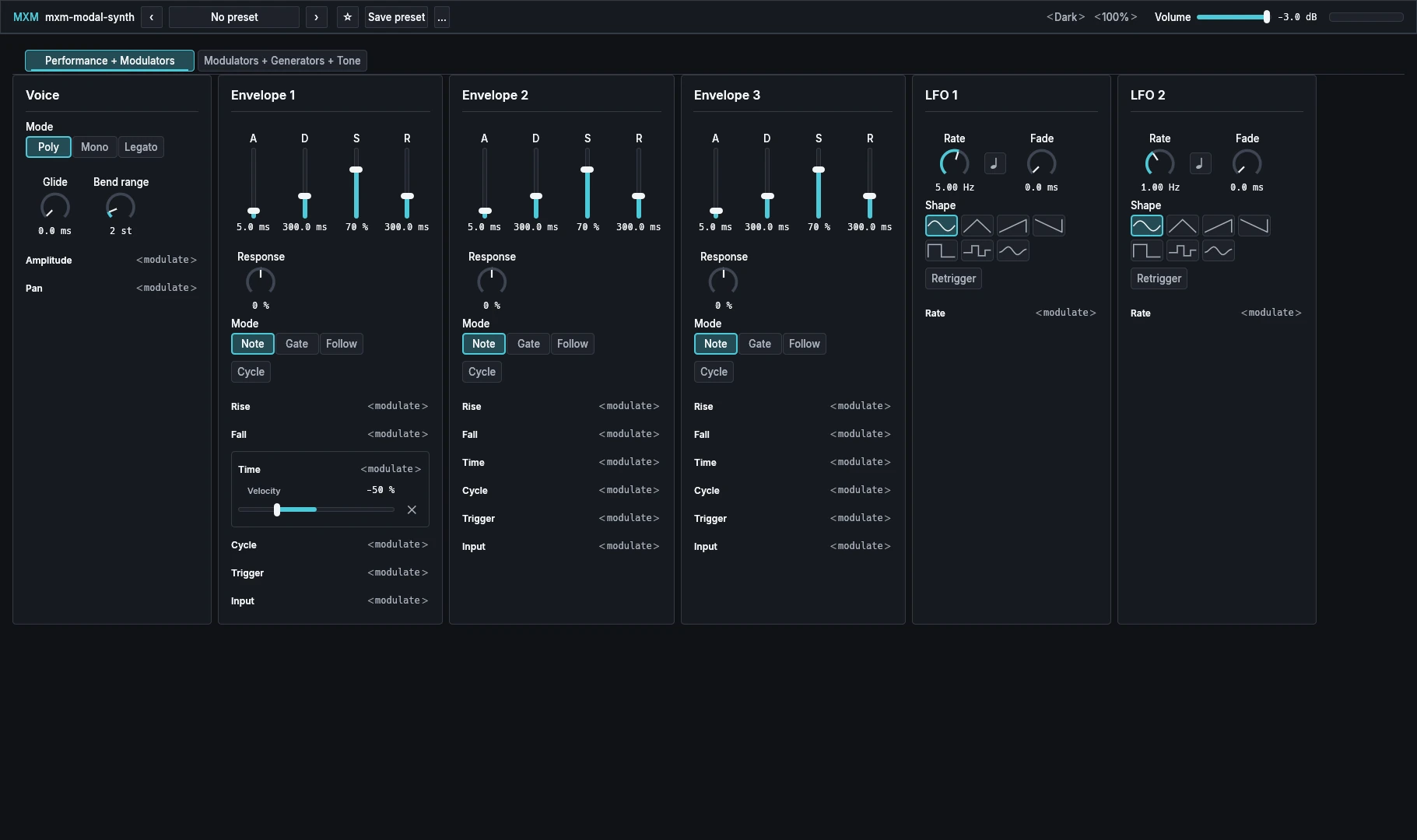
Choose a source and it takes a free slot, the one this target had before if there is one, so a removed source comes back at its old depth. The route appears as a row named after its source, with an amount slider and a ×. The × switches the source off and keeps the depth. ‹ modulate › only offers sources not yet on that target. When all sixteen slots are in use, every line reads all 16 in use until you remove a route.

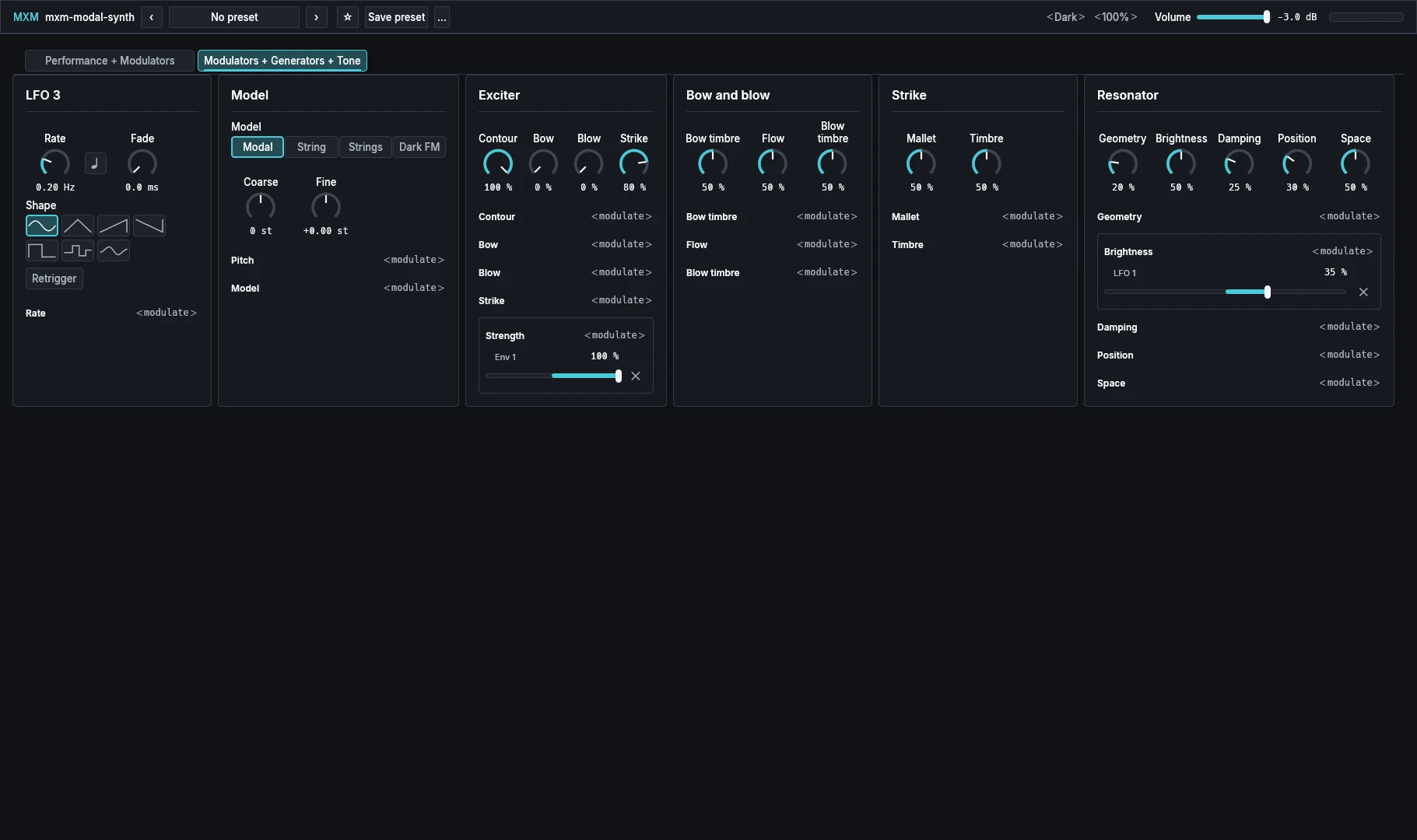
The sources are:
- Env 1, Env 2 and Env 3, from 0 to 1
- a rise end and a cycle end for each envelope: gates, the first high from the end of the attack until the envelope rests or attacks again, the second its opposite
- LFO 1, LFO 2 and LFO 3, from −1 to 1
- Contour, the voice’s own exciter envelope (on Dark FM, that voice’s envelope)
- Key, the note after glide, measured from middle C
- Velocity, measured down from the hardest note
- Wheel (CC 1) and Pressure (channel pressure), from 0 to 1, and Bend, from −1 to 1
- Random, a new value for each note
| Card | Targets |
|---|---|
| Voice | Amplitude, Pan |
| Envelope 1, 2 and 3 | Rise, Fall, Time, Cycle, Trigger, Input |
| LFO 1, 2 and 3 | Rate |
| Model | Pitch, Model |
| Exciter | Contour, Bow, Blow, Strike, Strength |
| Bow and blow | Bow timbre, Flow, Blow timbre |
| Strike | Mallet, Timbre |
| Resonator | Geometry, Brightness, Damping, Position, Space |
Amounts run from −100 % to 100 % of the target’s reach:
| Target | Full reach |
|---|---|
| Pitch | ±12 st |
| Model | ±3 models, enough to reach every model from any |
| Space | ±200 %, past the freeze |
| Amplitude | from silence to double |
| Rate | ±4 octaves |
| Time | 16 times shorter or longer; positive shortens |
| Rise, Fall | the whole range, 0.5 ms to 30 s; positive slows |
| Everything else | the whole range |
Key routes reach per octave. An amount of 100 % on Rise or Fall adds 30 seconds, so for small changes use Time. Cycle and Trigger are high while the routes on them add up to more than half. Only the envelopes, their gates, the LFOs and Contour can drive them. Two slots with the same source and target add up. A loop, such as an envelope triggering itself, runs one 0.5 ms step late and behaves the same way every time.
Playing notes
The voices run at 32 kHz inside, and a converter takes them to the host’s rate, so nothing in the sound goes above about 14.4 kHz. At 32 kHz there is no latency. At other rates the latency is fixed and reported to the host: 100 samples at 44.1 kHz, 108 at 48 kHz, 216 at 96 kHz and 432 at 192 kHz.
MXM Modal Synth answers notes with velocity, pitch bend, the mod wheel (CC 1), channel pressure and, in a CLAP host, per-note tuning. MIDI CC 120 cuts every note at once, and CC 123 releases every held key. There is no audio input.
A resonator, a cycling envelope or the reverb’s tail can sound with no key held, so the instrument keeps running while anything sounds. A released note always ends 30 seconds after its key went up.
A few things are kept as the original has them: its 16-bit output, and one soft limit in the resonators, in which held chords of bowed or blown sounds flatten. The Dark FM voice also drones while its note is held with Space under about 10 %, a drone that fades out over 10 ms once the voice has gone quiet.