MXM Grain FX manual
Source code on GitHub · Questions on Discord
This manual goes through MXM Grain FX card by card. What every MXM editor shares, such as presets, pages, zoom, themes and the keys, is in Using the MXM editors.

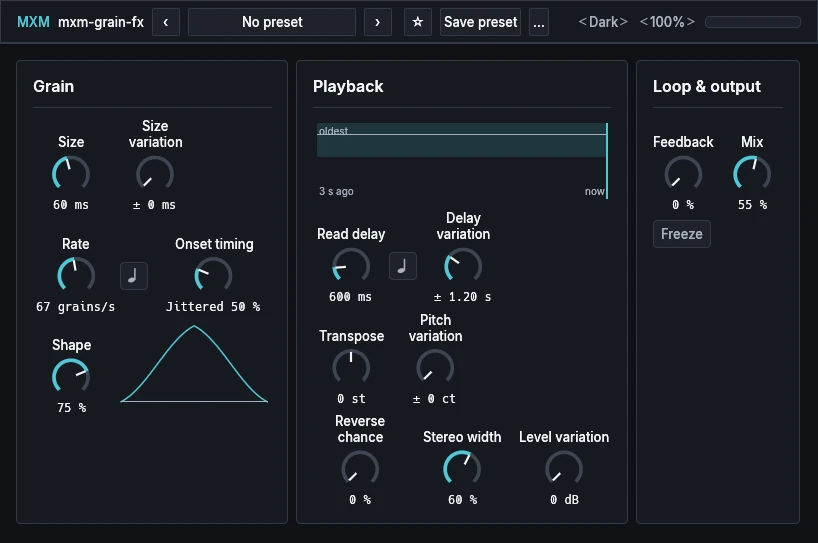
The effect records its input all the time into a buffer four seconds long. Grains are short, windowed reads of that recording, scattered in time and added back over the dry sound. Each grain is given its own length, position, pitch, direction, window and place in the stereo field when it starts, and keeps them until it ends. Every control that varies grains sits beside the property it varies.
App bar
Nothing beyond the shared preset row, Theme, Scale and a level meter. There are no factory presets yet, so the browser holds only Init. Mix is on the Loop & output card.
Grain
| Control | Range | Init |
|---|---|---|
| Size | 2 ms to 500 ms | 60 ms |
| Size variation | ± 0 ms to ± 249 ms | ± 0 ms |
| Rate | 0.5 grains/s to 500 grains/s | 67 grains/s |
| Rate sync | Off, On | Off |
| Onset timing | Regular to Random | Jittered 50 % |
| Shape | 0 % (Hard) to 100 % (Smooth) | 75 % |
This card is what one grain is and when grains start.
Size is how long each grain is (a host lists Size, Rate and Shape as Grain size, Grain rate and Grain shape). Short grains buzz, middle ones blend into a texture, and long ones, past about 100 ms, are heard one by one. Size variation scatters the length either side of Size, for a looser texture.
Rate is how many grains start each second. It is independent of Size: how much the grains overlap is the size times the rate, so a longer grain at the same rate overlaps more. Rate sync is the note symbol beside the knob. With it on and a tempo from the host, the knob picks a note length from 1/64 to a whole note, the top the fastest.
Onset timing is how irregularly the grains start. Its reading names the stretch of the knob you are in. At the bottom, Regular, the grains start on a strict clock. Turning up, Jittered moves each start further around inside its own slot. Then Handed over passes the starts to a random draw that leaves some slots empty and doubles up in others, until at the top it reads Random. Init is Jittered 50 %.
Shape is the window of each grain, from clicky to smooth. Hard, at 0 %, is close to a rectangle and sounds brighter, 50 % is a triangle, and Smooth, at 100 %, a soft bell curve. The drawing beside it is the grain’s window as the effect uses it.
Playback
| Control | Range | Init |
|---|---|---|
| Read delay | 0 ms to 4.00 s | 600 ms |
| Read delay sync | Off, On | Off |
| Delay variation | ± 0 ms to ± 4.00 s | ± 1.20 s |
| Transpose | −24 st to +24 st | 0 st |
| Pitch variation | ± 0 ct to ± 24.0 st | ± 0 ct |
| Reverse chance | 0 % to 100 % | 0 % |
| Stereo width | 0 % to 100 % | 60 % |
| Level variation | 0 dB to “0 to −12.0 dB” | 0 dB |
This card is where the grains read from and how much each differs from the last.
The timeline at the top is the recording, with now at the right edge, where the sound comes in, and older sound to the left. The marks are the starts of the grains actually playing. Its captions assume a 48 kHz sample rate; at other rates only the labels are off.
Read delay is how far back in time the grains read. Read delay sync, the note symbol beside it, picks a note length from 1/64 to 2 bars, the top the longest, and the timeline’s read line follows it. Delay variation scatters where each grain reads from, for a thicker cloud. It starts at ±1.20 s because with every variation at zero the effect is a plain delay.
Transpose shifts the grains in semitones. A grain keeps the pitch it started with, so sweeping Transpose steps rather than glides. Pitch variation scatters each grain’s pitch. The knob gives a few cents of detune room near the bottom, for a chorus, and reaches two octaves either way for a cloud. It reads in cents below a semitone and in semitones above.
Reverse chance is how often a grain plays backwards. Stereo width spreads the grains across the stereo field; it starts at 60 % for the same reason as Delay variation. Level variation scatters how loud each grain is. At the bottom every grain is at full level, and at the top each falls somewhere from 0 dB to −12 dB.
Loop & output
| Control | Range | Init |
|---|---|---|
| Feedback | 0 % to 100 % | 0 % |
| Mix | 0 % to 100 % | 55 % |
| Freeze | Off, On | Off |
Feedback sends the grains back into the recording, so each pass is scattered again. The loop has a saturator, and a low cut whose corner rises with the amount.
Mix is the balance of dry sound and grains. At zero the effect is off: the grains fade to nothing, the output is the dry sound to the bit, and the recording and the grains are emptied. Turning Mix up again starts from an empty recording and fades in.
Freeze stops the recording, so the grains keep playing what is held. Feedback is faded out while it is on, and the dry sound still passes. Switch it off and the recording takes in new sound again.
Tempo, tail and hosts
Rate and Read delay follow the host’s tempo only through their note symbols, and only when the host sends a tempo. While the grains die away after the input stops, the effect tells the host how long it has left. A texture that keeps going is reported as still playing. The effect runs at sample rates from 1 kHz to 768 kHz. There is no MIDI input.