MXM FX Oldify manual
Source code on GitHub · Questions on Discord
This manual goes through MXM FX Oldify card by card. What every MXM editor shares, such as presets, pages, zoom, themes and the keys, is in Using the MXM editors.

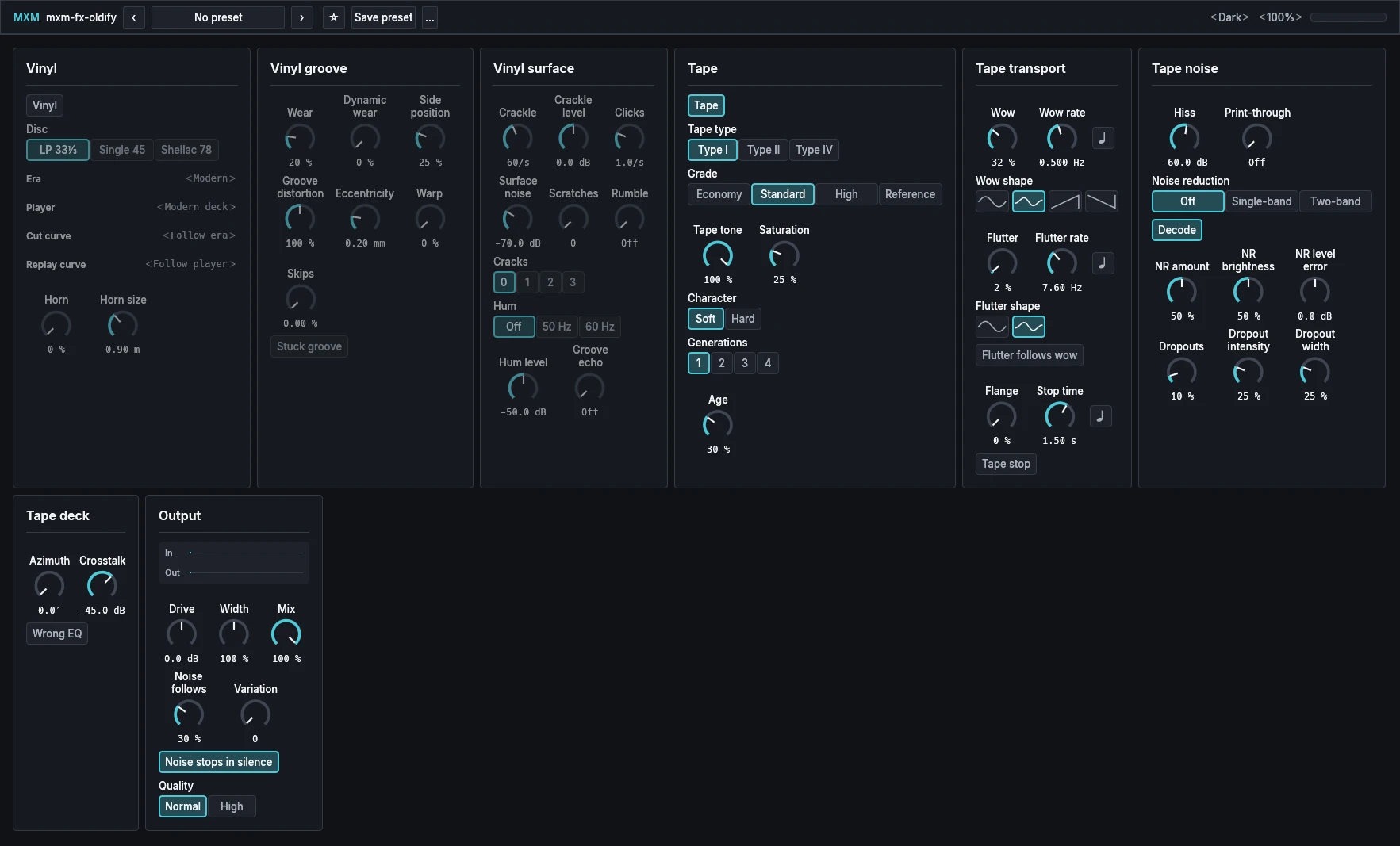
The three Vinyl cards make an old record, the four Tape cards a cassette, and with both switched on the record is taped onto a cassette. A half that is switched off is dimmed, but you can set it up before switching it on.
App bar
Nothing beyond the shared preset row, Theme, Scale and a level meter whose clip light stays on until you click it. The effect has no output level: it ends in Mix, on the Output card.
Vinyl
| Control | Range | Init |
|---|---|---|
| Vinyl | Off, On | Off |
| Disc | LP 33⅓, Single 45, Shellac 78 | LP 33⅓ |
| Era | Nine eras (below) | Modern |
| Player | Seven players (below) | Modern deck |
| Cut curve | Follow era, Flat, UK 78, UK 78 with treble lift, US 78, Early LP, Early 45, Transcription, West Coast LP, Standard | Follow era |
| Replay curve | Follow player, Flat, then the same curves as Cut curve | Follow player |
| Horn | 0 % to 100 % | 0 % |
| Horn size | 0.57 m to 1.50 m | 0.90 m |
Vinyl plays the sound as an old record, vinyl or shellac. Disc is the record’s speed and size: a long-player at 33⅓, a seven-inch single at 45 or a shellac disc at 78.
Era is when the record was cut, and so how it was recorded and cut:
| Era | What it is |
|---|---|
| Acoustic | Before 1925: cut through a horn, about 250 Hz to 2.5 kHz |
| Early electrical | 1925 to 1935: the first microphones, a ringing top near 4.5 kHz |
| US 78, 1940s | The top cut sharply at 8.5 kHz, the peaks held down |
| UK 78, 1940s | Wider, to about 12 kHz, the peaks left alone |
| Late 78 | The 1950s, cut to about 14 kHz |
| Early single | The first 45s, 1949 to 1952: bright, the peaks held down |
| Early LP | 1948 to 1954, before one curve was agreed |
| Mono LP | 1955 to 1958 on the standard curve, nearly full range |
| Modern | From stereo on: full range, nothing added by the cut |
Player is what the record is played on:
| Player | What it is |
|---|---|
| Wind-up gramophone | A steel needle, a soundbox and a horn, nothing electrical |
| Radiogram | 1940s: crystal pickup, scratch filter, valves, cabinet speaker |
| Jukebox | 1949: heavy pickup, push-pull valves, big speaker |
| Portable | 1950s: crystal pickup, valves, small speaker |
| Mono hi-fi | 1955: magnetic pickup, good speaker |
| On the radio | 1940s: the station’s turntable, the broadcast, a table radio |
| Modern deck | A fine cartridge, adding nothing of its own |
Cut curve is the treble and bass curve the record was cut with, and Replay curve the one it is played back with. By default they follow the Era and the Player. A replay curve different from the cut tilts the sound. Standard is the curve every record has used since the mid-1950s.
Horn is how much of the sound went through acoustic horns, into the record and out of the gramophone: thin, honky and tinny. It works with any era and player. Horn size is the horn’s length. A short one honks higher and sounds more tinny, a long one fuller.
Vinyl groove
| Control | Range | Init |
|---|---|---|
| Wear | 0 % to 100 % | 20 % |
| Dynamic wear | 0 % to 100 % | 0 % |
| Side position | 0 % to 100 % | 25 % |
| Groove distortion | 0 % to 200 % | 100 % |
| Eccentricity | 0.00 mm to 5.00 mm | 0.20 mm |
| Warp | 0 % to 200 % | 0 % |
| Skips | 0.00 % to 100 % | 0.00 % |
| Stuck groove | Off, On | Off |
Wear dulls the top and adds distortion and surface noise. Dynamic wear wears the loud passages more, so loud bass and sharp treble go gritty and dull. Side position is where the needle is on the side; the inner grooves are duller and more distorted. Groove distortion is how much the needle distorts as it traces the groove, with 100 % what the groove itself gives.
Eccentricity puts the hole off centre, so the pitch sways once a turn. Past about 2.5 mm it sways further than any real record. Warp makes the pitch lurch once a turn and the level dip with it. Real warps sit low on the knob; 100 % is a measured full warp.
Skips is the chance, per turn, that the stylus jumps back a groove, plays the last turn again and jumps on. Real records skip a few times in a hundred turns at most. Stuck groove plays the last turn round and round while it is on; off, the stylus jumps on to where the record has got to.
Vinyl surface
| Control | Range | Init |
|---|---|---|
| Crackle | 0.0/s to 2000/s | 60/s |
| Crackle level | −24.0 dB to +24.0 dB | 0.0 dB |
| Clicks | 0.0/s to 50/s | 1.0/s |
| Surface noise | Off (−80 dB) to −15.0 dB | −70.0 dB |
| Scratches | 0 to 8 | 0 |
| Rumble | Off (−80 dB) to −35.0 dB | Off |
| Cracks | 0, 1, 2, 3 | 0 |
| Hum | Off, 50 Hz, 60 Hz | Off |
| Hum level | Off (−80 dB) to −20.0 dB | −50.0 dB |
| Groove echo | Off (−80 dB) to −12.0 dB | Off |
Crackle is how many tiny crackles come a second, and Crackle level how loud each is, with 0 dB a typical record’s. Clicks are louder, from dust in the groove. Surface noise is the disc’s own hiss and roar.
Scratches and Cracks are counted. Each ticks or pops once a turn for half a minute to a minute, then the next turns up elsewhere.
Rumble is the turntable’s low rumble. Hum is mains hum at 50 Hz, as in Europe, or 60 Hz, as in America, and Hum level sets how loud. Its Init level is ready to be heard as soon as you switch Hum on. Groove echo is a faint ghost of the music a turn later, mostly its bass, heard in the quiet after a loud passage. Real records sit low on the knob.
Tape
| Control | Range | Init |
|---|---|---|
| Tape | Off, On | On |
| Tape type | Type I, Type II, Type IV | Type I |
| Grade | Economy, Standard, High, Reference | Standard |
| Tape tone | 0 % to 100 % | 100 % |
| Saturation | 0 % to 100 % | 25 % |
| Character | Soft, Hard | Soft |
| Generations | 1, 2, 3, 4 | 1 |
| Age | 0 % to 100 % | 30 % |
Tape switches the cassette half on, as at Init. Tape type is the kind of tape: Type I is ferric, warm with a soft top; Type II is chrome, brighter with less hiss; Type IV is metal, the brightest and cleanest. Grade is how good the tape and the deck are, from cheap to the best there was. Tape tone is how much of the tape’s own tone you hear.
Saturation is how hard the tape is pushed into distortion. Character is how it distorts: Soft rounds the peaks off, Hard clips them. Generations is how many times the tape has been copied, each copy adding hiss, wobble and dullness. Age is how worn it is; older loses more top.
Tape transport
| Control | Range | Init |
|---|---|---|
| Wow | 0 % to 100 % | 32 % |
| Wow rate | 0.100 Hz to 5.00 Hz | 0.500 Hz |
| Wow sync | Off, On | Off |
| Wow shape | Sine, Random, Saw, Reverse saw | Random |
| Flutter | 0 % to 100 % | 2 % |
| Flutter rate | 4.00 Hz to 30.00 Hz | 7.60 Hz |
| Flutter sync | Off, On | Off |
| Flutter shape | Sine, Random | Random |
| Flutter follows wow | Off, On | Off |
| Flange | 0 % to 100 % | 0 % |
| Stop time | 50 ms to 10.00 s | 1.50 s |
| Stop sync | Off, On | Off |
| Tape stop | Off, On | Off |
Wow is a slow drift of the pitch, as an uneven tape speed gives, and Flutter a fast tremble that roughens the sound. The top of either is already more than a real tape does. Wow shape is drawn as four waves: Sine drifts evenly, Random wanders and holds a pitch before stepping to another, Saw sags slowly flat and catches up quickly, Reverse saw creeps sharp and drops back quickly. Flutter has Sine and Random. Flutter follows wow stops the wow from moving the pitch itself, and has it speed the flutter up and slow it down instead, as a slipping belt does.
The note symbols beside Wow rate, Flutter rate and Stop time lock them to the host’s tempo: Wow rate from 4 bars to 1/8, Flutter rate from 1/8 to 1/32 triplets, Stop time from 1/32 to 4 bars.
Flange blends in a steady copy of the tape, for the sweep of two tapes running side by side. Tape stop slows the tape to a halt over Stop time and keeps it stopped while it is on. Switch it off and the tape starts again.
Tape noise
| Control | Range | Init |
|---|---|---|
| Hiss | Off (−96 dB) to −30.0 dB | −60.0 dB |
| Print-through | Off (−80 dB) to −12.0 dB | Off |
| Noise reduction | Off, Single-band, Two-band | Off |
| Decode | Off, On | On |
| NR amount | 0 % to 100 % | 50 % |
| NR brightness | 0 % to 100 % | 50 % |
| NR level error | −6.0 dB to +6.0 dB | 0.0 dB |
| Dropouts | 0 % to 100 % | 10 % |
| Dropout intensity | 0 % to 100 % | 25 % |
| Dropout width | 0 % to 100 % | 25 % |
Hiss is the tape’s own hiss. Print-through is a faint, muffled ghost of the music a couple of seconds later, printed from the tape wound next to it on the reel.
Noise reduction lifts quiet treble on the way onto the tape and takes it back off on the way out, which lowers the hiss. Single-band works on the treble; Two-band reaches lower, for about twice the reduction. Switch Decode off to hear the tape without its decoder: brighter, compressed, and breathing on quiet passages. NR amount is how much is lifted and taken back, with 50 % the usual 10 dB of the period. NR brightness moves where its band begins, between about 1 and 6 kHz. NR level error sets the playback level off from the recording’s, so the treble pumps and the hiss breathes with the music.
Dropouts is how often the tape briefly loses the head. Dropout intensity trades many shallow dropouts for fewer, deeper ones, and Dropout width sets how differently they hit left and right.
Tape deck
| Control | Range | Init |
|---|---|---|
| Azimuth | 0.0′ to 60.0′ | 0.0′ |
| Crosstalk | Off (−80 dB) to −30.0 dB | −45.0 dB |
| Wrong EQ | Off, On | Off |
Azimuth tilts the playback head, in minutes of arc, with 15′ at the middle of the knob. It dulls the top, and more so in mono. Crosstalk is how much each side leaks into the other. Wrong EQ plays the tape back with the wrong treble setting, too bright or too dull.
Output
| Control | Range | Init |
|---|---|---|
| Drive | −24.0 dB to +24.0 dB | 0.0 dB |
| Width | 0 % to 200 % | 100 % |
| Mix | 0 % to 100 % | 100 % |
| Noise follows | 0 % to 100 % | 30 % |
| Variation | 0 to 9999 | 0 |
| Noise stops in silence | Off, On | On |
| Quality | Normal, High | Normal |
The display at the top shows the In and Out levels.
Drive is how hard the sound goes onto the tape. It is taken back out afterwards, so more drive distorts more and buries the hiss without getting louder. Width runs from mono at 0 % to twice as wide at 200 %. Mix is the balance of the dry sound and the aged one, and at zero the effect is off. The effect has a fixed latency of about 41 ms, reported to the host, and Mix blends against the dry sound delayed to match.
Noise follows is how far the noise rises with loud passages and falls with quiet ones. Variation picks another take of the wobble, hiss, dropouts and crackle; the same number always sounds the same. Noise stops in silence stops the noise a couple of seconds after the sound does, never in the gaps between hits, so the host can rest the effect. Off, the noise plays on in silence.
Quality is how hard the effect works. Normal runs light, with the tape’s saturation at twice the sample rate. High saturates at four times the rate and reads the moving tape and record more finely, for cleaner treble, at more CPU. Loading a factory preset keeps your Mix and Quality.