MXM FX Delay manual
Source code on GitHub · Questions on Discord
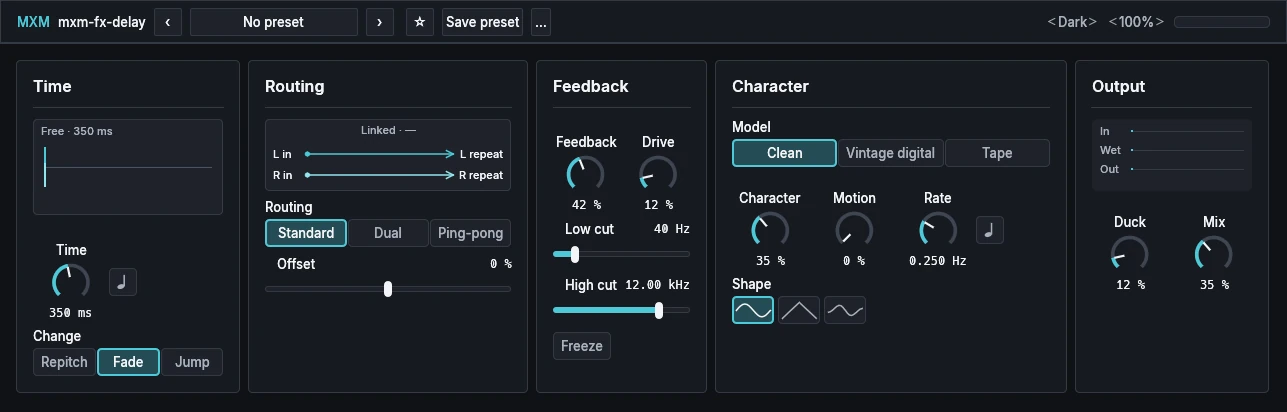
This manual goes through MXM FX Delay card by card. What every MXM editor shares, such as presets, pages, zoom, themes and the keys, is in Using the MXM editors. All five cards are on one page at the opening size, and every control is on a card: nothing hides behind an Advanced button.

App bar
Nothing beyond the shared preset row, Theme, Scale and a level meter whose clip light stays on until you click it. Mix and Duck are on the Output card.
Time
| Control | Range | Init |
|---|---|---|
| Time | 5 ms to 8.00 s | 350 ms |
| Time sync | Off, On | Off |
| Change | Repitch, Fade, Jump | Fade |
Time is the delay time. Time sync is the note button beside it. With sync on, the knob picks a note length of the host’s tempo instead: 1/64, 1/32T, 1/32, 1/16T, 1/16, 1/8T, 1/16., 1/8, 1/4T, 1/8., 1/4, 1/4., 1/2 or 1/1. A length that falls outside 5 ms to 8 s at the current tempo is held at the nearest end. With no tempo from the host, Time uses its free value, and it never guesses a tempo or keeps an old one.
Change decides what the echoes do when the time changes, by the knob or by a new tempo. Repitch bends their pitch, like tape. Fade crossfades smoothly to the new time. Jump goes straight there, without a click.
The timeline at the top of the card shows the left and right repeat times and the motion around them. Its caption reads “Free · 350 ms” at Init. Synced, it gives the note length and the time it works out to, such as “1/8 · 250 ms”, or “No tempo” when the host has none. While Freeze holds, it reads Held.
Routing
| Control | Range | Init |
|---|---|---|
| Routing | Standard, Dual, Ping-pong | Standard |
| Offset | −100 % to +100 % | 0 % |
Routing decides how the echoes sit in stereo. Standard is one delay that keeps the source’s stereo picture; a mono source stays in the centre. Dual gives left and right their own times, and Offset spreads them apart. Ping-pong bounces the echoes between left and right, starting on the left. Offset only does something in Dual.
The diagram above the buttons draws the paths from L in and R in to L repeat and R repeat. Its caption reads Linked for Standard, Separate with the two times for Dual, and Cross-feedback for Ping-pong.
Feedback
| Control | Range | Init |
|---|---|---|
| Feedback | 0 % to 100 % | 42 % |
| Drive | 0 % to 100 % | 12 % |
| Low cut | 10 Hz to 8.00 kHz | 40 Hz |
| High cut | 200 Hz to 20.00 kHz | 12.00 kHz |
| Freeze | Off, On | Off |
Feedback is how many times the echoes repeat. It reaches unity near the top of its travel, and above that the echoes build up on their own, with a saturator keeping them in bounds. Drive saturates every repeat. Low cut and High cut take low and high end out of every repeat. All three sit inside the loop, so they act again on each pass and shape what is fed back as well as what you hear.
Freeze holds the echoes already in the line and repeats them for as long as it is on, letting no new sound in. It first takes in one full round, one lap in Standard and Dual, or left, right and back to left in Ping-pong, and then holds it without wearing it any further: filtering, drive, wear and random variation are all bypassed while it holds. If the line is empty, Freeze waits for sound before it takes its round. Changing the model while frozen leaves the held echoes alone; changing Routing replaces them.
Character
| Control | Range | Init |
|---|---|---|
| Model | Clean, Vintage digital, Tape | Clean |
| Character | 0 % to 100 % | 35 % |
| Motion | 0 % to 100 % | 0 % |
| Rate | 0.010 Hz to 20.00 Hz | 0.250 Hz |
| Rate sync | Off, On | Off |
| Shape | Sine, Triangle, Random | Sine |
Model is the delay’s character. Clean gives clear, full-range echoes. Vintage digital gives the grainy, darker sound of early digital delays: a fixed memory read by a clock that changes speed, so range, conversion and bandwidth are tied together. Tape gives warm, softened echoes that waver: a moving medium, where speed, playback loss and the transport’s motion are tied together. Neither of the last two is modelled on a named unit.
Character makes the model darker and more worn as you turn it up.
Motion is how much the delay time wavers, and zero is steady. Rate is how fast it wavers. Rate sync is the note button beside it, and with sync on the knob picks a division of the host’s tempo, 4 bars at the bottom and 1/32 at the top. Shape is the wavering’s shape: Sine is a smooth, even wobble, Triangle sweeps evenly up and down, and Random wanders smoothly and unpredictably.
Output
| Control | Range | Init |
|---|---|---|
| Duck | 0 % to 100 % | 12 % |
| Mix | 0 % to 100 % | 35 % |
Duck lowers the echoes while you play, so they fill the gaps. It acts on the echoes only, never on the dry sound.
Mix is a straight crossfade between the dry sound and the echoes. At exactly 0 % the effect is off: the output is the dry signal to the bit, the echoes are cleared and the delay rests. Turning Mix up again starts from an empty line.
The three bars above the knobs are meters for In, Wet and Out. Their clip light stays on until you click it.
Channels and presets
Two layouts: mono in, stereo out, and stereo in, stereo out. Stereo input is never summed. The plugin runs at sample rates from 1 kHz to 768 kHz, with the full eight seconds of delay at every rate. After the input stops, it tells the host how long the echoes will last at the current settings. With feedback above unity, or while Freeze holds, it tells the host it is still playing.
There are 50 factory presets: clean utility echoes, stereo and ping-pong, vintage digital, tape, dub and motion. Browsing them leaves your Mix where it is, so a delay used on an insert or on a send keeps its balance. The presets you save keep their Mix. Init is the complete default patch, Mix included.
In alphabetical order, as the browser lists them: Bright memory, Bright runaway, Clean chorus, Clean eighth, Clean quarter, Clock descent, Clocked vocal, Dark throw, Digital dotted, Digital orbit, Digital ping, Dotted lift, Dub clean, Dub digital, Dub tape, Ducked dub, Edge of orbit, Fast shimmer echo, Grainy width, Guitar room, Left first, Long clear, Long converter, Maintained tape, Moving ping, Narrow memory, Ping horizon, Ping rhythm, Plain echo, Random memory, Random width, Right first, Self field, Short slap, Slow horizon, Slow transport, Stereo quarter, Tape dotted, Tape drift, Tape flutter, Tape pair, Tape stop play, Travelling ping, Triangle double, Twin slap, Voice pocket, Warm echo, Wide pair, Wide reverse lead and Worn repeat.