mxm-folded-spring manual

Three controls in a single module. Two of them model the Roland System-100 spring tank; Feedback is a deliberate addition and is marked as one below.

The reverb code is the same as the spring inside mxm-mono-00. Adding tank choice did not change that instrument’s render — a digest captured before the change still matches.

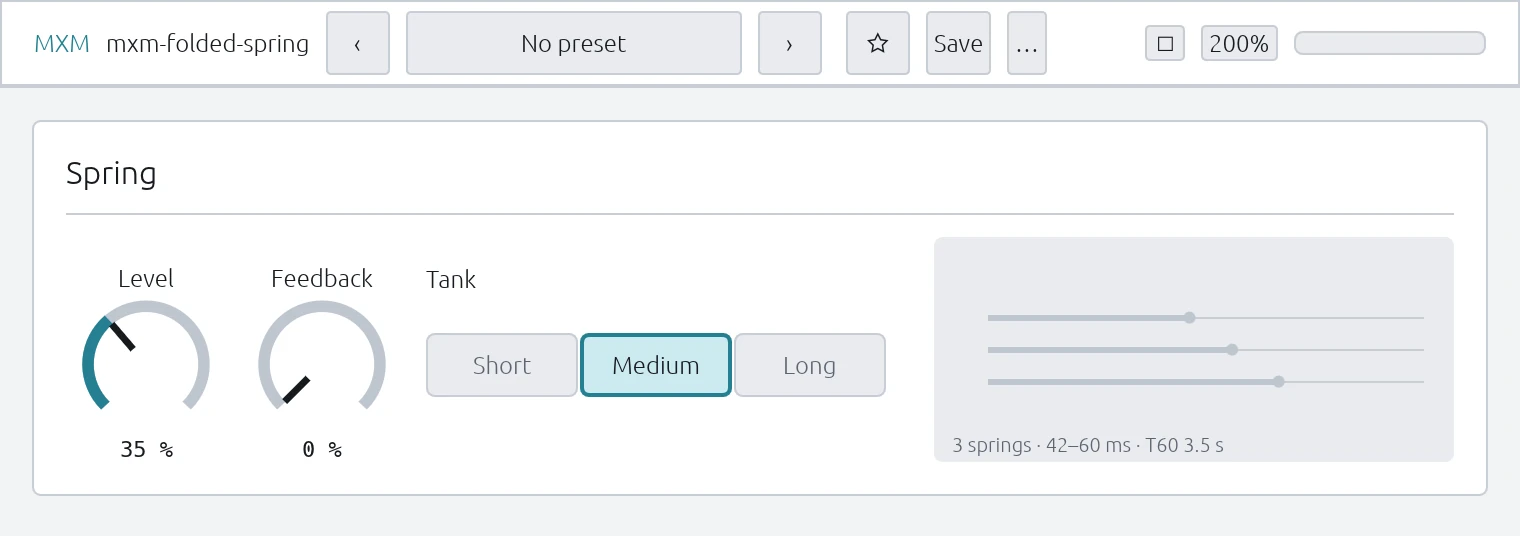
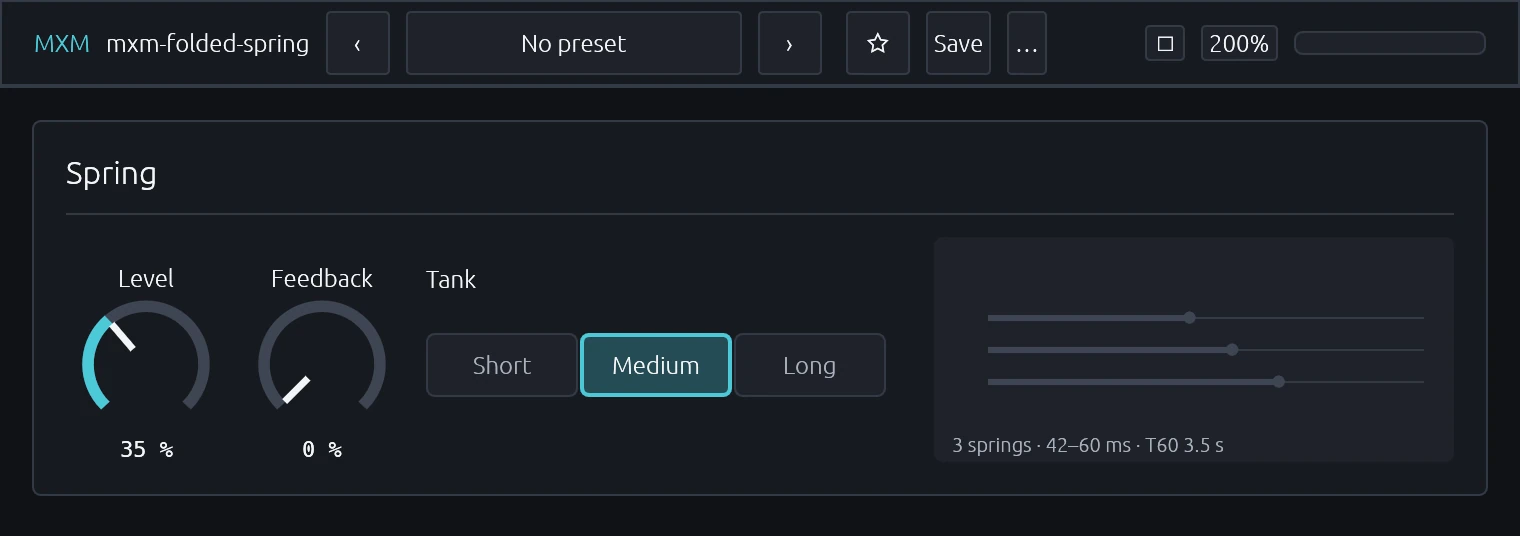
The mxm-folded-spring editor, at 200 % zoom The mxm-folded-spring editor, at 200 % zoom
The mxm-folded-spring editor, at 200 % zoom · click for full size

Controls

Level — 0 … 100 %, Init 35 %

The wet return. The dry path is untouched and does not turn down, so this adds the tank’s output rather than crossfading to it.

Zero is Off. The tank empties rather than freezing, and the DSP then stops running — so raising Level cannot release audio that was stored ten seconds earlier. That matters more here than in most effects, because a spring’s tail is long enough that a frozen buffer would be plainly audible on the way back in.

Tank — Short, Medium or Long, Init Medium

Which set of springs the reverb runs.

Medium is the reference. It uses three spring transits at 41.6, 50.4 and 60.0 ms with a 3.5-second decay and a narrow midrange drive, and it is the tank that comes from a capture.

Short scales that model to two brighter springs with a quicker decay. Long stretches it to three darker springs ringing for almost six seconds. Both are chosen variations rather than measurements of other boxes, and they are named by length instead of borrowing product names from hardware nobody measured.

Changing tanks cannot be an ordinary crossfade: the delay lines hold returns timed for a different set of springs. The plugin fades the wet signal out, swaps the model at silence, then fades back in. Dry audio is not touched, so the change is audible in the tail only.

Feedback — 0 … 100 % (sings from about 90 %), Init 0 %

Sends the tank’s output back into its input.

This was not part of the source mixer. It is an addition drawn from dub routing and from spring modules that put the return under a performer’s hand, and it is the one control here the System-100 did not have.

Most of the travel lengthens and darkens the tail. From about 90 % upward it holds a tone with no new input at all — the springs sing. Each tank is calibrated to reach that point at the same place on the control even though their loop gains differ, so switching tanks does not move the edge under your fingers.

The loop passes through the tank’s band limit on every lap, and its gain falls as the return gets louder. That is what keeps the self-oscillation bounded instead of collapsing into a clipped square wave, and it is why the control is a curve rather than a straight line.

What the display shows

Every spring is drawn on one fixed time scale, so a longer line always means a longer transit and the three tanks can be compared by eye. It brightens from the wet signal the audio thread has just produced.