mxm-chorus-06 manual

Four controls, all the same size and all in one row. The Roland JUNO-106 chorus had a three-position switch and nothing else; what this opens up is the circuit behind those positions, so the three settings become detents on a continuous Rate control and the factory presets One, Two and Onetwo.

At those presets the standalone effect matches the chorus inside mxm-poly-06 sample for sample under the documented comparison conditions — it is the same DSP, not a second implementation.

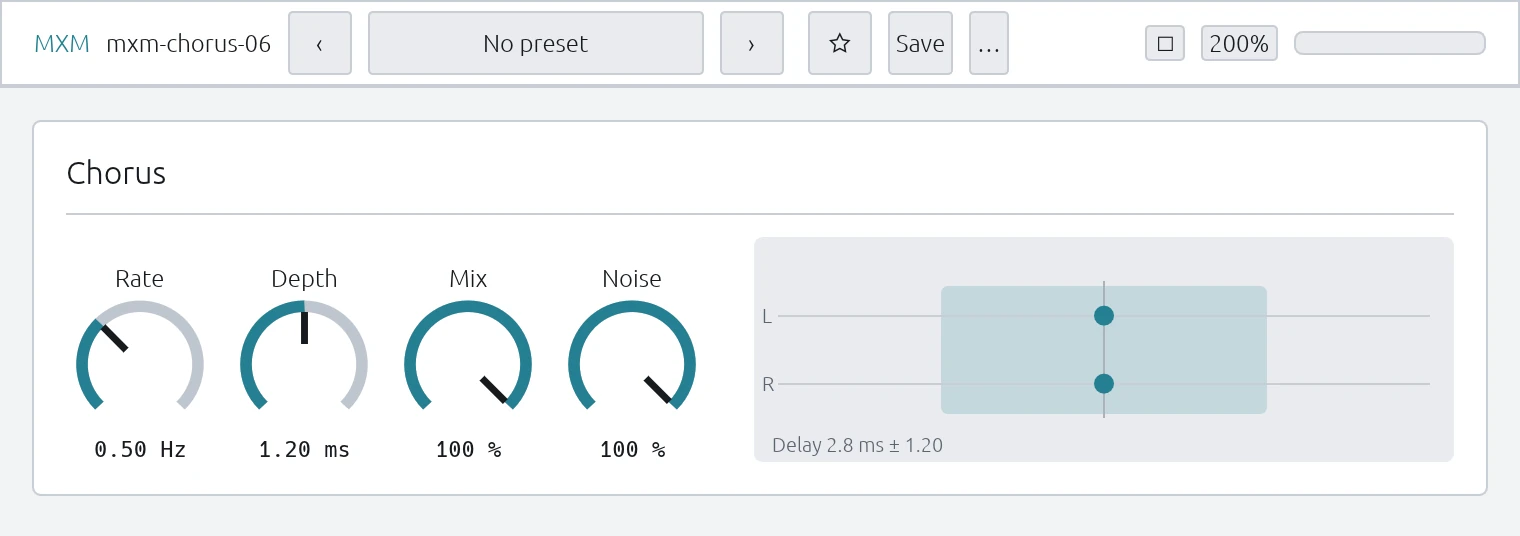
The mxm-chorus-06 editor, at 200 % zoom The mxm-chorus-06 editor, at 200 % zoom
The mxm-chorus-06 editor, at 200 % zoom · click for full size

Controls

Rate — 0.05 … 10.00 Hz, Init 0.50 Hz

The speed of the one triangle that moves both delay lines.

The circuit’s three switch positions sit on this control as exact detents: 0.5 Hz is I, 0.8 Hz is II, and 1.3 Hz is both switches down. Init is I. The control is skewed so the slow end — where the circuit lives — gets most of the travel, rather than compressing all three detents into the first tenth of the knob.

Below the detents the movement becomes a slow drift rather than a chorus; above them it crosses into vibrato and then into something the circuit could not do at all.

Depth — 0.00 … 2.40 ms, Init 1.20 ms

How far the triangle swings the delay time either side of its centre.

The circuit sits at exactly halfway, which is why the range runs to twice the hardware value rather than to some round number: 1.2 ms is the machine, and the control reaches 2.4 ms so there is as much room above the circuit as below it.

At zero the delay lines stop moving and the effect becomes a fixed short delay — audible as comb filtering rather than as chorus, since it is the movement that makes the width.

Mix — 0 … 100 % of the circuit’s wet level, Init 100 %

The wet level, as a fraction of the circuit’s. The dry path does not turn down, so this adds wet signal rather than crossfading.

Zero is Off, and it is a real bypass rather than a silent wet path. Once its short mute has closed, the delay lines are emptied and the chorus core stops running: the host may sleep it, and if the host keeps calling, processing costs a copy. Raising Mix starts from empty lines, so audio from before the bypass can never reappear.

Init is 100 % because an inserted effect should demonstrate the effect it is named after.

Noise — 0 … 100 % of the circuit’s noise floor, Init 100 %

The bucket brigades’ noise floor, as a fraction of the circuit’s.

Bucket-brigade delay chips hiss, and the JUNO’s chorus hisses whether or not anything is playing. That noise enters here at the point in the signal path where the chips would add it, so it is coloured by what follows rather than laid over the top.

Init is the circuit’s own level. Turn it down when the chorus is on a quiet source and the hiss is more character than you want; the modulation is unaffected either way.

What the display shows

The Sweep display draws delay time across a horizontal axis, with the left and right dots crossing at the centre and the shaded band showing Depth in time. It reads the modulator value the audio thread has just produced rather than running a second animation clock, so what moves on screen is what moved in the signal.

At Mix zero the dots disappear and an Off label joins a greyed display. The Mix knob stays active, because it is the way back in.