MXM Bucket Delay manual
Source code on GitHub · Questions on Discord
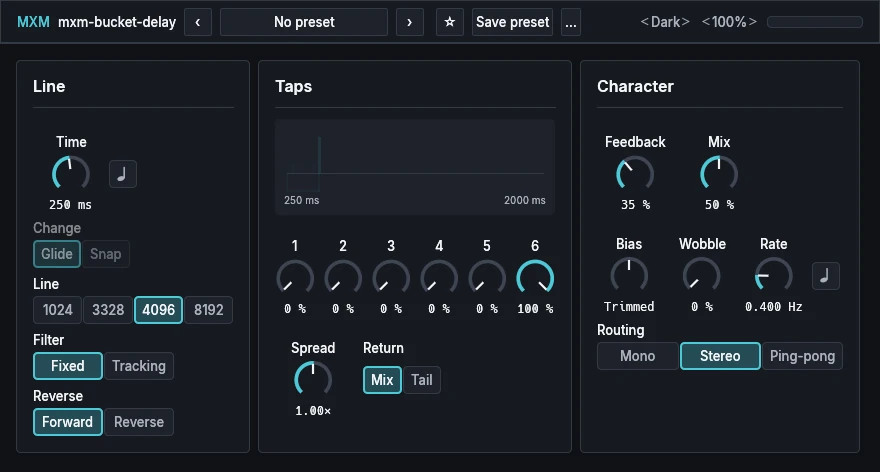
This manual goes through MXM Bucket Delay card by card. What every MXM editor shares, such as presets, pages, zoom, themes and the keys, is in Using the MXM editors. The delay’s clock is its only time control, so most controls here change more than one thing at once, as the chips do.

App bar
Nothing beyond the shared preset row, Theme, Scale and a level meter whose clip light stays on until you click it. Mix and Feedback are on the Character card.
Line
| Control | Range | Init |
|---|---|---|
| Time | 10 ms to 2.00 s | 250 ms |
| Time sync | Off, On | Off |
| Change | Glide, Snap | Glide |
| Line | 1024, 3328, 4096, 8192 | 4096 |
| Filter | Fixed, Tracking | Fixed |
| Reverse | Forward, Reverse | Forward |
Time sets the clock, and so the delay of the last tap. A longer time means a slower clock, which is darker and noisier, and turning the knob while echoes are sounding bends their pitch, as tape would. The knob is smoothed on purpose, so it glides rather than clicks.
Time sync is the note button beside Time. With it on, the knob picks a note length of the host’s tempo: 1/32, 1/16T, 1/16, 1/8T, 1/16., 1/8, 1/4T, 1/8., 1/4, 1/4. or 1/2, as far as the tempo and the line allow. On a short line the knob stops at the longest note length the chip can hold. The note length is kept by the knob’s position, so a saved patch keeps it when the tempo changes. With no tempo from the host, Time goes back to its free value.
Change only works with sync on, and is grey otherwise. It decides what a synced tail does when the tempo or the note length changes: Glide bends into the new time as tape would, and Snap jumps there at once, in time and audibly digital.
Line chooses which delay chip is fitted. Length, noise floor, bandwidth and distortion move together, so two lines at the same delay time sound different. Each has a range it was made for:
| Line | Delay within spec | Good for |
|---|---|---|
| 1024 | 5.1 ms to 51 ms | Doubling and chorus-like echoes |
| 3328 | 16.6 ms to 166 ms | Slapback echoes |
| 4096 | 20.5 ms to 205 ms | The same, a little grittier |
| 8192 | 41 ms to 410 ms | Long echoes, with the most grit |
Time goes well past these ranges on purpose. Below the chip’s specified clock, charge leaks between the stages and the repeats go droopy and hissy. The 1024 line stops near 0.73 s. Long tails come from Feedback, not from a longer line.
Filter set to Fixed is the hardware’s own 2 kHz filter, so short delays stay dark. Tracking follows the clock, so short delays stay bright.
Reverse buffers the input and flips it into the line, so the repeats play backwards. The loop’s own return isn’t reversed again. The reversed window follows the delay time, up to 1 s.
Taps
| Control | Range | Init |
|---|---|---|
| 1 | 0 % to 100 % | 0 % |
| 2 | 0 % to 100 % | 0 % |
| 3 | 0 % to 100 % | 0 % |
| 4 | 0 % to 100 % | 0 % |
| 5 | 0 % to 100 % | 0 % |
| 6 | 0 % to 100 % | 100 % |
| Spread | 0.00× to 2.00× | 1.00× |
| Return | Mix, Tail | Mix |
The six knobs are the tap levels, Tap 1 to Tap 6 in your DAW. Tap 6 is the last and longest, and on its own it is a plain single delay. The levels are weights against each other: the mix is evened out, so opening another tap spreads the sound across more echoes rather than making it louder.
The taps’ spacing comes from the MN3011. On that chip they sit at stages 396, 662, 1194, 1726, 2790 and 3328, ratios of 1.000, 1.672, 3.015, 4.359, 7.045 and 8.404, deliberately not multiples of each other. The same spacing is scaled onto every line. Spread stretches the earlier taps out from the last one, or bunches them towards it. At 1.00× it is the chip’s own spacing.
Return chooses what feeds the loop. Mix sends the whole tap mix round again, so it builds into a wash. Tail sends the last tap alone, so the repeats stay clean underneath.
The display draws the six taps at their actual delay, on a fixed scale up to 2000 ms, each as bright as its level. A loop line runs from the taps that Return feeds back and brightens as Feedback goes up. The caption on the left gives the delay in force.
Character
| Control | Range | Init |
|---|---|---|
| Feedback | 0 % to 100 % | 35 % |
| Mix | 0 % to 100 % | 50 % |
| Bias | −100 % to +100 % | Trimmed |
| Wobble | 0 % to 100 % | 0 % |
| Rate | 0.050 Hz to 12.00 Hz | 0.400 Hz |
| Rate sync | Off, On | Off |
| Routing | Mono, Stereo, Ping-pong | Stereo |
Feedback sends every repeat round the whole circuit again, through the filters, distortion, noise and compander, so the repeats wear out as they go. In the last tenth of the travel the line sings on its own noise. Turn it back down and it stops.
Mix is a crossfade: at 0 % only the dry signal, at 100 % only the echoes. At 0 % the effect is off, the lines are emptied and it does no work.
Bias is the chip’s trimmer. The centre, which reads Trimmed, gives the least distortion, and turning either way adds grit, three to five times as much at the ends.
Wobble moves the clock for chorus and vibrato, pulling it by up to 15 % at full depth. Rate is how fast: tape flutter at one end, seasick at the other. Rate sync is the note button beside it, and with sync on the knob picks a division of the host’s tempo from 4 bars to 1/32, the fastest at the top.
Routing places the echoes. Mono gives one echo, the same on both sides. Stereo runs two lines wobbling in opposite directions, for width. Ping-pong bounces the echoes between left and right.
Channels and presets
Two layouts, one channel in or two, both with two out, and nothing is ever summed. When Feedback is in the range where the line sings, the plugin tells the host it is still playing, so the host doesn’t cut it off. Otherwise it reports a tail from the current settings, up to 30 s.
There are 50 presets. Init is a plain single echo: 250 ms on the 4096 line, tap 6 only, Mix at 50 % and Bias trimmed. The presets come in seven families:
| Family | What it is, with examples |
|---|---|
| Echoes | One tap: Slapback, Runaway, and the synced ones such as Quarter note and Sixteenth stutter |
| Washes | All six taps into the loop: Reverberation, Chamber, Hall, Cavern |
| Rhythms | A few taps as a pattern rather than a space: Two tap, Gallop, Scatter |
| Modulation | The clock moved: Chorus, Vibrato, Deep flange |
| Reverse | Reverse swell, Backwards wash |
| The warts | The circuit’s flaws, reachable on purpose: Below spec, Gritty, Starved, Singing line |
| Routing | Ping-pong, Wide ping-pong, Mono tight |
In the browser they run in this order: Slapback, Tape slap, Long echo, Dub, Dark repeats, Bright repeats, Runaway, Quarter note, Dotted eighth, Triplet echo, Sixteenth stutter, Half note, Reverberation, Chamber, Hall, Bloom, Dark room, Cavern, Close ambience, Drifting wash, Wide bloom, Tight cluster, Two tap, Gallop, Scatter, Three against two, Backbeat, Wide scatter, Comb rhythm, Chorus, Vibrato, Deep flange, Seasick, Warble tape, Slow drift, Wow and flutter, Detune double, Reverse swell, Reverse stab, Backwards wash, Reverse rhythm, Below spec, Gritty, Starved, Lo-fi short, Singing line, Noise floor, Ping-pong, Wide ping-pong and Mono tight.
Reverberation is the one to try first: it opens all six taps at the weighting of the reference circuit’s own resistors, from 0 dB on the first tap down to −3.52 dB on the last. Chorus is the same device at a very short delay with no feedback at all.