 Macro-oscillator synth
Beta
MXM Thanks EG
Built on code from Mutable Instruments PlaitsNot affiliated with Mutable Instruments
Eight voices, each running one of 24 synthesis engines, all played from the same four controls. Around them sit envelopes that double as function generators, LFOs and sixteen routes.

Sound
MXM Thanks EG has eight voices. Each runs one of 24 synthesis engines, and every engine is played from the same four controls: Frequency, Harmonics, Timbre and Morph. What the last three do belongs to the engine. Each note then goes through a low-pass gate with its own decay. Colour decides whether the gate simply fades the note or darkens it as it fades.
The engines are ported from Emilie Gillet’s MIT-licensed code for Mutable Instruments Plaits and match it bit for bit, its 16-bit grain included. Around them we added three envelopes and three LFOs per voice and sixteen route slots. There are no effects.
Engines
Three banks of eight. The first holds an analogue oscillator with a filter, phase distortion, three six-operator FM engines, a wave terrain, a string machine and a chiptune. The second has virtual analogue, waveshaping, two-operator FM, grain and formant, harmonic, wavetable, chords and speech. The third is noise and percussion: a granular cloud, filtered noise, particle noise, an inharmonic string, a modal resonator, a bass drum, a snare and a hi-hat.
Model is a route target too, so a random value can give every note a different engine.
Modulation
The three envelopes are also function generators. Each can start with the key, wait for a trigger, or follow another signal, and Cycle makes it repeat as a wave of its own. The end of each envelope’s rise and the end of its cycle are sources as well, so one envelope can trigger another. The three LFOs have seven shapes, a fade-in and tempo sync, and run either shared or once per voice.
Sixteen route slots connect 19 sources to 32 targets. There is no routing page: each target has a line on the card of the control it moves, and a route shows up as a row there. The note’s own decay envelope also reaches Pitch, Timbre and Morph through the From decay card.
Playing
Up to eight notes in Poly. Mono and Legato play one voice with last-note priority, and in Legato a note played over a held one carries on without starting again. Glide works in all three modes, and the bend range goes up to 24 semitones.
The editor
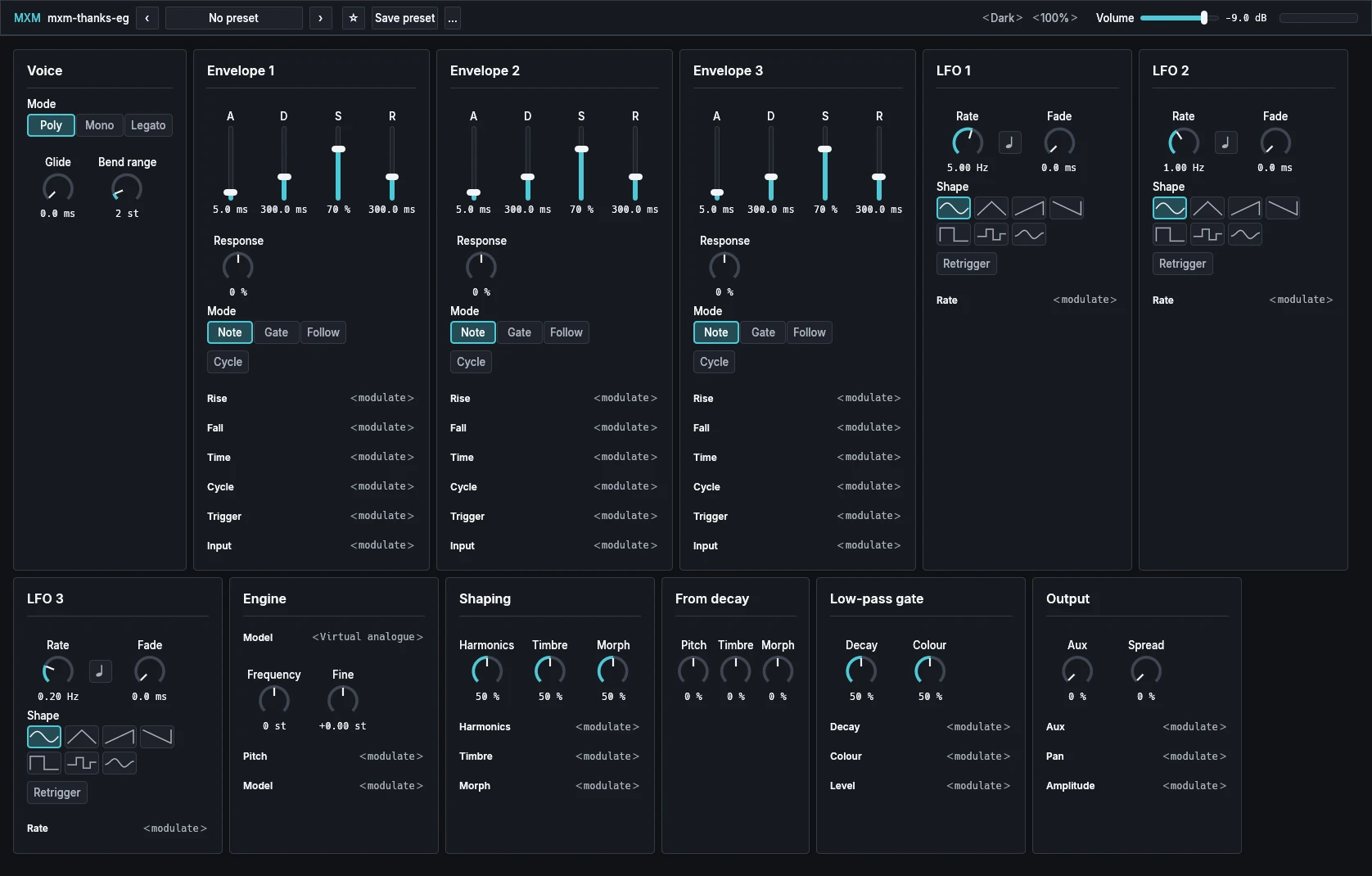
Twelve cards: Voice, Envelope 1 to 3, LFO 1 to 3, Engine, Shaping, From decay, Low-pass gate and Output. The editor opens at 1676 × 1070 with all twelve on one page and nothing hidden behind a button, and it can shrink to 446 × 360.
Presets
52 factory presets, at least one for every engine: keys, basses, leads, pads, plucks, brass, strings, percussion, effects, sequences and drones. We levelled them in the sound itself, never with Volume, to within 5 LU of the set’s median loudness. Init has no file. It is the virtual analogue engine with its controls at the middle and nothing routed.
Status
Beta. MXM Thanks EG is done. Its parameters are fixed for good, so songs and presets saved now keep their meaning in every later version. We have listened to it and its sounds, and run it in Bitwig as a CLAP and a VST3.
Origin