mxm-poly-06
Inspired by Roland JUNO-106Independent project · not affiliated with Roland Corporation
Six simple voices and one very good chorus.
The synth, chorus, presets, and editor are working. DAW tests, visual checks, and hardware comparison are still to come.
Sound
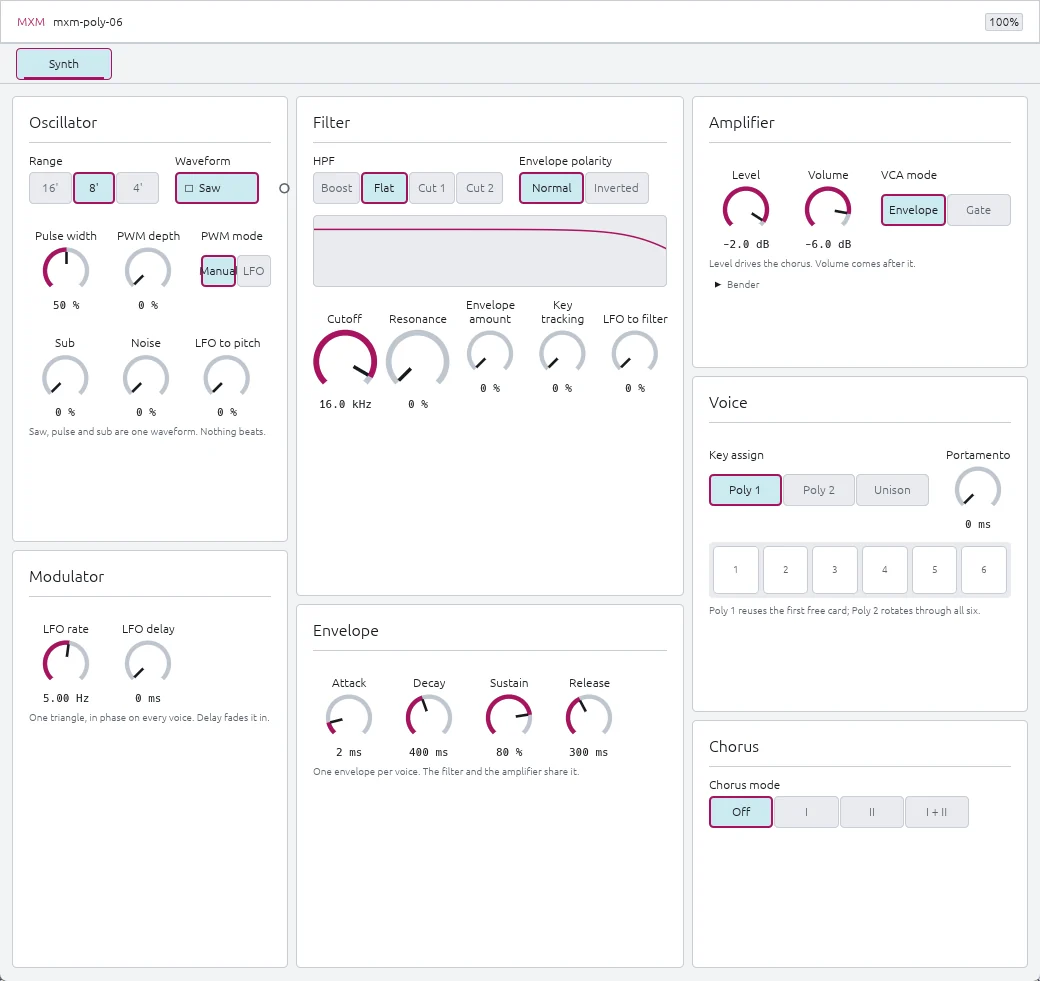
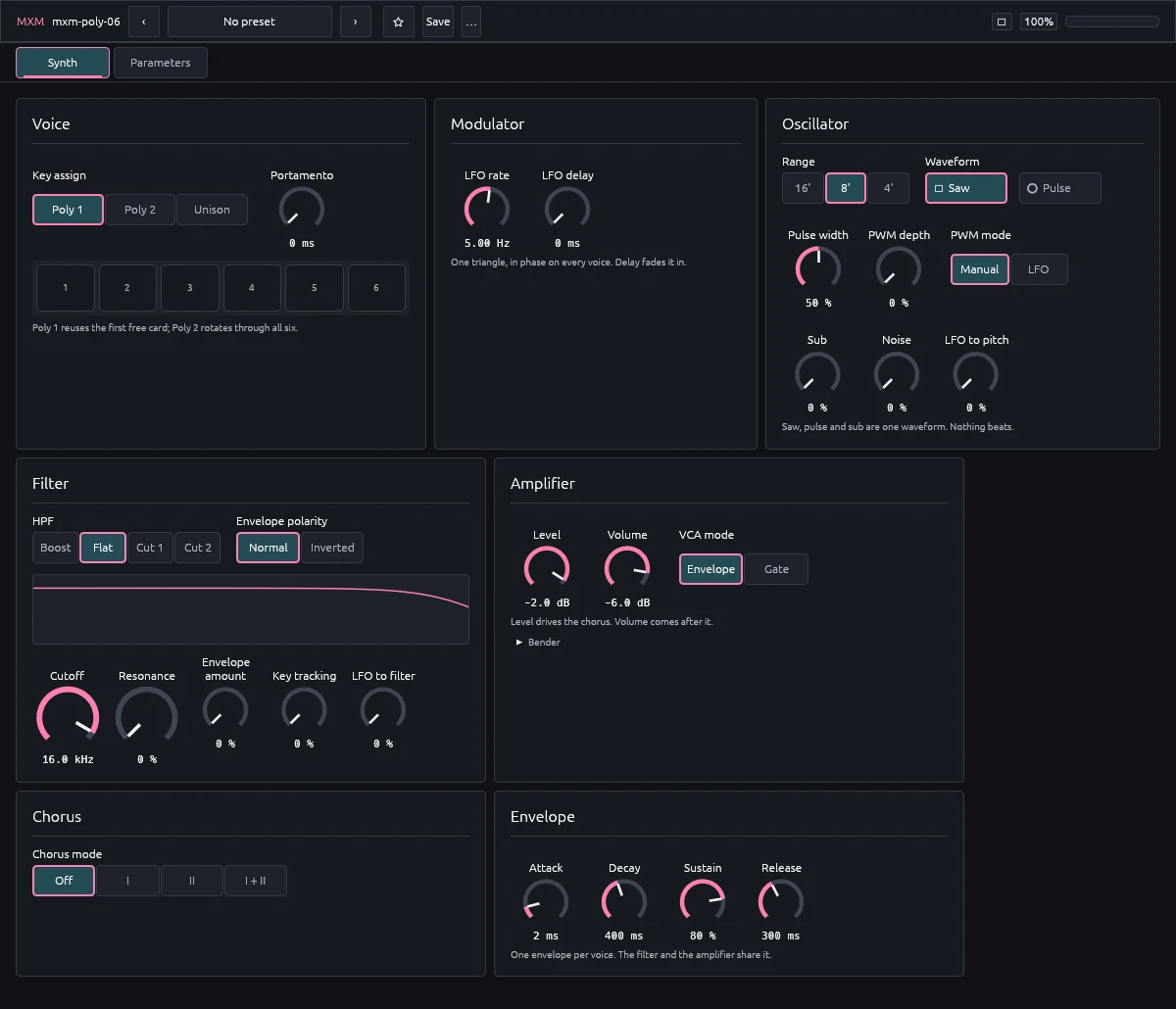
mxm-poly-06 has six voices. Each one runs a digitally controlled oscillator through its own low-pass filter and amplifier. The voices then meet at a global high-pass filter and the built-in stereo chorus.
Saw, pulse, and sub all come from the same stable ramp, so they stay locked together. One ADSR controls both the filter and volume for each voice. It is a simple setup, and that is a big part of the sound.
The high-pass filter has a lovely oddity: position 0 boosts the bass instead of bypassing the circuit. The next position is flat, and only the last two cut low frequencies. You can see the boost in the filter display.
Six voices, three modes
Poly 1 grabs the first free voice. Poly 2 rotates through all six, including their tiny differences. Unison stacks every voice on one note, in phase and without extra detune. It gets louder rather than wider.
At the end is a stereo bucket-brigade chorus with modes I, II, and both together. It uses two delay lines moving in opposite directions, which turns the clean DCO voice into something much wider and livelier.
Interface
Seven modules follow the signal path and wrap as the window gets narrower. The filter controls are large, and the voice display shows which of the six voices is playing each note.
The editor keeps the same layout in Light and Dark themes, with zoom from 75% to 200%.
Presets
There are 50 factory presets, from simple pads and basses to PWM, unison, and chorus-heavy sounds.
Patch Level sits before the chorus, so it can change how the chorus reacts. Master Volume sits after it and only changes the final level.
Status
| Current state | |
|---|---|
| Format | CLAP instrument, stereo output |
| Target systems | Windows, macOS, Linux |
| Editor | Built; final theme and scale checks remain |
| Validation | Project tests, fixed renders, and clap-validator pass |
| Commercial DAW | Not tested yet |
| Hardware comparison | Not done yet |
The original chorus is noisy even when idle. This version fades to silence when nothing is playing, which lets the host put it to sleep.
The inspiration
mxm-poly-06 started with the Roland JUNO-106
Roland and JUNO-106 are trademarks of Roland Corporation. I use the names only to identify the hardware that inspired this plugin.
MXM is my independent project. It is not affiliated with, authorised by, sponsored by, or endorsed by Roland Corporation. I do not use or distribute original firmware, samples, artwork, or panel graphics, and this is not a Roland product.