 Mono synth
Beta
MXM Mono PR1
Two free-running oscillators whose waveforms add instead of switching, a four-pole low-pass, and modulation from any of 14 sources to any of 10 targets.

Sound
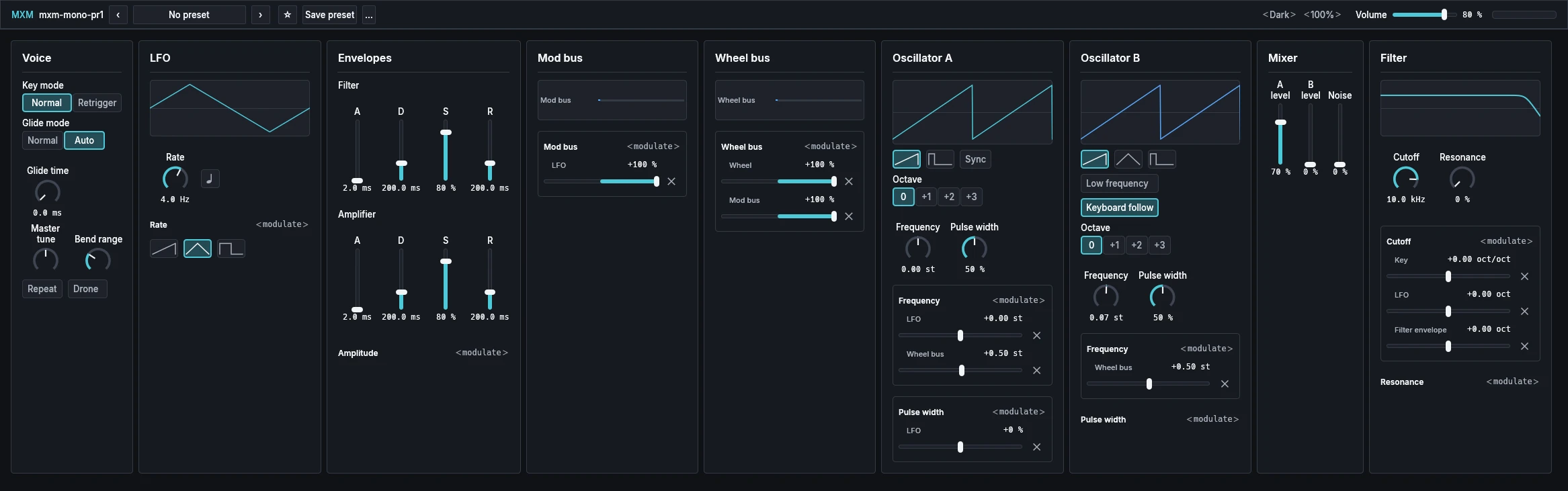
MXM Mono PR1 is a one-voice synth with two free-running oscillators. Oscillator A has a saw and a pulse. Oscillator B has a saw, a triangle and a pulse. Each wave has its own switch, and the waves you turn on add together. Oscillator A can hard-sync to B, even with B turned down in the mixer. B can also drop seven octaves and stop following the keys, and its waveform is a modulation source, so it doubles as a second LFO.
The two oscillators and noise go into a four-pole resonant low-pass, with separate ADSR envelopes for the filter and the amplifier. Volume drives the amplifier rather than simply turning down, so near the top it saturates. There are no effects, no arpeggiator and no audio input.
Modulation
Any of 14 sources can reach any of 10 targets, each at its own signed depth, from a ‹ modulate › menu under the control it moves. Amounts read in the target’s unit, such as semitones or octaves.
Two cards are routing stages of their own. Mod bus adds up whatever you put into it. Wheel bus multiplies its inputs together. Put the LFO in Mod bus, route Wheel bus to an oscillator’s frequency, and the mod wheel fades the vibrato in and out as you play. Init is wired that way, so the wheel brings in vibrato on a fresh instance.
Playing
On Normal key mode the lowest held key sounds, and a new key over held ones doesn’t restart the envelopes. On Retrigger the last key sounds and every new key starts them again. Glide runs up to 30 seconds, on every note or only when notes overlap. Repeat restarts both envelopes on every LFO cycle, so with the LFO synced to tempo the sound pulses on the beat. Drone holds a note on with no key down. Velocity and pressure are sources you can route, but they reach nothing at Init.
The editor
Nine cards: Voice, LFO, Envelopes, Mod bus, Wheel bus, Oscillator A, Oscillator B, Mixer and Filter. Every control is always in view. The LFO draws its summed shape, each oscillator its waveform, the two buses their live level and the filter its response. The editor opens at 1881 × 760, with Mixer and Filter on a second page, and can shrink to 424 × 360.
Presets
50 factory presets: 15 leads, 10 pads, 8 effects, and plucks, basses, sequences and brass. Some show one idea each, such as Hidden sync, Vibrato wheel, Mixed buses and Tempo repeat. Init isn’t a file: it is built from the default values, Oscillator A’s saw with B’s saw switched on but mixed out and tuned slightly sharp, so raising B’s level makes the two beat at once.
Status
Beta. The sound, the routing, the presets and the editor are done and tested.