 Patchable mono synth
Beta
MXM Mono 08
A complex oscillator and a modulation oscillator through two low-pass gates, moved by an envelope, a clock, four random levels and a five-step sequencer.

Sound
MXM Mono 08 is a patchable one-voice synth. Its complex oscillator has two separate controls for its shape: Wave mix fades from a sine toward a spike, a square or a triangle, and Timbre adds harmonics. A second, modulation oscillator runs from 0.16 Hz to 50 Hz, or 88 times higher with its High range switch on, and moves the complex oscillator’s volume (AM) or its pitch (FM). Slow, that is tremolo or vibrato. Fast, it makes bell-like and metallic tones.
The sound then goes through two low-pass gates, with no resonance. Each opens as an amplifier, a filter or both, and with both it rings like a struck object, its brightness falling faster than its level. The second gate plays either the mod oscillator or the first gate’s output, and it reaches the mixer at opposite polarity to the first, so the two can cancel. A mono spring reverb after the mix is the only effect.
Patching
There are no cables and no matrix. Fifteen sources reach eleven destinations, each pair at its own signed amount, and you patch at the destination, under the control the route moves. The control sources are an envelope, a clock, the five-step sequencer, four random levels that hold until the next trigger, and an inverter. Key, pressure, velocity, mod wheel, pitch bend and both oscillators at audio rate are sources too.
Triggers are a set of their own. A key going down, the clock’s beat or a sequencer step can fire the envelope, the clock, the sequencer and the random levels, with a switch for each of the twelve pairs. The sequencer has five steps, each with a level and its own trigger switch, and plays two to five of them. Patch it into the clock’s period and every step changes the tempo of the clock that drives it.
Playing
Last-note priority. Let go of a later key and the voice goes back to the one still held, gliding there without a new attack. Glide is linear, one octave per Glide time. Velocity, pressure and the mod wheel are sources only, and do nothing until routed. Init stays silent until you play: a key fires the envelope, and the envelope opens the first gate.
The editor
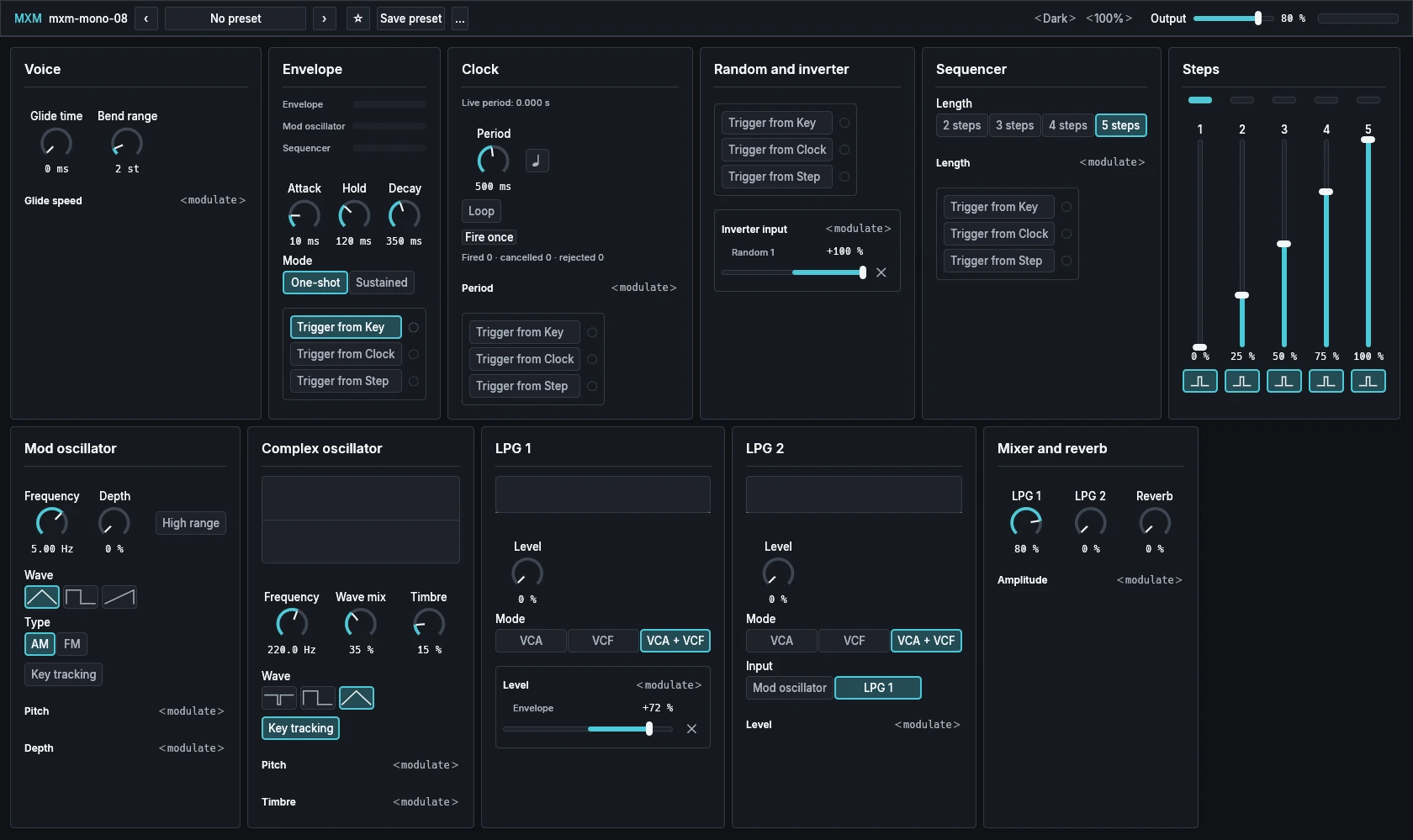
Eleven cards, all on one page at the opening size of 1680 × 999. The editor can shrink to 540 × 420. It shows the live levels of the envelope, the mod oscillator and the sequencer, the clock’s period, which step is playing, the complex waveform and each gate’s response. Fire once fires the clock by hand. It is never saved, so loading a sound never starts the clock.
Presets
50 factory presets: 10 sequences, 7 drones, 6 percussion sounds, 5 plucks, 5 effects, and keys, basses, pads and leads. Every one that runs the sequencer also routes it somewhere. Patch laboratory is a starting point for patching. Init isn’t a file: it is built from the default values.
Status
Beta. The sound, the patching, the sequencer, the presets and the editor are done and tested.