mxm-mono-03
Inspired by Roland TB-303Independent project · not affiliated with Roland Corporation
Start a pattern, grab the filter, and see where it goes.
The synth, editor, presets, accents, and slide are working. DAW tests and a hardware comparison are still to come.
Sound
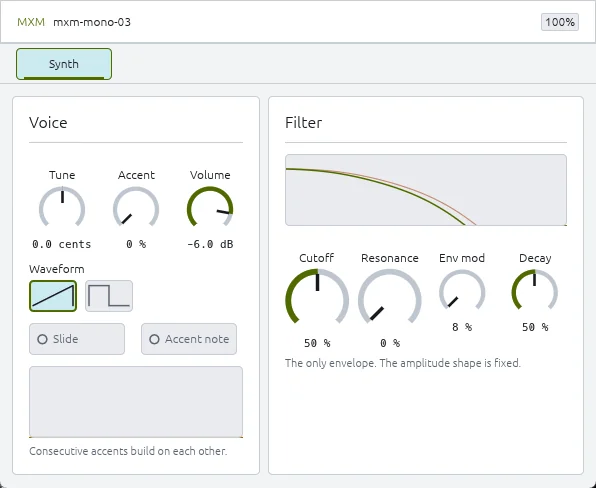
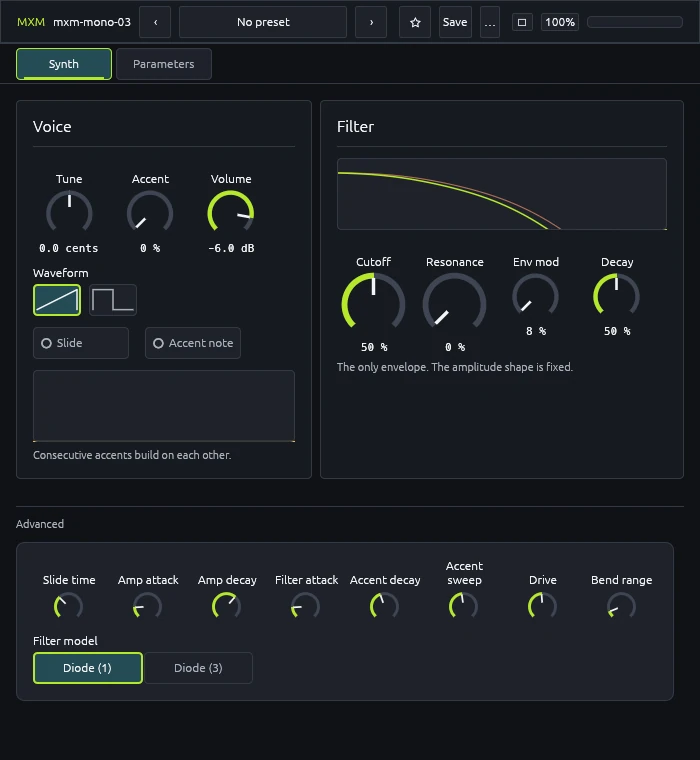
This one has a very clear job: play a repeating bass line and work the filter. Cutoff and resonance are the big controls. Envelope amount, decay, and accent shape the movement around them.
The oscillator switches between saw and square. The square is shaped from the saw, so it gets broader on low notes instead of staying perfectly even across the keyboard.
The diode-ladder filter sags and loses bass as resonance rises. I kept that behaviour, along with the small amount of envelope movement that remains even at the minimum setting. There is no built-in distortion; add your own after the synth if you want the overdriven acid sound.
Accents that build
Accent changes level, shortens the filter envelope, and adds another sweep. That extra charge carries into the next note, so a run of accents gets brighter as it goes. The editor shows the stored charge beside the control.
Slide lives in the synth voice too. Combine it with tied notes from your sequencer to glide without restarting the envelopes.
Interface
The main panel is just Voice and Filter. Open Advanced if you want to change the fixed bits of the original design, including slide time, envelope timing, drive, and filter model.
The two modules stack when the window gets narrow, and Advanced stays below them. Everything remains on one page.
Presets
There are 50 factory presets. Slide and Accent note are left alone because those choices usually belong to the pattern, not the patch.
Init gives you a plain voice with the original non-zero envelope floor, ready for cutoff, resonance, and decay.
Status
| Current state | |
|---|---|
| Format | CLAP instrument |
| Target systems | Windows, macOS, Linux |
| Editor | Built, responsive, and scalable from 75–200% |
| Validation | Project tests and clap-validator pass |
| Commercial DAW | Not tested yet |
| Hardware comparison | Not done yet |
The tests cover accents, slide, the filter, silence, and numeric limits. A proper side-by-side listen is still on the list.
The inspiration
mxm-mono-03 started with the Roland TB-303
Roland and TB-303 are trademarks of Roland Corporation. I use the names only to identify the hardware that inspired this plugin.
MXM is my independent project. It is not affiliated with, authorised by, sponsored by, or endorsed by Roland Corporation. I do not use or distribute original firmware, samples, artwork, or panel graphics, and this is not a Roland product.