mxm-mono-02
Inspired by Roland SH-2Independent project · not affiliated with Roland Corporation
Two oscillators, a solid sub, and lots of lovely beating.
The synth, presets, MIDI, external input, and editor are working. DAW tests and hardware comparison are still to come.
Sound
mxm-mono-02 starts with two free-running oscillators. Tune them a few cents apart and they beat against each other; switch VCO-2 to its wide range and you can dial in intervals instead. A sub stays locked one octave below VCO-1 for extra weight.
Each oscillator plays one waveform at a time. Between them you get sine, saw, square, pulse, and noise. One pulse-width section controls both oscillators, which ties the pair together in a nicely musical way.
The resonant low-pass filter is based on a four-stage OTA design. It thins out as resonance rises and can self-oscillate. One ADSR can control the filter, volume, and pulse width, while the LFO handles vibrato, filter movement, random steps, and delayed modulation.
There is also an optional audio input, so you can run another signal through the filter.
Interface
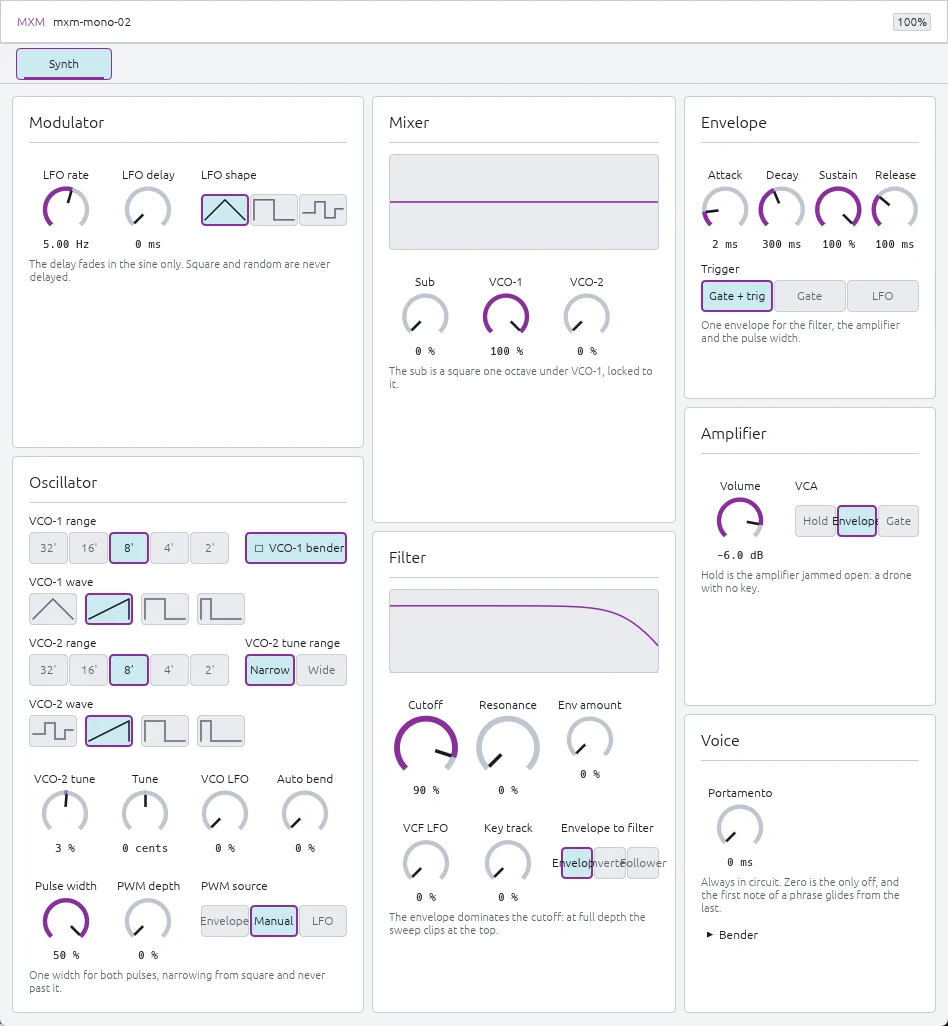
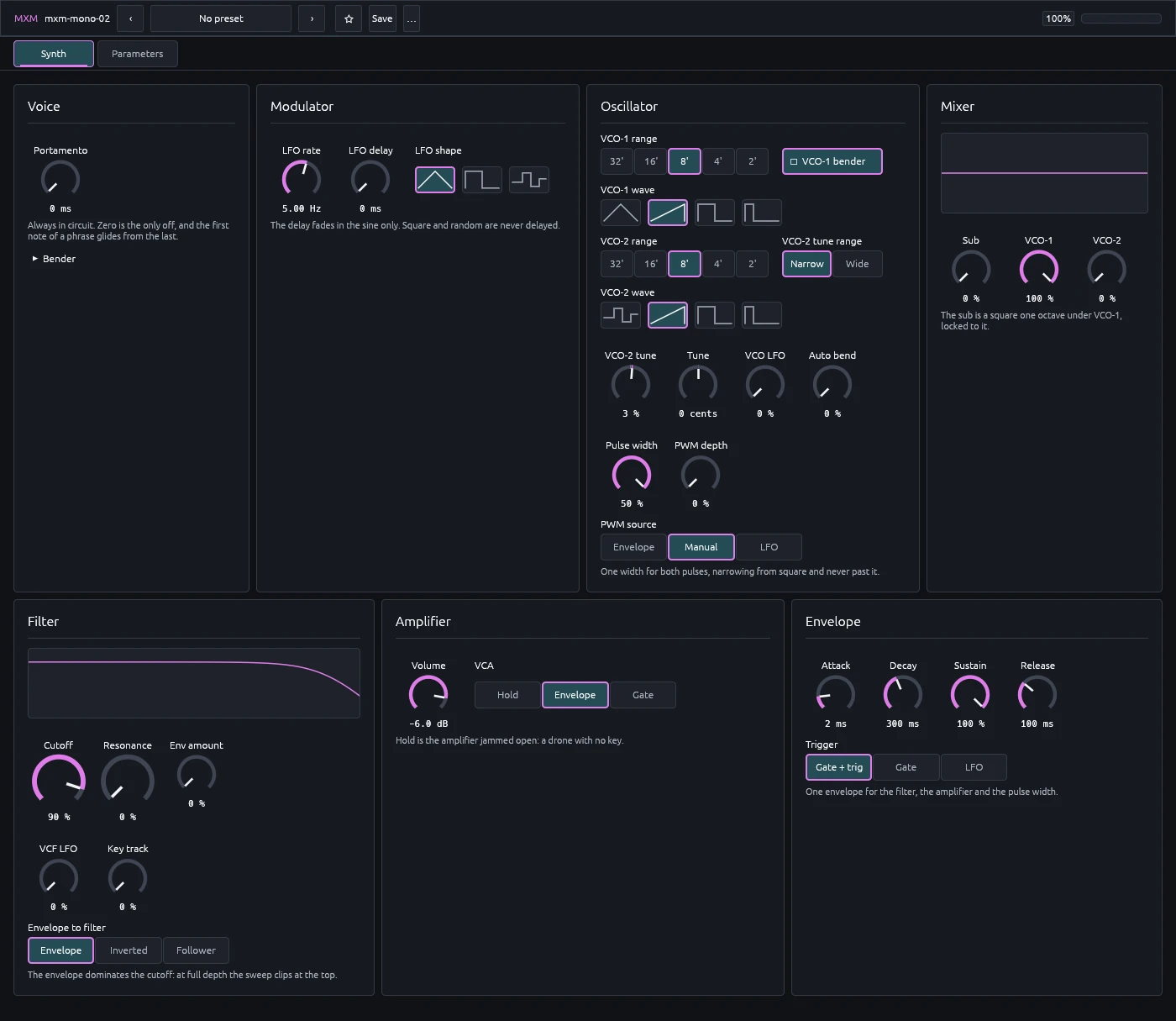
Seven modules follow the signal path. Both oscillators stay together, and the filter display shows its current curve plus the modulation range. A small scope lets you see the two oscillators beating before they reach the filter.
The editor reflows as you resize it and zooms from 75% to 200%. Nothing disappears into a hidden page.
Presets
The 50 factory presets include detuned saws, sub basses, square leads, PWM, delayed vibrato, random filter movement, fifths, glide, and LFO trills.
Init begins with VCO-1 on its own. Bring up VCO-2 and its slight detune is ready to go.
Status
| Current state | |
|---|---|
| Format | CLAP instrument, with an optional audio input |
| Target systems | Windows, macOS, Linux |
| Editor | Built; final visual checks remain |
| Validation | Project tests and clap-validator pass |
| Commercial DAW | Not tested yet |
| Hardware comparison | Not done yet |
The external input works in the plugin tests. I still need to check how a range of DAWs expose and route it.
The inspiration
mxm-mono-02 started with the Roland SH-2
Roland and SH-2 are trademarks of Roland Corporation. I use the names only to identify the hardware that inspired this plugin.
MXM is my independent project. It is not affiliated with, authorised by, sponsored by, or endorsed by Roland Corporation. I do not use or distribute original firmware, samples, artwork, or panel graphics, and this is not a Roland product.