mxm-mono-01
Inspired by Roland SH-101Independent project · not affiliated with Roland Corporation
A simple mono synth for basses, leads, and happy accidents.
The synth and editor are working. I’m still testing it in DAWs and comparing it with the original hardware.
Sound
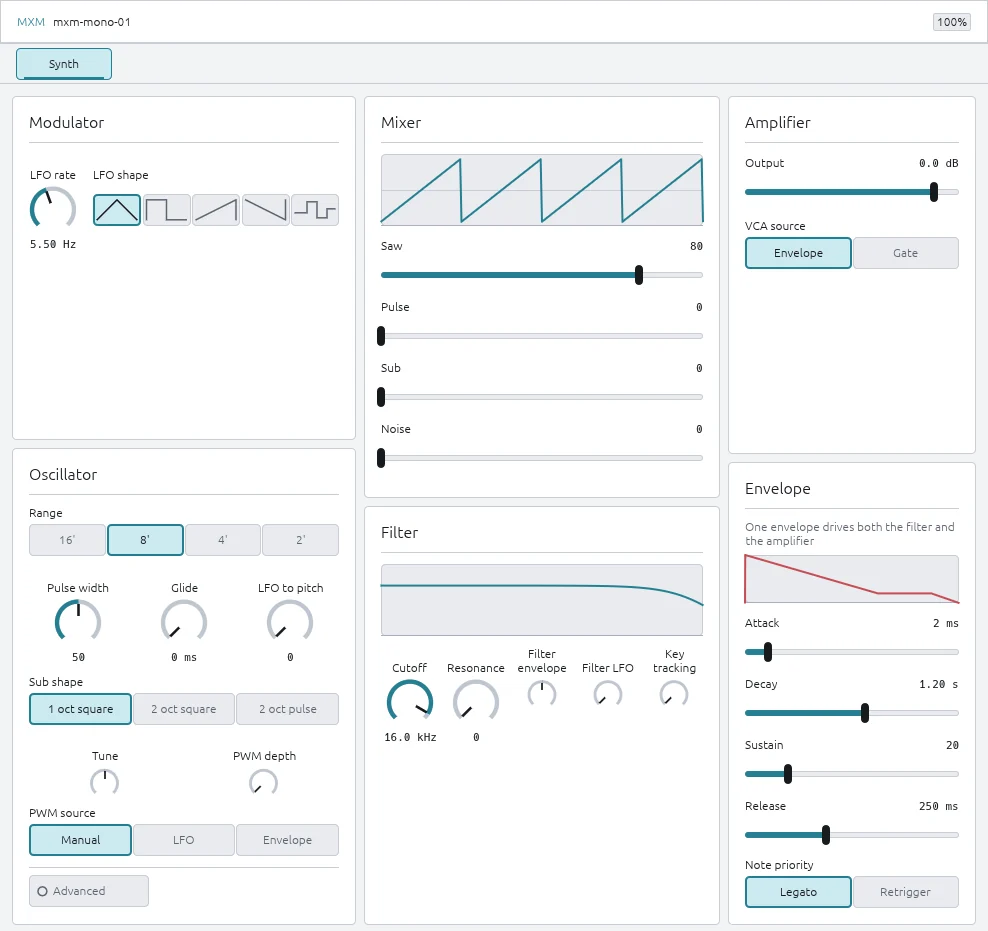
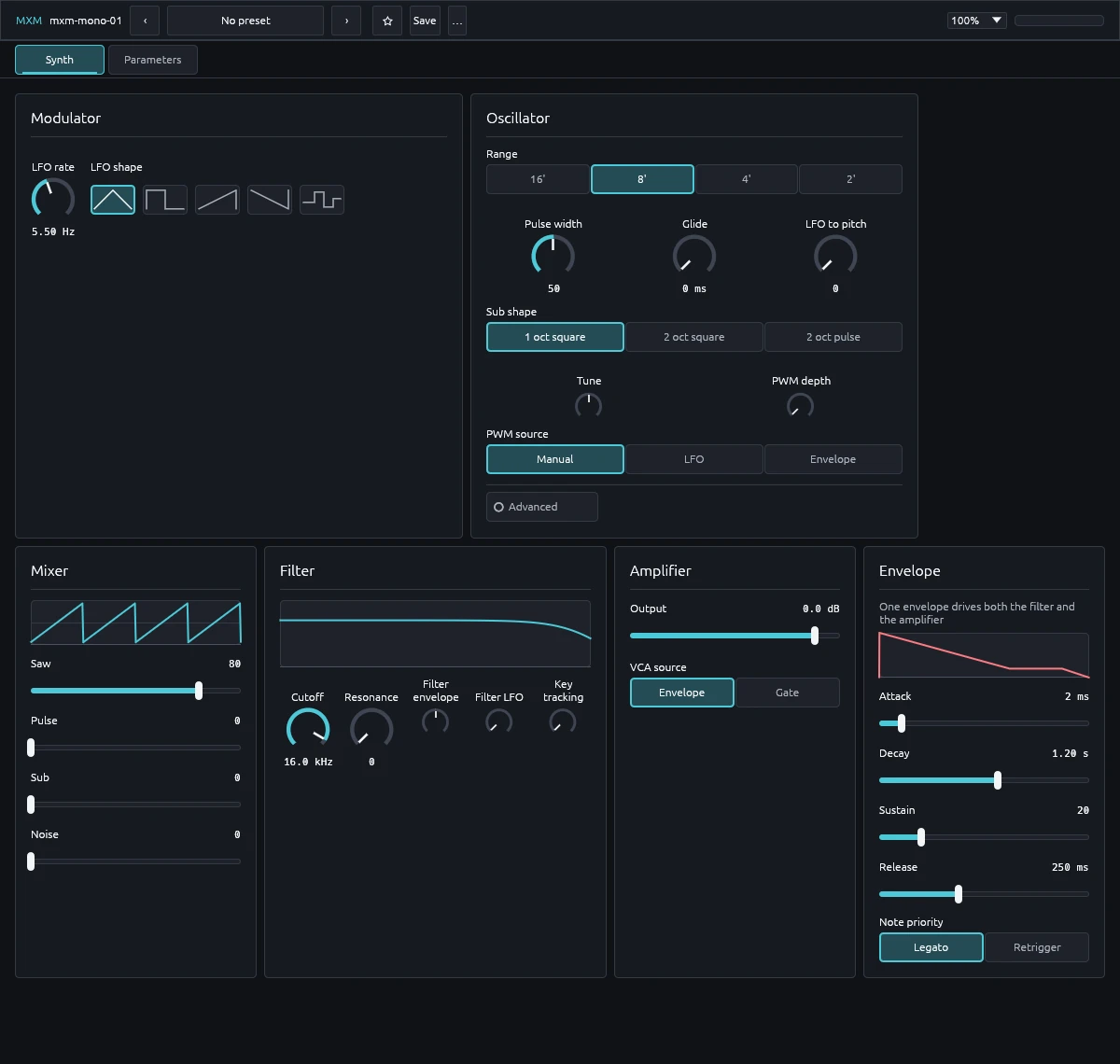
This is the little one. One oscillator, one filter, one envelope, and one LFO. Pick a range, mix in some saw, pulse, sub, or noise, then shape it with the filter. You can build a bass or lead in a few seconds.
The single envelope controls both the filter and the volume. That means decay and release change the tone and the shape of a note together. It is a limitation, but a fun one: there is less to set up and more reason to just turn the knobs.
The filter is a resonant four-pole low-pass. It loses a little bass as the resonance rises and can self-oscillate near the top. Glide, legato, and retrigger are built into the voice for smooth mono lines.
Interface
The six modules follow the signal from left to right: Modulator, Oscillator, Mixer, Filter, Amplifier, and Envelope. The filter gets the big knobs, while the mixer and envelope use sliders so their shapes are easy to read.
Three small displays show the mixed waveform, the filter curve, and the envelope. Resize the window and the modules wrap into new rows without changing order. There is also a Parameters view for exact values and text entry.
Presets
There are 50 factory presets covering basses, leads, pulses, noise, glide, and modulation. Init is a plain saw through an open filter—a good blank patch to start from.
Status
| Current state | |
|---|---|
| Format | CLAP instrument |
| Target systems | Windows, macOS, Linux |
| Editor | Built and working in MXM Player |
| Validation | Project tests and clap-validator pass |
| Commercial DAW | Not tested yet |
| Hardware comparison | Not done yet |
The core synth is working. DAW behaviour, host scaling, automation, and a proper side-by-side listen are still on my release checklist.
The inspiration
mxm-mono-01 started with the Roland SH-101
Roland and SH-101 are trademarks of Roland Corporation. I use the names only to identify the hardware that inspired this plugin.
MXM is my independent project. It is not affiliated with, authorised by, sponsored by, or endorsed by Roland Corporation. I do not use or distribute original firmware, samples, artwork, or panel graphics, and this is not a Roland product.