mxm-mono-00
Inspired by Roland System-100Independent project · not affiliated with Roland Corporation
A big semi-modular for patches that move, loop, and surprise you.
The synth and all four editor views are working. Final visual checks, DAW tests, packaging, and hardware comparison are still to come.
Sound
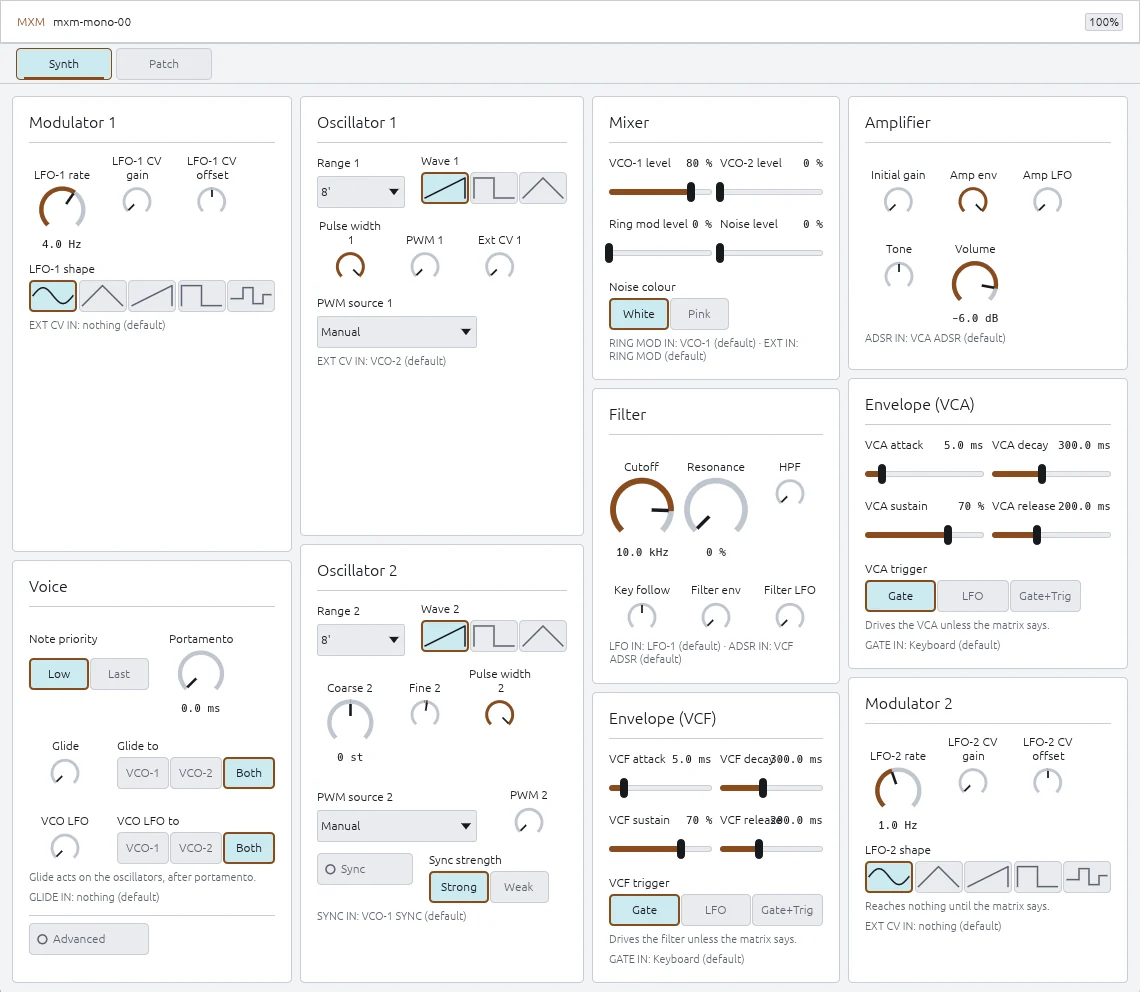
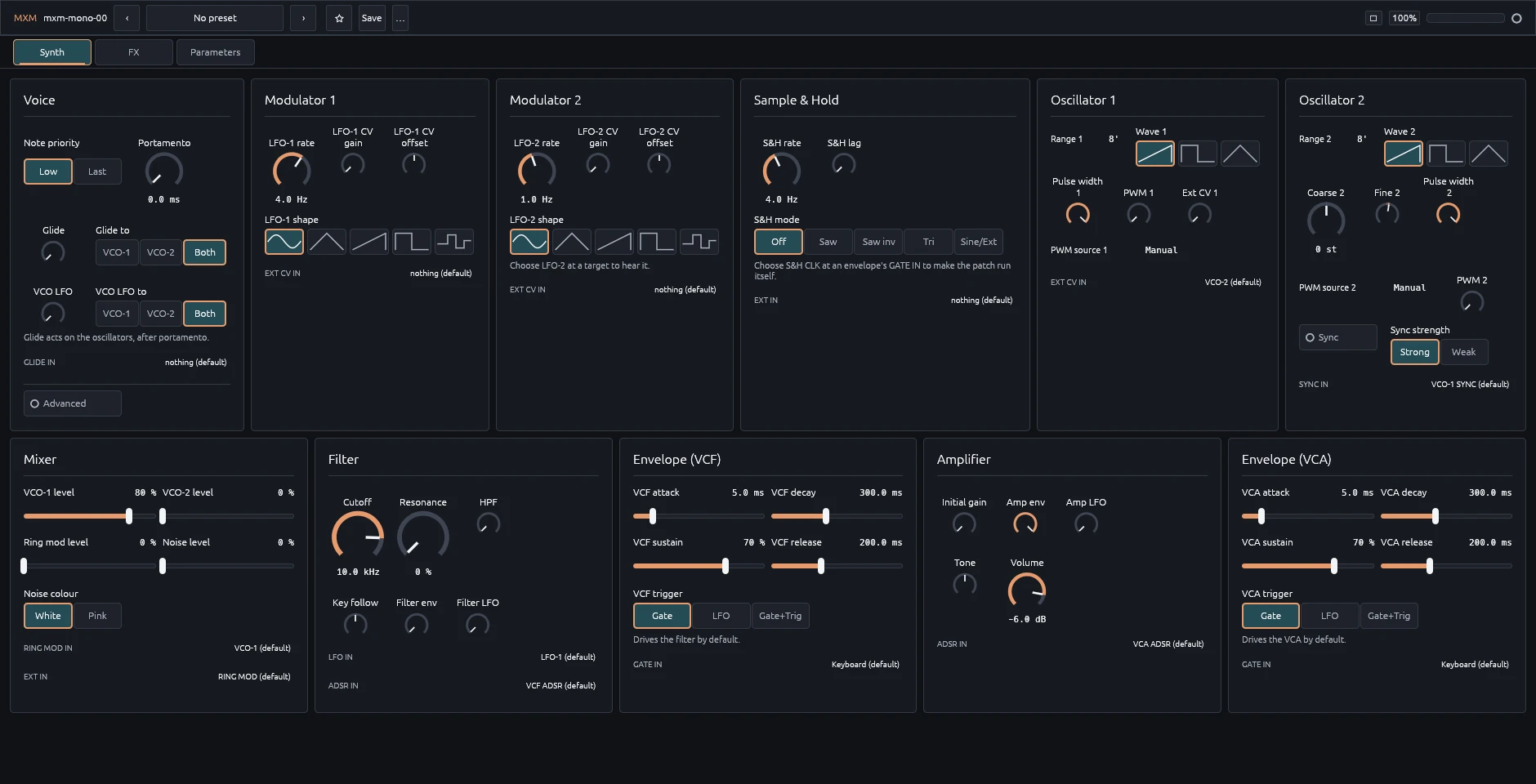
This is the big semi-modular in the collection. It combines the Roland System-100’s 101 synth and 102 expander into one voice, then swaps the patch cords for an automatable routing matrix.
You get two oscillators, a four-channel mixer, a high-pass filter, and a resonant diode ladder. VCO-2 has wide tuning, ring modulation, and both strong and weak sync. Strong sync locks hard; weak sync hangs around musical intervals and slides between them.
Two LFOs, two ADSR envelopes, sample-and-hold, and a matrix clock can keep a patch moving after you let go of the keyboard. Phaser, delay, and spring reverb finish the signal path.
The routing matrix
The matrix has 15 inputs and 14 possible sources. Every connection is a normal plugin parameter, so you can automate a route or lock it to a step in MXM Player.
Choose Default on any row to restore the original connection. The Patch view also shows the signals moving through the active cells, which makes self-running patches much easier to follow.
Interface
The instrument is split into four views:
| View | What is there |
|---|---|
| Synth | The main voice, arranged in signal order |
| Patch | Routing matrix and sample-and-hold |
| FX | Phaser, delay, and spring reverb |
| Parameters | All 82 parameters with exact value entry |
Modules wrap as the window narrows, and zoom runs from 75% to 200%. The layout changes shape without changing the signal order.
Presets
There are 50 factory presets with detuned oscillators, intervals, sync, ring modulation, noise, sample-and-hold, drones, self-running patches, and all three effects.
Init starts with one saw through an open filter. VCO-2 is seven cents sharp, so bring it up in the mixer and the oscillators start beating straight away.
Status
| Current state | |
|---|---|
| Format | CLAP instrument |
| Target systems | Windows, macOS, Linux |
| Editor | All four views are built; final visual checks remain |
| Validation | Project tests and clap-validator pass |
| Commercial DAW | Not tested yet |
| Hardware comparison | Not done yet |
The model is stable in the project tests. A proper side-by-side listen with the hardware is still on my release checklist.
The inspiration
mxm-mono-00 started with the Roland System-100
Roland and System-100 are trademarks of Roland Corporation. I use the names only to identify the hardware that inspired this plugin.
MXM is my independent project. It is not affiliated with, authorised by, sponsored by, or endorsed by Roland Corporation. I do not use or distribute original firmware, samples, artwork, or panel graphics, and this is not a Roland product.