 Modal synth
Beta
MXM Modal Synth
Built on code from Mutable Instruments ElementsNot affiliated with Mutable Instruments
A bow, a breath and a strike play into a resonator that rings like a bar, a plate, a bell or a string. Eight voices share one room.

Sound
MXM Modal Synth has eight voices. In each, a bow, a breath and a strike play into a resonator. The strike can be one of nine recorded hits, a mallet, a plectrum or a shower of particles, and Contour shapes the bow and the breath, from a short pluck through a swell to a held note.
Model chooses what the exciters play into. Modal rings like a bar, a plate or a bell, and Geometry moves it from a stretched string through bars and plates to bells. String is one string. Strings is five strings tuned to a chord, and Geometry picks the chord from eleven. Dark FM swaps the resonator for a dark pair of FM voices that the exciters’ controls shape. Brightness, Damping and Position finish the tone: how bright it rings, how long, and where it is struck and heard.
All voices share one room. Space runs from the dry exciter, through a widening stereo image, into a reverb that grows at the top of its travel. A route can take Space past the end of the knob, and an envelope that carries it beyond 175 % freezes the reverb while a key is held.
The voice is ported from Emilie Gillet’s MIT-licensed code for Mutable Instruments Elements and matches it bit for bit, with one change: a struck mode above about 7.4 kHz, which in the original can ring louder without end, dies away here like the rest.
Modulation
Each voice has three envelopes that double as function generators. They can start with the key, wait for a trigger, follow another signal or cycle as a wave of their own. Three LFOs have seven shapes, a fade-in and tempo sync. Sixteen route slots connect 19 sources to 40 targets, among them every exciter and resonator control, Space, and the model itself, so a random value can pick a different resonator for each note. Each route appears on the card of the control it moves. At Init nothing is routed.
Playing
Up to eight notes in Poly. Mono and Legato play one voice with last-note priority. Glide works in all three, the bend range goes up to 24 semitones, and Coarse transposes three octaves either way. Strength, the accent of all three exciters, has no knob and is moved only by routes.
The editor
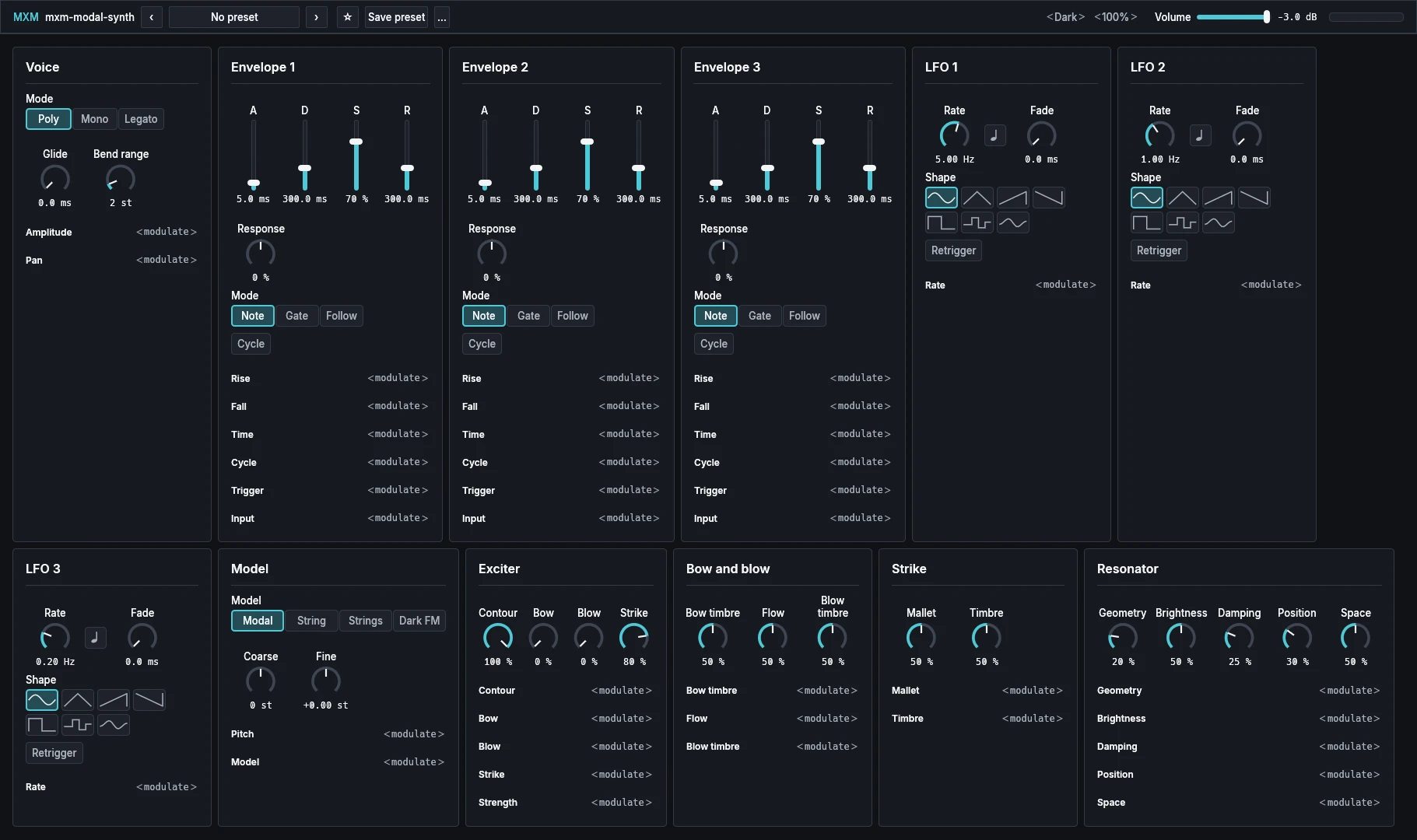
Twelve cards: Voice, Envelope 1 to 3, LFO 1 to 3, Model, Exciter, Bow and blow, Strike and Resonator. The editor opens at 1821 × 1080 with all twelve on one page, and it can shrink to 446 × 360.
Presets
59 factory presets, each one idea pushed to its end, in basses, leads, pads, keys, plucks, brass, strings, percussion, effects, sequences and drones. We levelled them in the sound itself, never with Volume. Init has no file. It is the modal resonator, struck, with Space at the middle and nothing routed.
Status
Beta. MXM Modal Synth is done. Its parameters are fixed for good, so a song saved now opens the same way in every later version. We have approved its sounds and run it in Bitwig as a CLAP and a VST3.
Origin