 Sampler
Beta
MXM Creative Sampler
Drop a sound on one of two layers and play it at once. Then shape it: repitched like tape, stretched, or scattered into grains, and run through a converter that sounds like an old sampler.

Sound
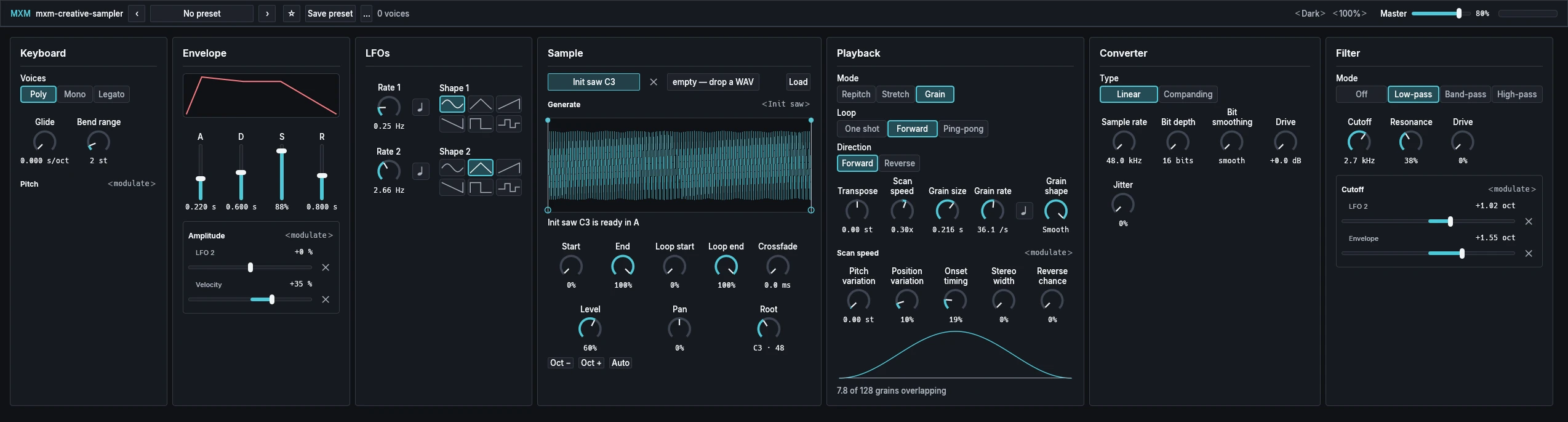
MXM Creative Sampler has two layers, A and B. Drop an audio file on a layer and you can play it straight away. Each layer reads its sound in one of three modes. Repitch plays higher notes faster and shorter, like tape. Stretch keeps pitch and length apart, so every note lasts as long as the sample. Grain turns the sample into a cloud of small overlapping grains, with controls for their size, rate, shape, detune and stereo width, where in the sample they come from, how evenly they start and how often one plays backwards.
After A and B are mixed, each voice goes through a converter modelled on old samplers: a lower sample rate, fewer bits, stepped or smooth output, drive and unsteady timing, with a linear or a companding type. At Init it changes nothing. A driven multimode filter and an amplitude envelope follow.
The sampler also generates 17 source sounds of its own, and 16 of them change their spectrum along their length. A new instance starts with a generated saw on layer A.
Samples
It reads WAV, AIFF, FLAC, ALAC, MP3, AAC in M4A and Ogg Vorbis, recognised by their content rather than their file extension. Each layer holds up to two minutes at 48 kHz. A WAV with its own loop arrives looping, and in tune if the loop is a pitch. Its root note comes from the end of the file name if that names a note, or else C4, and Auto listens for it when you ask. The host saves the audio inside your project, so a song keeps working after the original file is moved or deleted.
Modulation
Two LFOs, the envelope, velocity, key, mod wheel, pressure, bend, a random value per note and each layer’s own audio can reach five targets: amplitude, cutoff, pitch, and the scan speed of each layer. Each route sits under the control it moves. At Init, velocity and LFO 2 are on the amplitude, and LFO 2 and the envelope on the cutoff.
Playing
Up to eight notes in Poly, one in Mono and Legato, which remember up to 16 held keys. Glide works in Mono and Legato and is measured in seconds per octave. Polyphonic pressure and per-note tuning, volume and pan all work.
The editor
Seven cards on two pages: Keyboard, Envelope and LFOs, then Sample, Playback, Converter and Filter. The editor opens on the Sample card, since loading a sound comes first. It opens at 1780 × 1077 and can shrink to 520 × 420. Controls that belong to a mode the layer isn’t in are hidden, and the card keeps room for them so nothing jumps.
Presets
Four factory presets: Long bass, Held pad, Struck hit and Drifting texture. They carry no audio. Each is a different way of reading the sound you have loaded. Init keeps the loaded audio, its root note and its region, and resets everything else.
Status
Beta. MXM Creative Sampler is done, and its parameters are fixed for good, so songs saved now keep their meaning. It ships four presets, where our other instruments have about fifty. The Load button and the hints on the panel say WAV, but every format above loads. It leaves out recording, multisampling, slicing, streaming large libraries, sequencing and built-in effects on purpose.