 Drum instrument
Beta
MXM Chaos Drums
Here a note doesn't fire a hit. It adds charge to one of sixteen cells, and the way you play decides how the drum sounds.

Sound
MXM Chaos Drums has sixteen cells, and each cell is one drum. A note doesn’t start a sample or an envelope. It adds charge to its cell. Holding the note keeps filling it, sounding spends it, and at rest it leaks away. A cell can never be louder than its charge allows, so how you play is part of the sound: loud hits die sooner, a long note sustains, fast repeats stack charge, and a starved cell sputters.
Each cell plays one of 25 models, drums built from up to four of five engines called Ring, Spark, Fold, Loop and Dust. Each engine changes character as its charge rises: fill the kick past its threshold and it stops dying and starts to sing. There is a kick, a snare, hats, toms, hand drums, a clap, cymbals, bells, shakers, a guiro and a brush, and each engine on its own. Chaos Drums is an original design and copies no machine.
Temper
The cells sit on a 4 × 4 grid whose edges wrap round. At Temper 0 every cell is a predictable drum. As Temper goes up, charge flows from fuller cells to emptier neighbours and each cell’s sound feeds into theirs, so the kit starts to play itself.
Every held note draws from one shared supply, the Pool, so holding many at once makes the kit sag and pump. Two buses can power cells with no note at all, for drones.
However wild it gets, it repeats exactly. A Seed chooses the jitter, and the same notes from the same start give the same samples at any buffer size, on every platform. With Reset on play, each playback starts from rest, so a bounce is what you heard.
Playing
Notes 36 to 51 strike cells 1 to 16, on every MIDI channel. Notes 52 to 67 touch them instead, like a hand on the drum, feeding the cell’s own sound back into its charge. Each cell plays through the main stereo output or a mono output of its own.
Modulation
Each cell has four routes, from three LFOs, the mod wheel, pressure, velocity or a random draw per hit. The kit has four more, for the Kit card’s knobs, such as Temper and the buses. Every route is a row under the knob it moves.
The editor
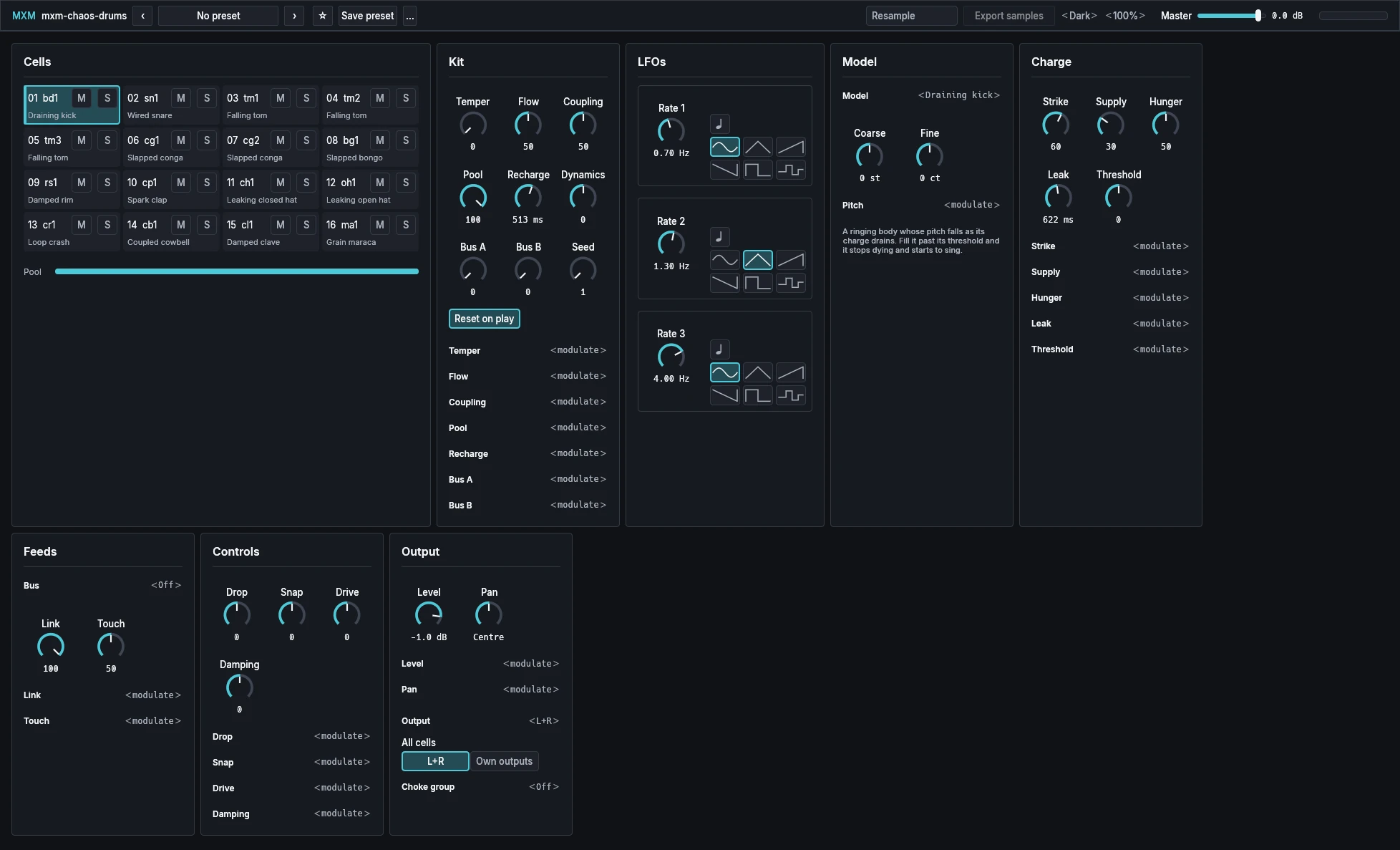
Eight cards. Cells, Kit and LFOs act on the whole kit, and Model, Charge, Feeds, Controls and Output edit the selected cell. The Cells card draws the grid, each cell’s charge as a fill and the charge moving between cells as lines. The editor opens at 1346 × 791 and can shrink to 444 × 320. Resample freezes the kit, and Export samples writes it out as 24-bit WAV one-shots.
Presets
50 kits, abstract and far apart: struck drums, ringing tones, grit, drones and kits with modulation everywhere. All use the same keys, so one drum part plays every kit. Init is a balanced kit at Temper 0.
Status
Beta. MXM Chaos Drums is done and tested: all 25 models play through the editor, and the CLAP validator finds no faults.