mxm-folded-spring
Inspired by Roland System-100 spring reverbIndependent project · not affiliated with Roland Corporation
A small spring reverb that can get wonderfully out of hand.
The effect, editor, tank models, presets, and audio layouts are working. Commercial DAW tests are still to come.
Sound
A spring reverb sends sound along metal springs and picks it up at the other end. The different travel times make that familiar splashy boing.
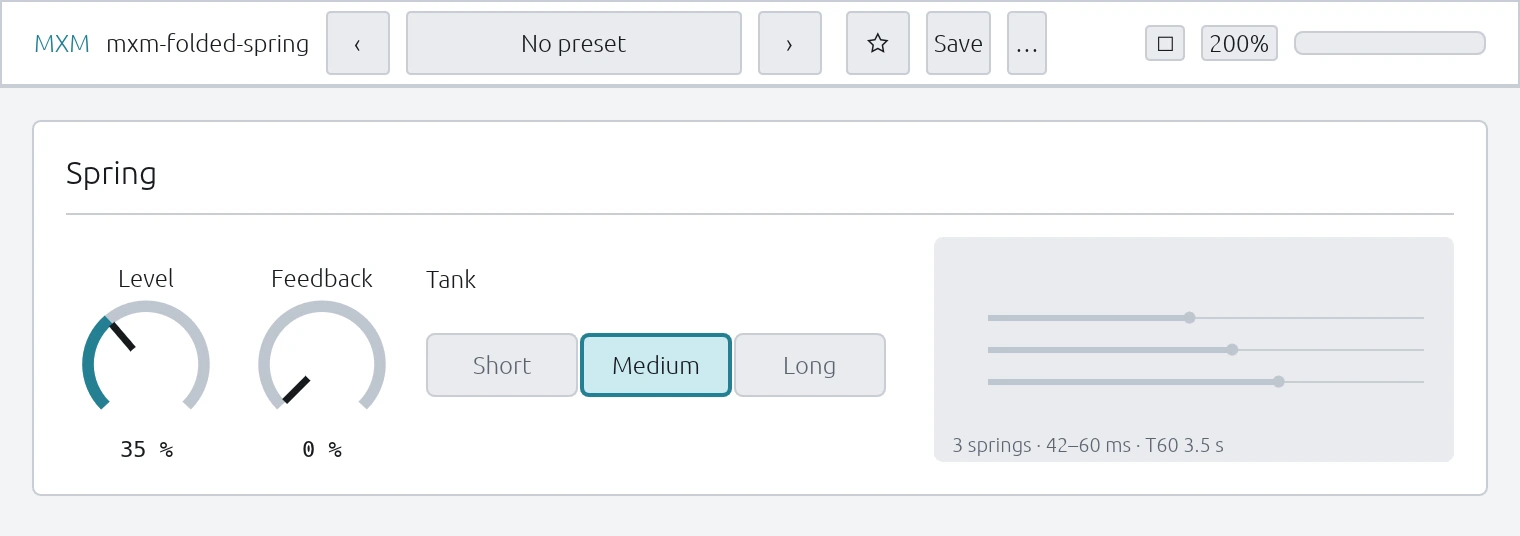
mxm-folded-spring uses the same reverb code as mxm-mono-00. Medium is the original model: three springs with a decay of about 3.5 seconds. Short is brighter and quicker. Long is darker and rings for almost six seconds.
Short and Long are my variations on the model, not measurements of other hardware.
Turn up the feedback
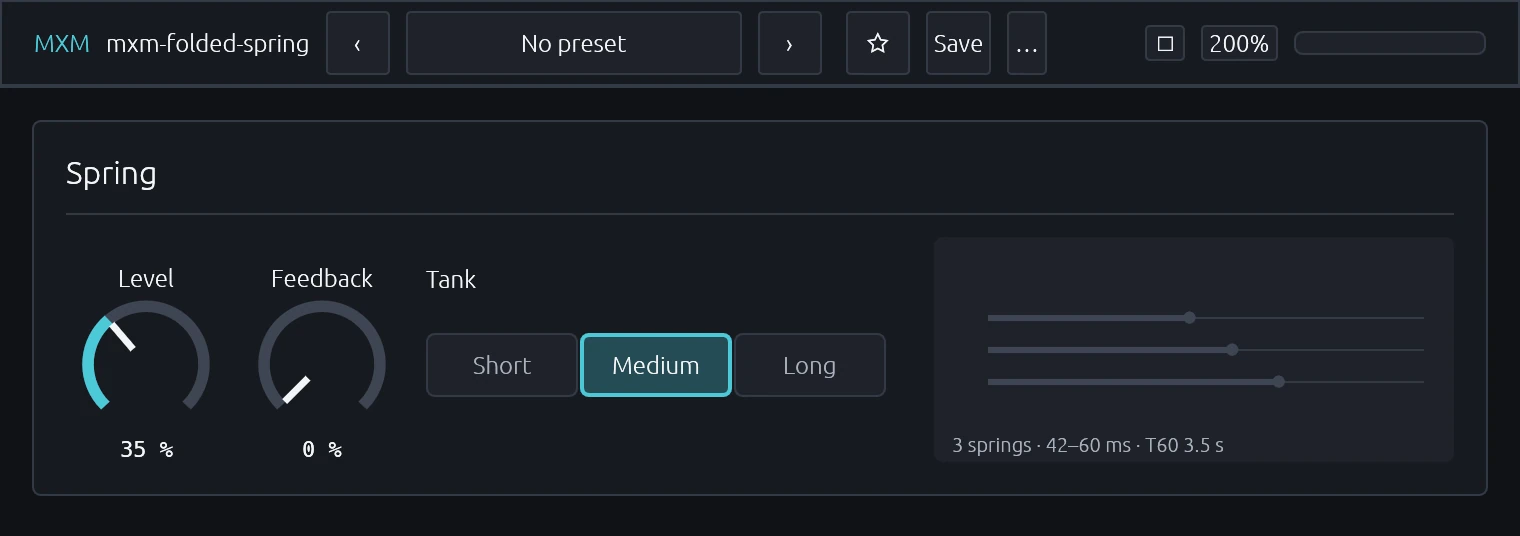
Level adds the spring return without touching the dry signal. Tank chooses the size. Feedback sends the return back through the springs again.
Most of the Feedback knob makes the tail longer and darker. Near the top, the reverb can hold a note on its own. The loop softens as it gets louder, so it sings instead of turning straight into a square wave.
Interface
Two knobs and a three-way tank switch sit beside the spring display. The lines use one shared time scale, so the longer tanks really do look longer. Their glow follows the wet signal.
Changing tanks briefly fades the reverb out, swaps the model, and fades it back in. The dry sound keeps playing. Set Level to zero and the tank drains before the effect goes to sleep, so an old tail cannot jump out later.
Presets
There is one preset for each tank, plus Regenerating for the long, feeding-back sound. Init uses Medium with no feedback—the same spring setup found inside mxm-mono-00.
Status
| Current state | |
|---|---|
| Format | CLAP audio effect |
| Audio layouts | Mono or stereo, with one mono tank return |
| Target systems | Windows, macOS, Linux |
| Validation | Project tests and clap-validator pass |
| Commercial DAW | Not tested yet |
| Hardware comparison | Not done yet; Short and Long are original variations |
In stereo, both channels feed one tank and the mono return comes back to both sides. The dry channels stay where they are.
The inspiration
mxm-folded-spring started with the Roland System-100 spring reverb
Roland and System-100 are trademarks of Roland Corporation. I use the names only to identify the hardware that inspired this plugin.
MXM is my independent project. It is not affiliated with, authorised by, sponsored by, or endorsed by Roland Corporation. I do not use or distribute original firmware, samples, artwork, or panel graphics, and this is not a Roland product.