 Delay
Beta
MXM Bucket Delay
Inspired by Panasonic MN3011Not affiliated with Panasonic
A bucket-brigade delay modelled on the chip family rather than on one pedal. The clock is the only time control, so a longer delay is also darker, noisier and grittier.

Sound
MXM Bucket Delay models the bucket-brigade device itself, not a particular pedal built around one. Its clock is the only time control. Lengthening the delay slows the clock, and that also narrows the bandwidth, raises the noise, deepens the distortion and bends the pitch of whatever is already in the line.
There are four lines to choose from, with 1024, 3328, 4096 and 8192 stages. Length, noise, bandwidth and distortion move together with the line, so two lines set to the same delay time sound different. The filters, the distortion, the noise and the compander all sit inside the feedback loop, so every repeat goes round the whole circuit again and wears out rather than just getting quieter.
Taps
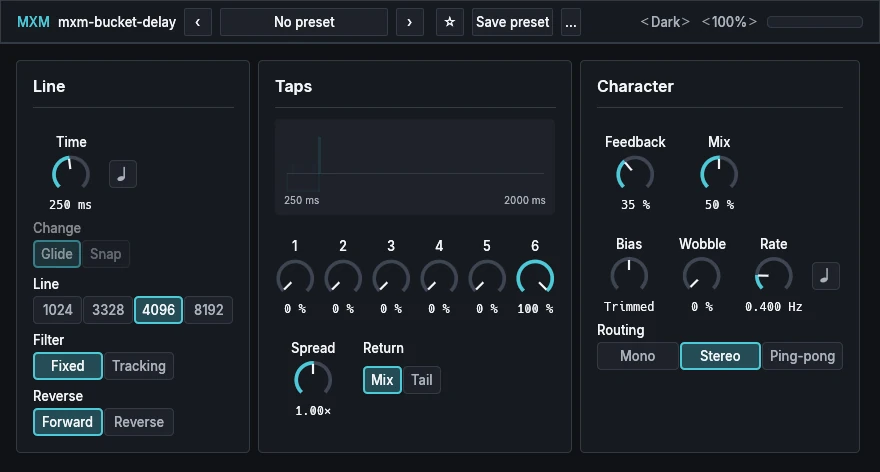
The six taps are copied from the MN3011, a six-tap chip that was sold as a reverb, and whose taps are deliberately not in multiple proportion with each other. Each tap has its own level. The last tap on its own is a plain echo. Open the others for rhythms, or all six for a reverb-like wash. Spread stretches or bunches the pattern, and the same spacing is scaled onto every line.
Using it
Time runs from 10 ms to 2 s, or in note lengths when synced to the host. In sync, Change decides what a tail does at a new tempo: Glide bends into the new time as tape would, Snap jumps at once. Feedback self-oscillates in its last tenth, the line singing on its own noise. Wobble and Rate move the clock for chorus and vibrato, Reverse flips the input into the line, and the echoes can sit in mono, in stereo, or bounce between the sides.
Mix is a crossfade from the dry signal to the echoes alone. At 0 % the effect is off, the lines are emptied and it uses no processing.
The editor
Three cards: Line, Taps and Character. The Taps card draws the six taps at their real delay on a scale up to 2000 ms, each as bright as its level, with a loop line from the taps that feed back. Mix and Feedback are on the Character card. The editor opens at 880 × 472 and can shrink to 562 × 400.
Presets
50 presets in seven groups: echoes, washes, rhythms, modulation, reverse, stereo routing, and the warts, such as Below spec, Starved and Singing line. Try Reverberation first: it opens all six taps at the weighting of the reference circuit’s own resistors. Chorus is the same device at a very short delay with no feedback at all. Init is a plain echo of a quarter of a second, on the 4096 line, from the last tap only.
Status
Beta. MXM Bucket Delay is done and tested.
Origin