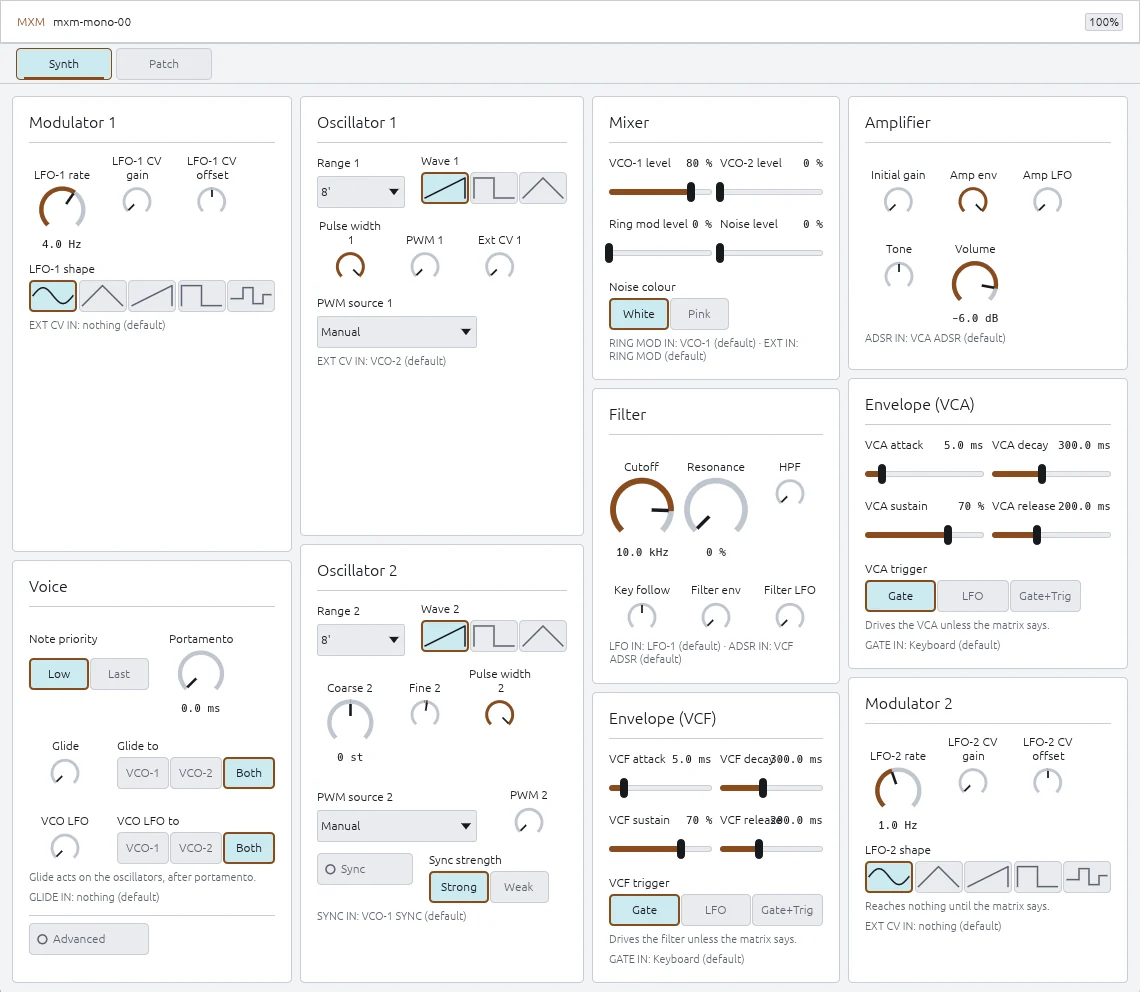
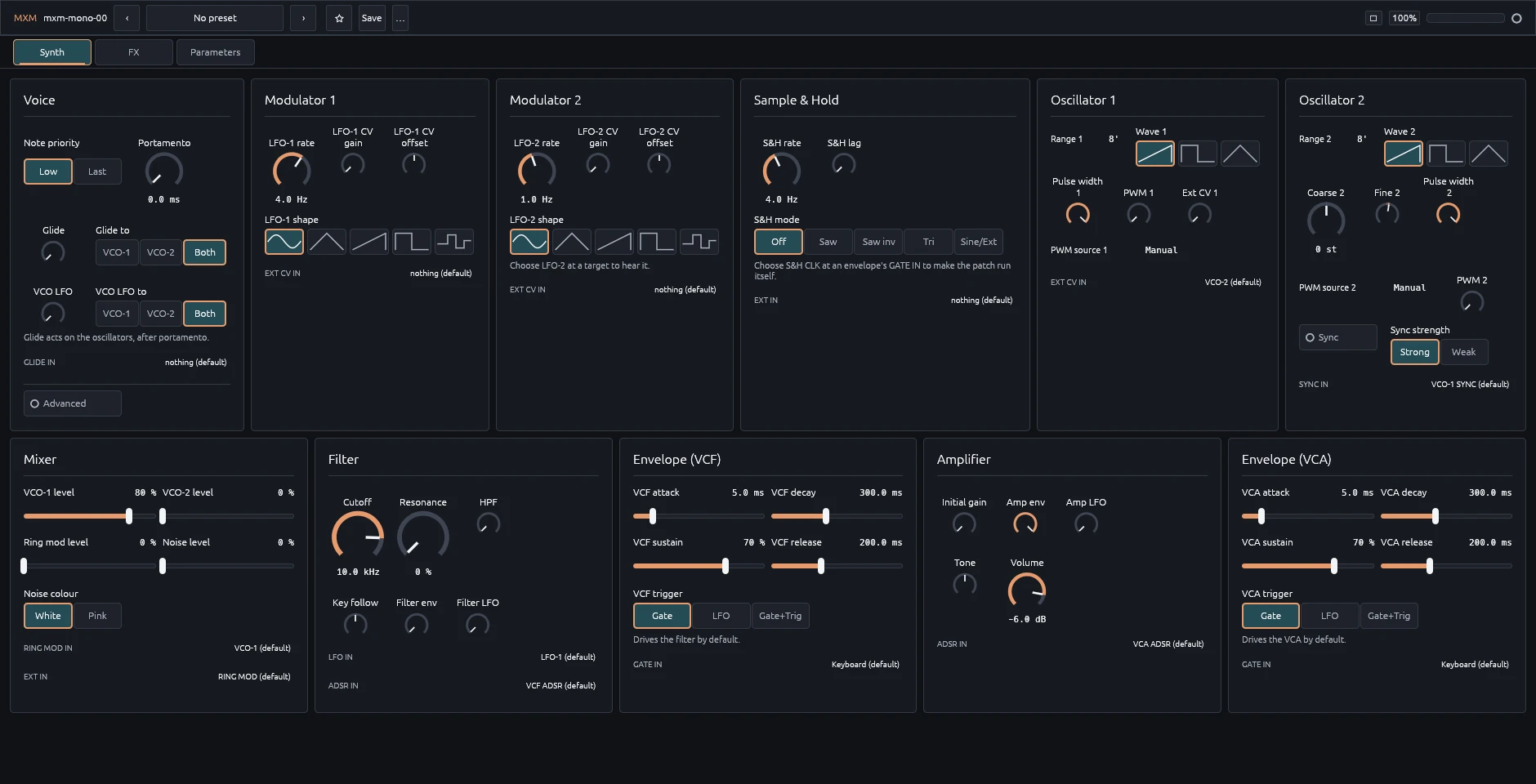
Nothing gets shuffled
Modules move to a new row, but the signal always reads the same way.
MXM Synth Collection
I’m making a small collection of CLAP synths and effects. They keep the fun quirks of the old machines, but get a fresh interface that fits your screen.
Coming to Windows, macOS, and Linux.
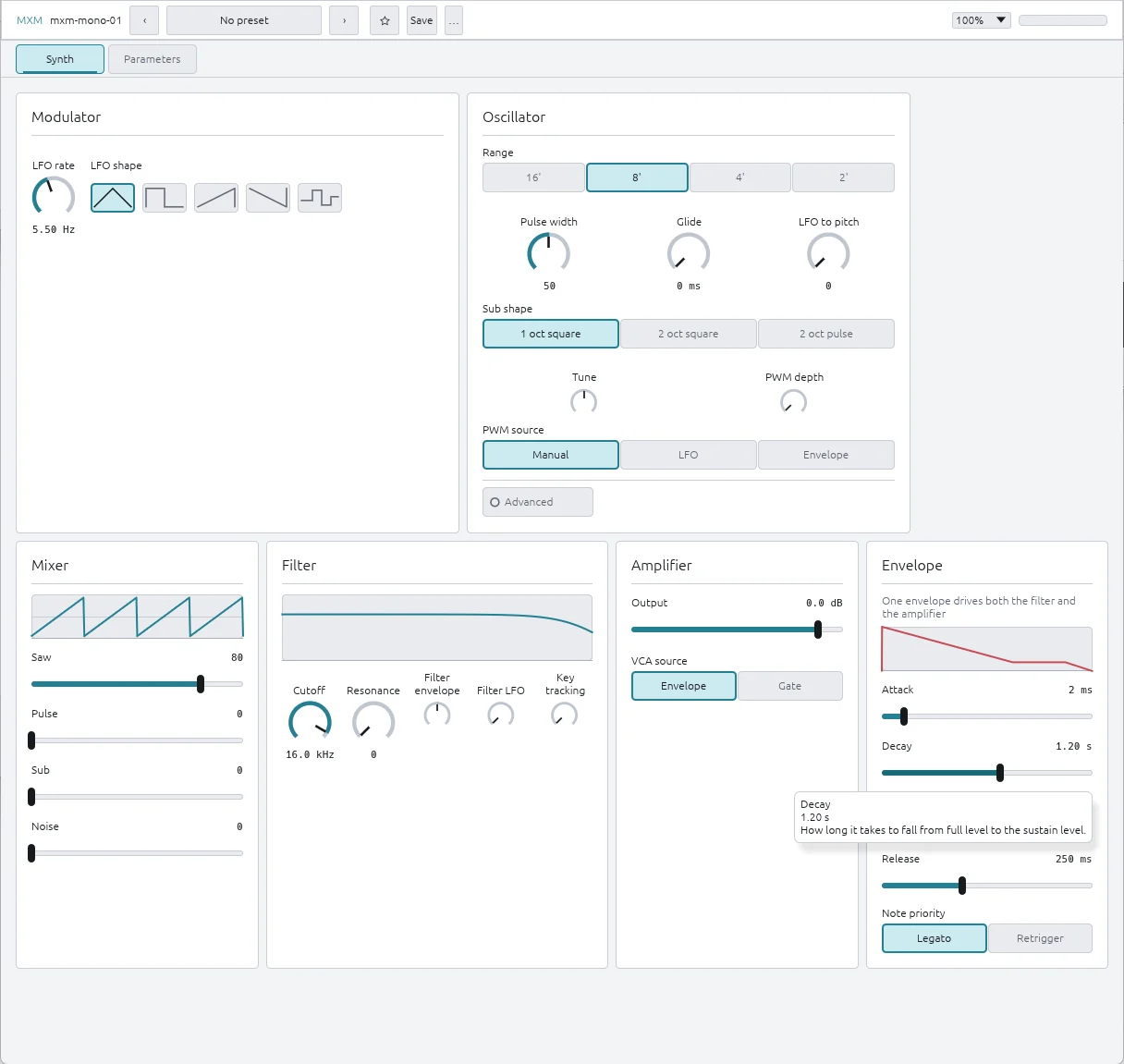
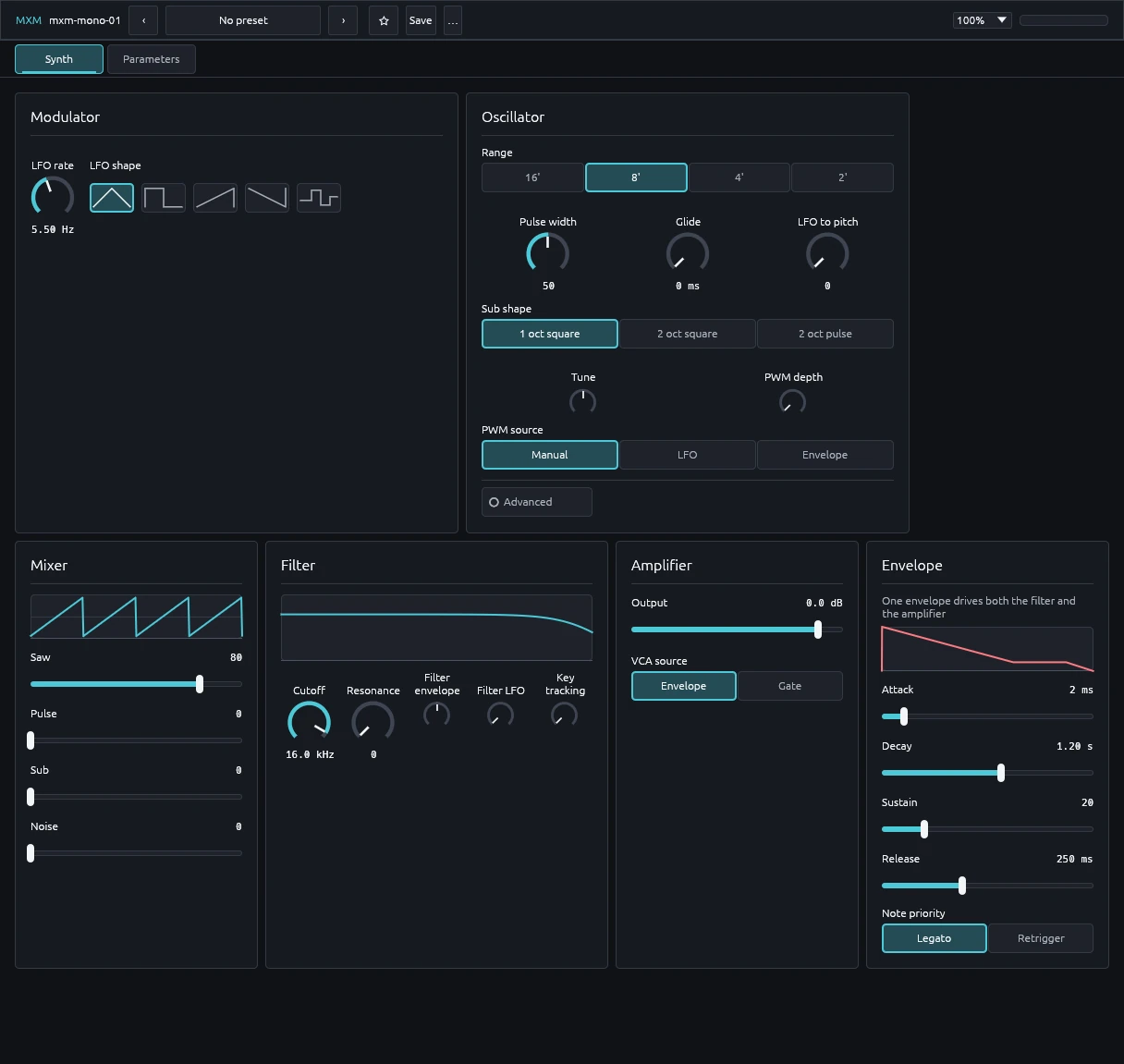
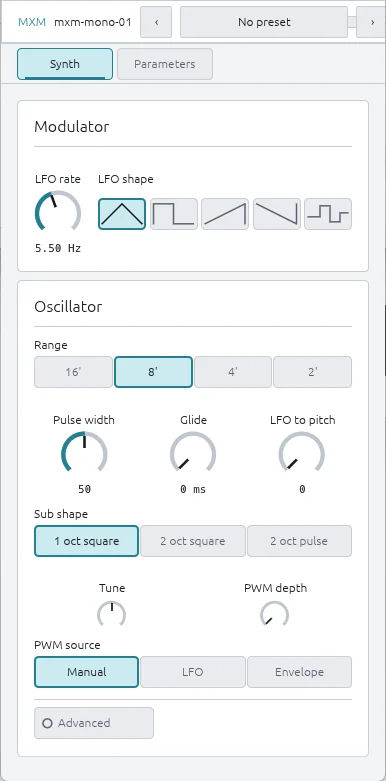
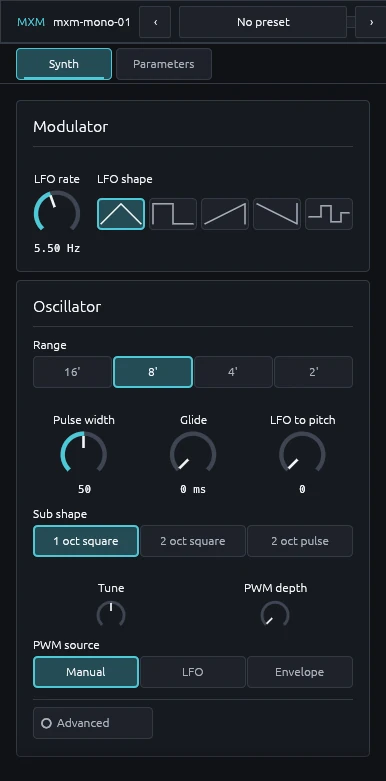
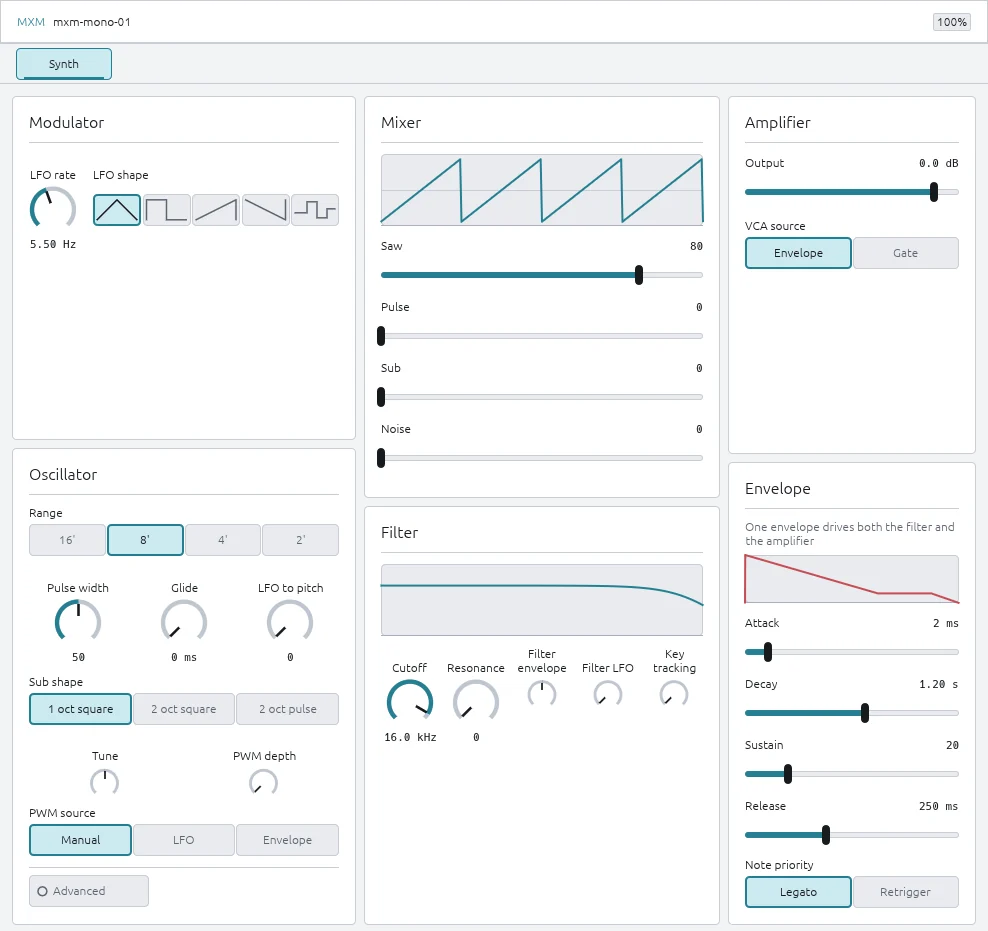
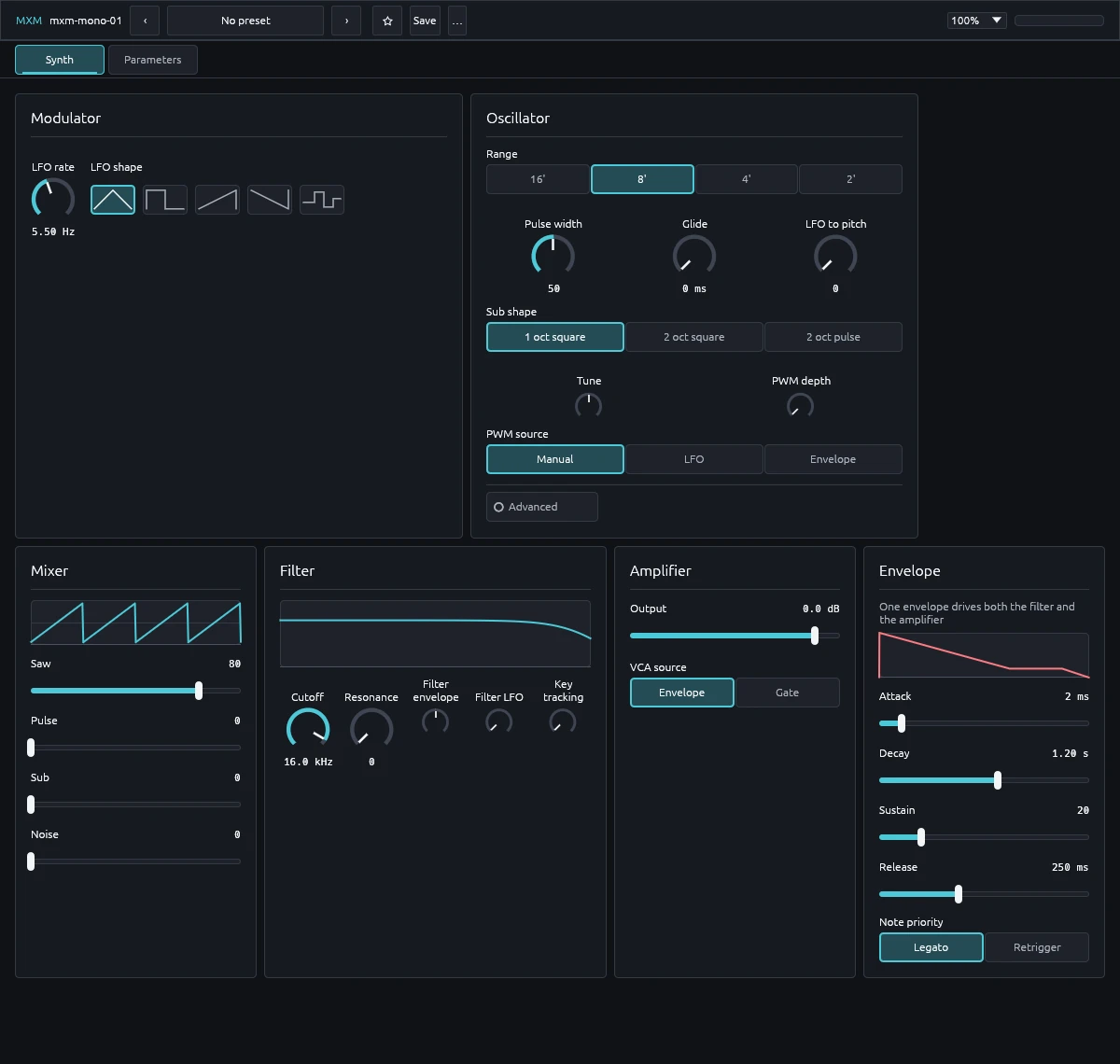
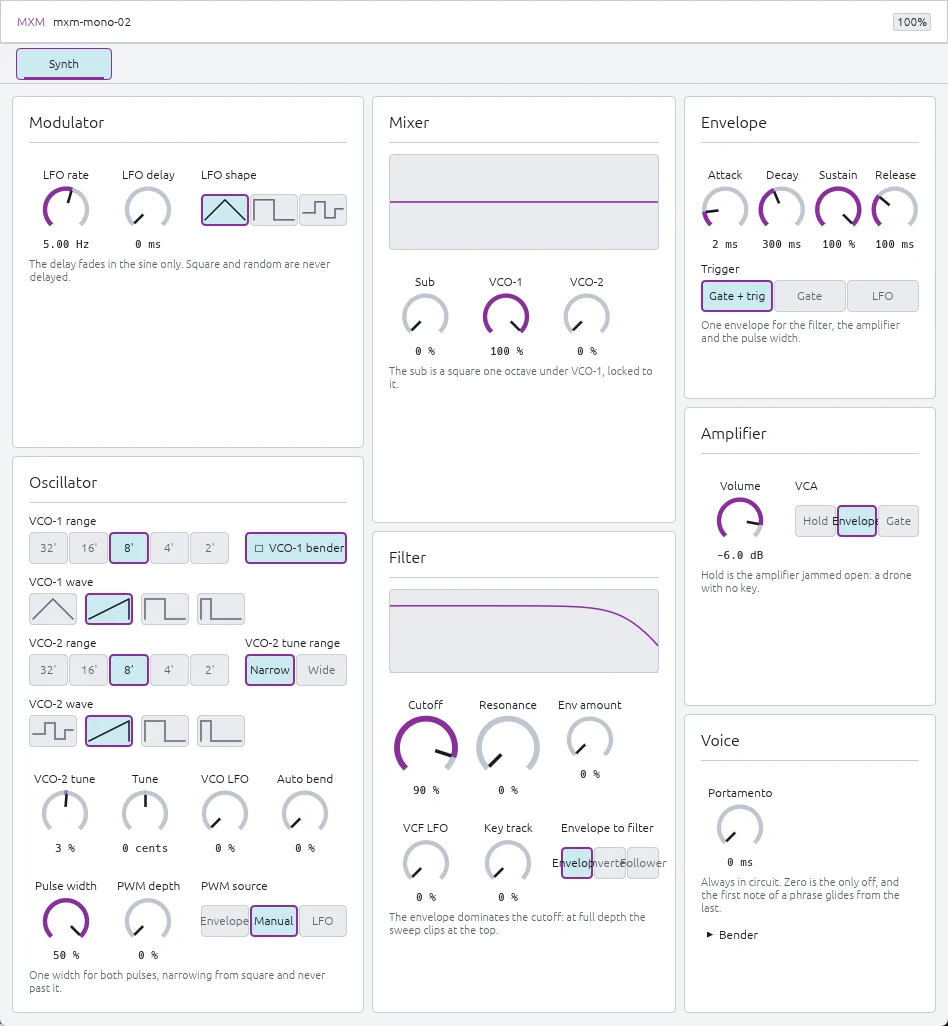
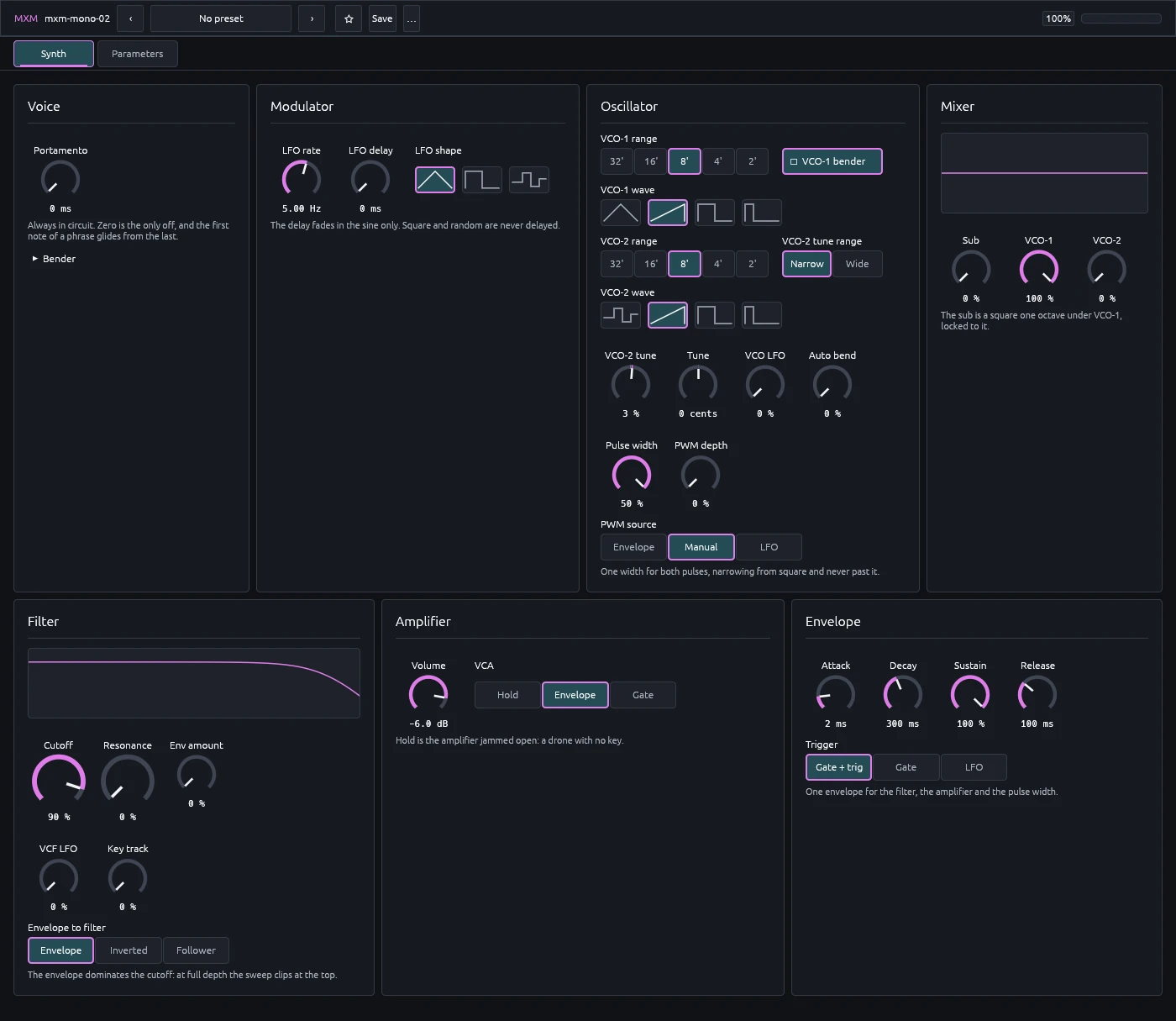
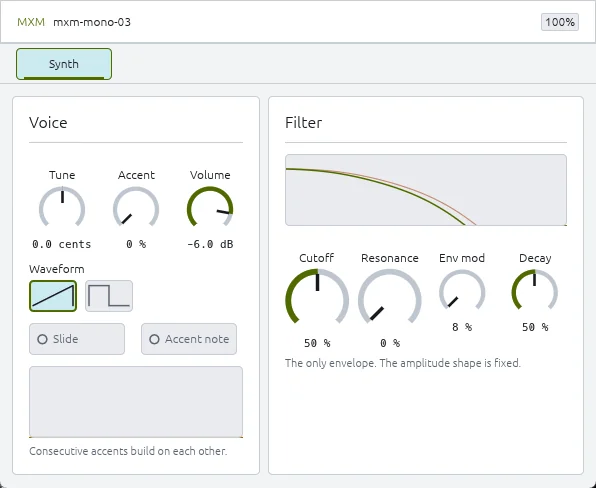
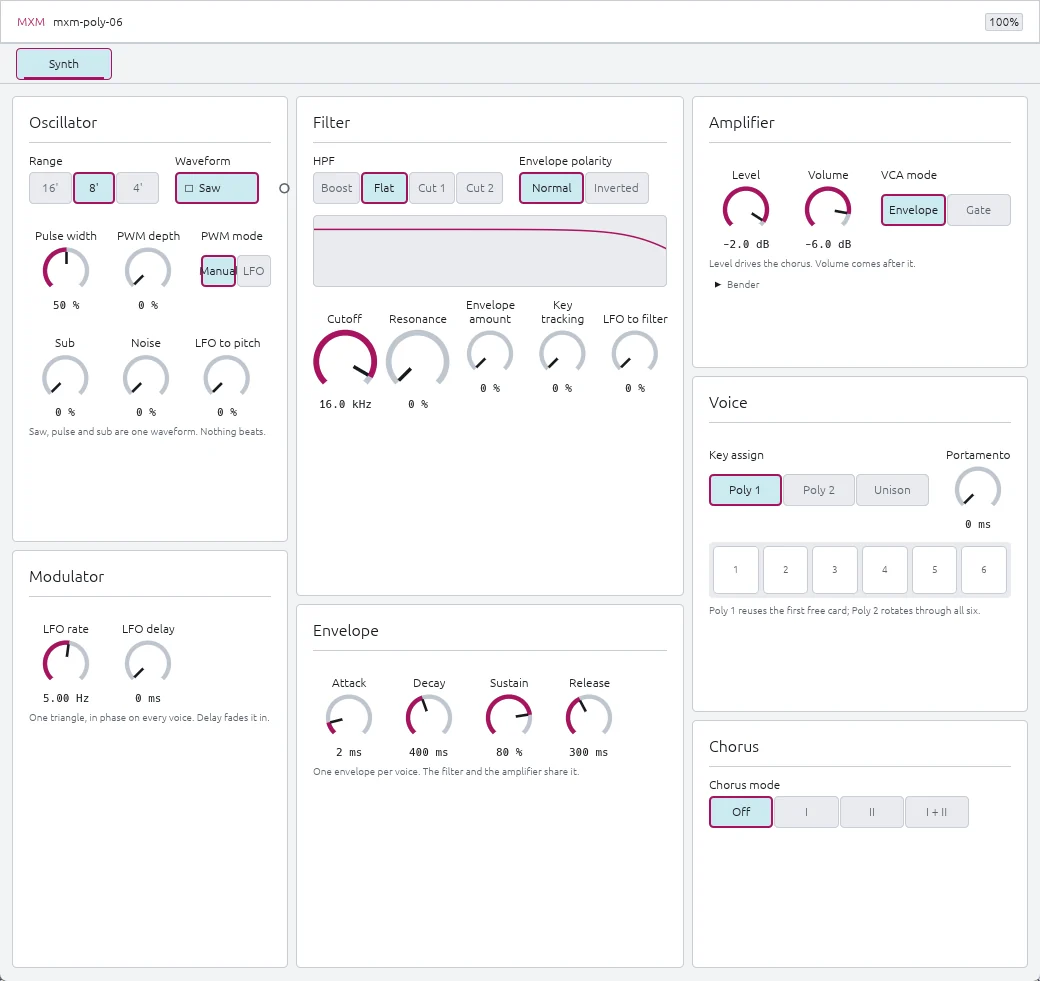
The modules wrap to fit, a bit like words on a page. Use a narrow tile, a normal plugin window, or the whole screen—the controls stay in the same order.
Modules move to a new row, but the signal always reads the same way.
Resize the layout, then choose any UI scale from 75% to 200%.
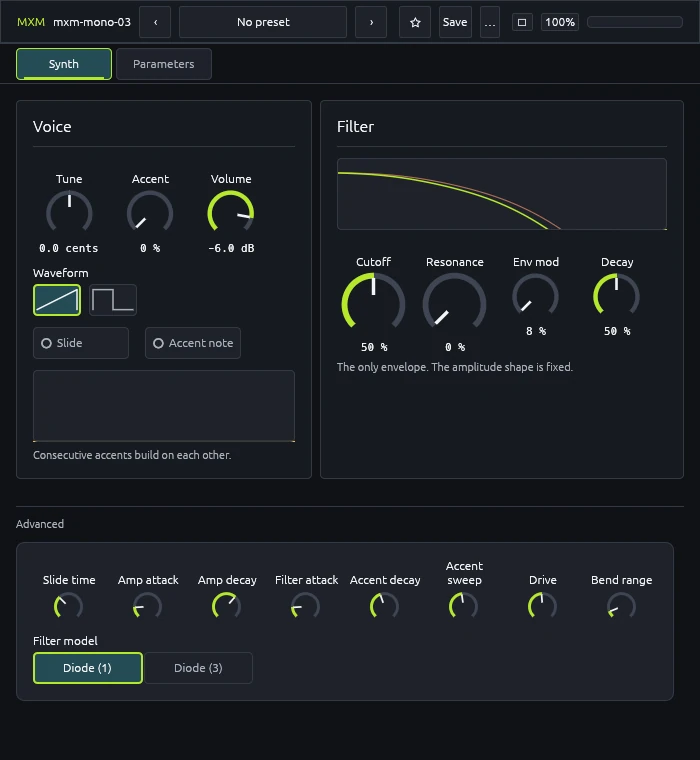
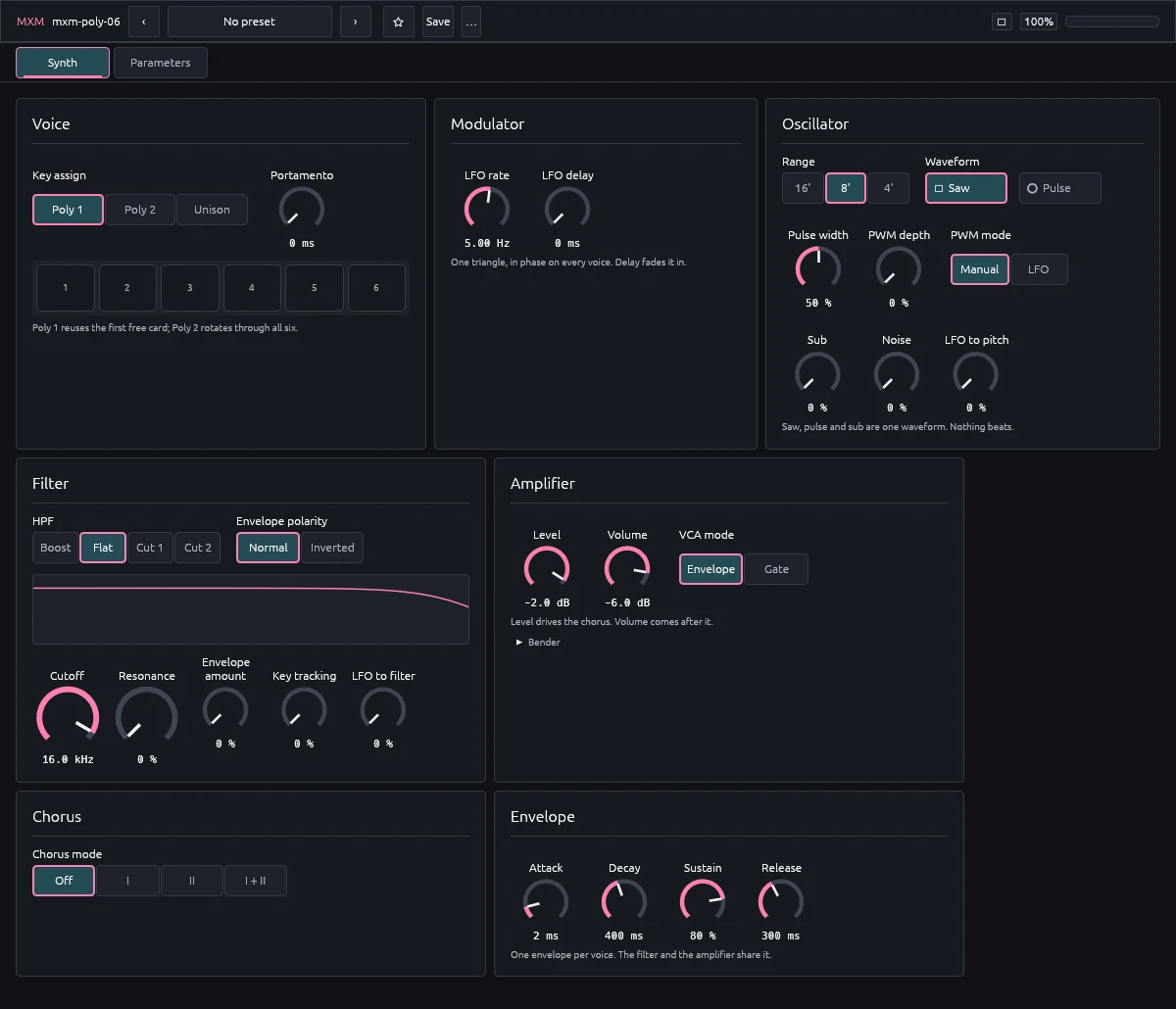
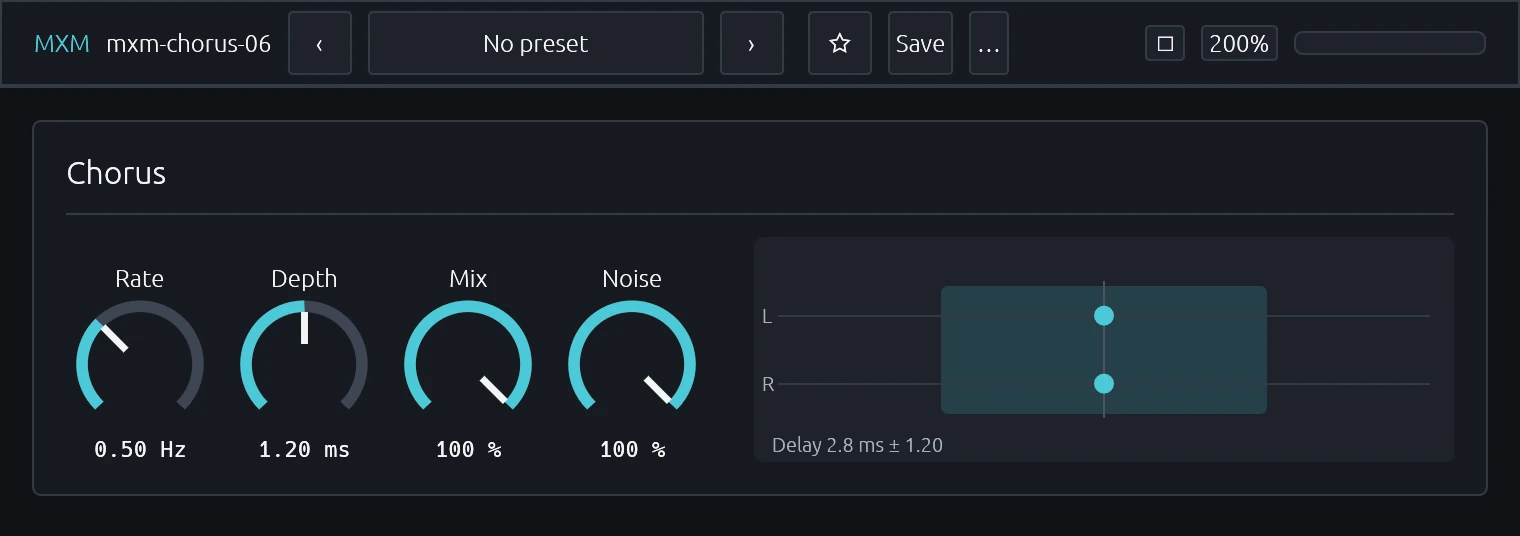
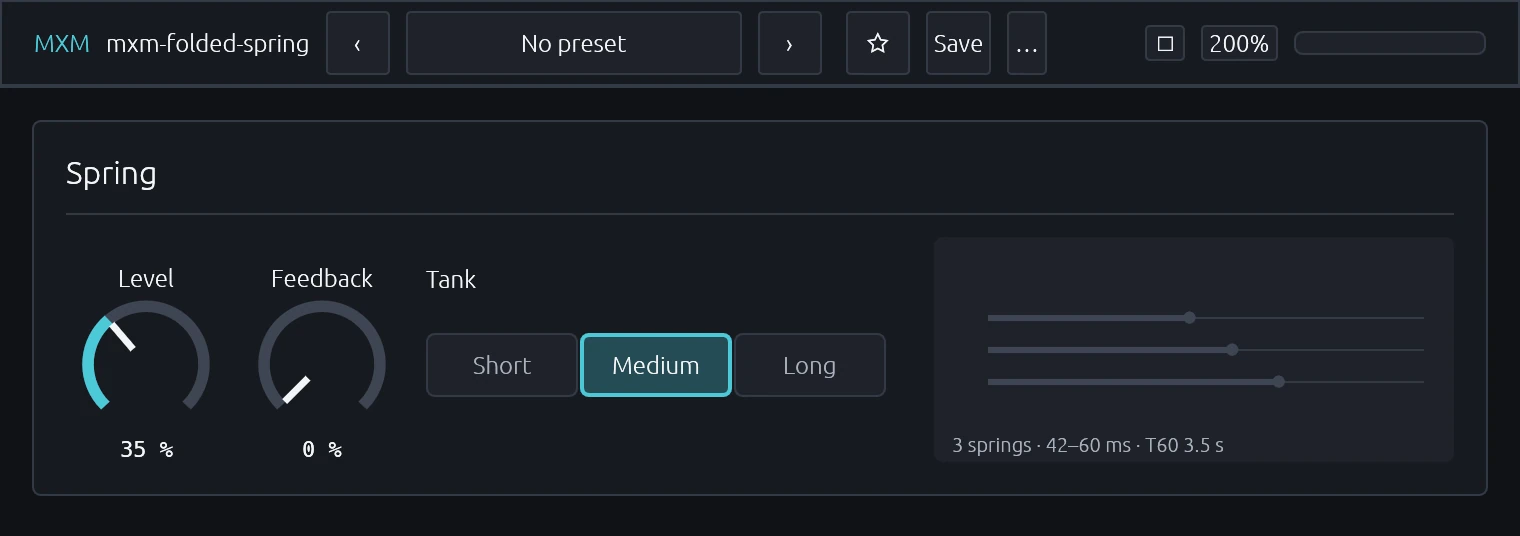
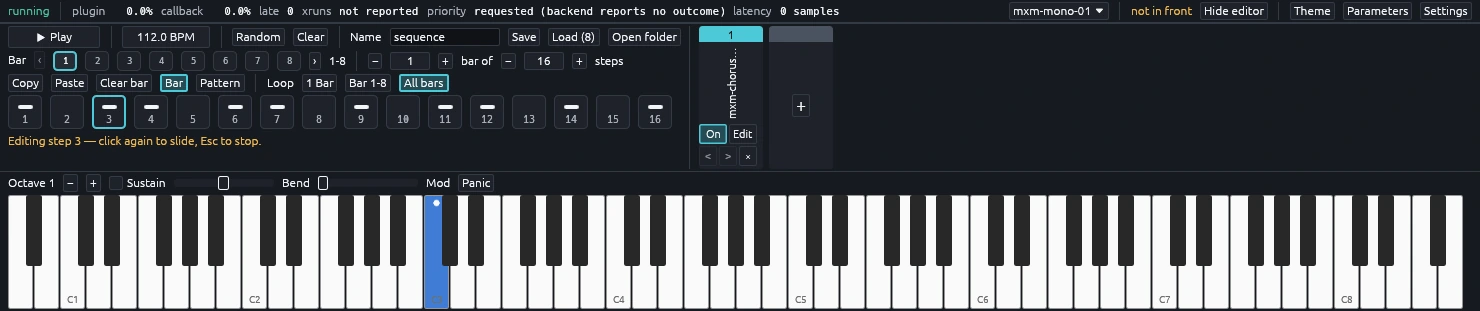
Pick whichever feels nicest. Both themes use the same clear layout.
There’s a quick one-oscillator mono, a beefy two-oscillator synth, an acid bass, a six-voice poly, and a semi-modular that can patch itself.
Inspired by the Roland SH-101
One oscillator, a sub, noise, and a shared envelope. Quick to learn and very easy to get moving.
Meet mxm-mono-01Inspired by the Roland SH-2
Two free-running oscillators, a locked sub, and one envelope shared by the filter, volume, and pulse width.
Meet mxm-mono-02Inspired by the Roland TB-303
A diode ladder, accents that build across notes, and slide right inside the synth voice.
Meet mxm-mono-03Inspired by the Roland JUNO-106
Six clean DCO voices, a bass-boosting high-pass setting, and the chorus that brings it all to life.
Meet mxm-poly-06Inspired by the Roland System-100
Two oscillators, two envelopes, two LFOs, three effects, and a routing matrix that can make the whole thing play itself.
Meet mxm-mono-00The chorus and spring reverb use the same code as their built-in versions. Now you can put them on anything.
Inspired by the Roland JUNO-106 chorus
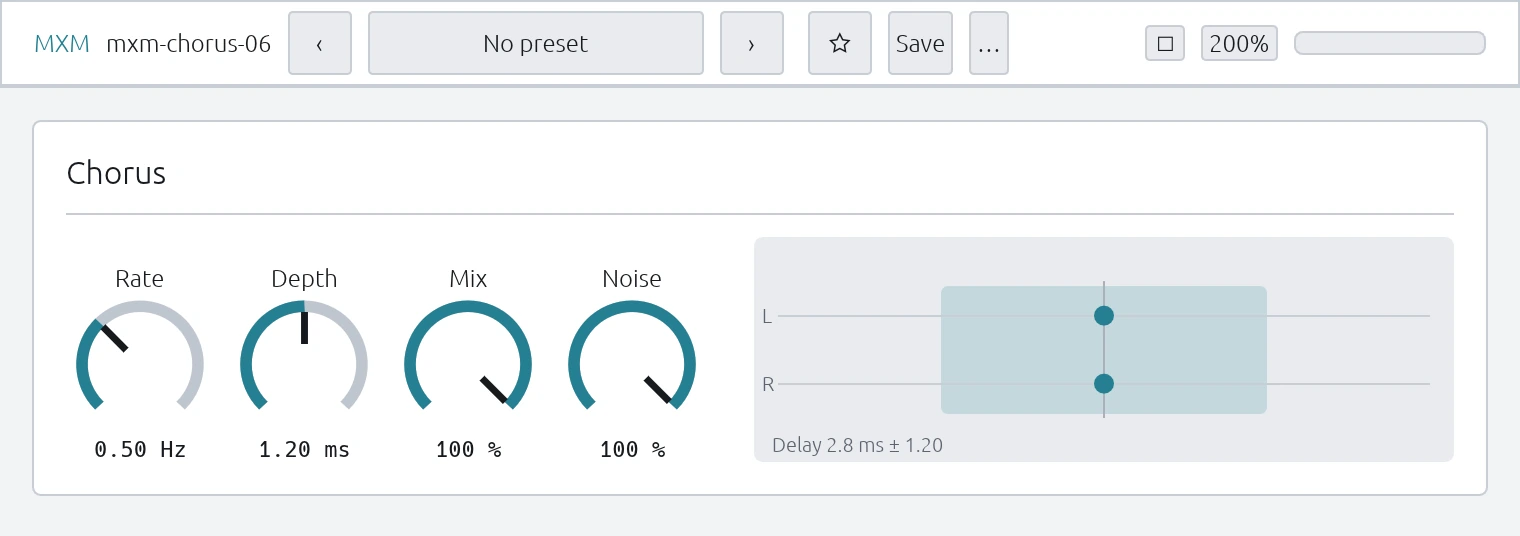
The chorus from mxm-poly-06, with its rate, depth, wet level, and noise opened up.
Meet mxm-chorus-06Inspired by the Roland System-100 spring reverb
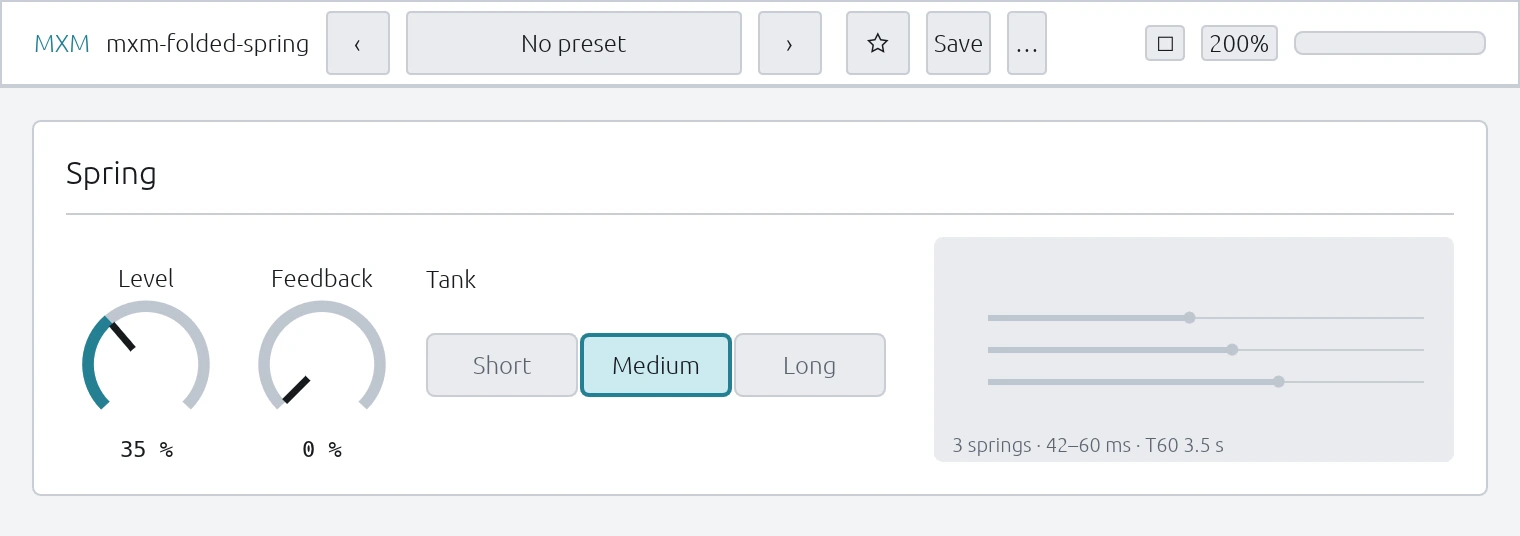
Pick a tank, turn up the return, and feed it back until the springs start singing.
Meet mxm-folded-springI love how the old circuits behave, but I don’t need fake screws and wooden side panels. So I’m keeping the sound and drawing the interface from scratch.
Filter droop, coupled controls, accent memory, and awkward little ranges can be the best part.
No fake wood or copied layouts. The controls follow the signal and fit the window.
I’ll tell you what was measured, what I chose by ear, and what still needs checking.
Every MXM device has one clear hardware inspiration. The product pages explain what I kept and what I changed.
| MXM device | Inspired by | What it shares |
|---|---|---|
| mxm-mono-01 | Roland SH-101 | Single-oscillator voice, sub and noise mixer, and one envelope shared by filter and amplifier |
| mxm-mono-02 | Roland SH-2 | Two free-running oscillators, a locked sub, and one envelope shared three ways |
| mxm-mono-03 | Roland TB-303 | Diode-ladder filter, accumulating accent circuit, and slide inside the voice |
| mxm-poly-06 | Roland JUNO-106 | Six DCO voices, the four-position high-pass filter, and the built-in bucket-brigade chorus |
| mxm-mono-00 | Roland System-100 | Voice architecture of the 101 synthesiser and 102 expander taken as one instrument |
| mxm-chorus-06 | Roland JUNO-106 chorus | The bucket-brigade chorus, its three switch positions, and its noise floor |
| mxm-folded-spring | Roland System-100 spring reverb | The spring tank of the System-100 mixer; Short and Long tanks and feedback are MXM additions |
Roland, System-100, SH-101, SH-2, TB-303, and JUNO-106 are trademarks of Roland Corporation. I use the names only to identify the hardware that inspired these plugins. MXM is independent and is not affiliated with, authorised by, sponsored by, or endorsed by Roland Corporation. I do not use or distribute Roland firmware, samples, artwork, or panel graphics.
MXM Player
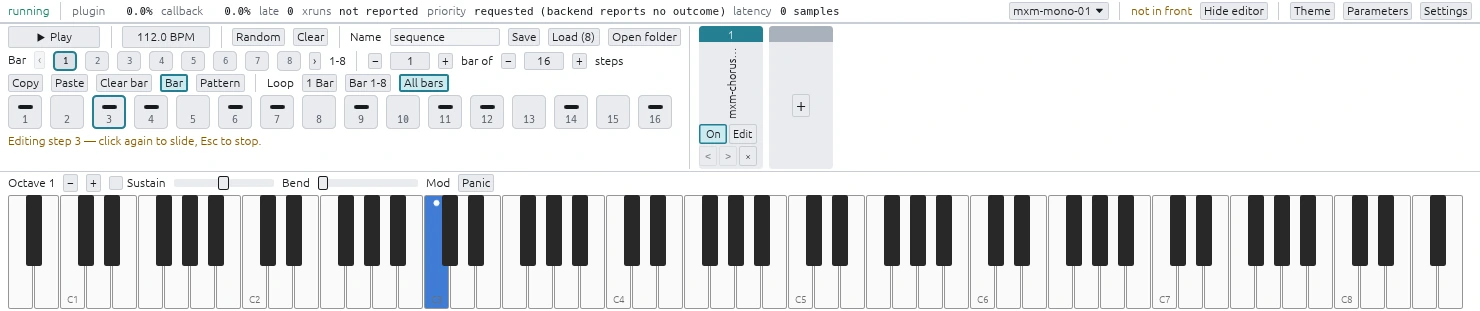
Load a synth, make a 16-step pattern, lock controls to individual steps, and add a few effects. That’s the whole idea.
See MXM PlayerStill in the workshop
The plugins work, and I use them every day. I still need to test more DAWs, compare the sounds with hardware, and make proper installers.